


The US lifted an arms embargo against Indonesia, ending a six-year ban on military contacts with the world's most populous Muslim nation because of human-rights concerns, the US State Department said.
The administration of US President George W. Bush has argued that isolating Indonesia, which has been hit by several bombings by al-Qaeda-linked terrorists in recent years, was not in Washington's strategic interests.
The move, announced on Tuesday in Washington, drew immediate criticism from rights groups.
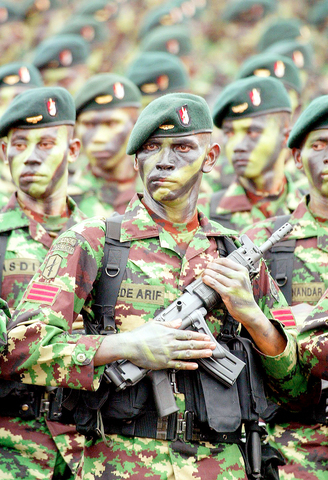
PHOTO: AP
"With the stroke of a pen, ... President Bush betrayed the untold tens of thousands of victims of the Indonesian military's brutality in Indonesia and East Timor,'' said John Miller, from the East Timor and Indonesia Action Network.
But Indonesian President Susilo Bambang Yudhoyono yesterday hailed Washington's decision to resume some military aid as marking a new chapter in relations, but other officials and politicians were more cautious.
"This is a new page, a new chapter in the strategic relations between Indonesia and the United States which have since 1999 gone through substantial ups and downs in relation to its defense cooperation," Yudhoyono said.
"The essence is that the sanction, or embargo imposed by the United States, has been lifted," the president told ElShinta radio in New Delhi, where he is on an official visit.
Yudhoyono said the US International Military Education and Training (IMET), Foreign Military Sales (FMS) and Foreign Military Financing (FMF) programs were now "back to normal."
US Congress cut ties with Indonesia's military in 1999 after it was accused of taking part in violence in East Timor during that territory's break from Jakarta rule in a UN-sponsored referendum.
Limited ties had been restored under the Bush administration -- chiefly a small officer-training program -- but Indonesia has been lobbying Washington to remove all restrictions.
The State Department used a national security waiver to drop the embargo, State Department spokesman Sean McCormack said in a statement.
He said that the administration planned to help modernize the Indonesian military and support US and Indonesian security objectives, including counterterrorism, but that Washington "remained committed to pressing for accountability for past human rights abuses."
Moves to restore ties received a boost after the tsunami last year, which killed 130,000 people on Indonesia's Sumatra Island. The US and Indonesian militaries worked together to deliver aid to victims.
Indonesia President Susilo Bambang Yudhoyono, a US-educated general elected a year ago in the country's first ever direct elections for head of state, is popular in Washington because of his moves to crack down on Islamic militants.
The Bush administration has argued that the ban on contacts should be lifted to help build Indonesia into a bulwark against al-Qaeda infiltration in Southeast Asia, where the Jemaah Islamiyah terror group has launched several terror attacks in the region.
Miller said that the Indonesian police -- not the military -- should be responsible for fighting terror, and that by removing the embargo Washington had lost its leverage with Indonesia.
"It gives the military the seal of approval," he said. "The military is not an institution promoting stability in Indonesia and the region. The way to encourage democracy [in Indonesia] is not to give it more guns."
The underfunded military has long been accused of human-rights violations in the course of putting down separatist insurgencies in far-flung regions of the sprawling and at times mostly inaccessible archipelago.
Nearly half of China’s major cities are suffering “moderate to severe” levels of subsidence, putting millions of people at risk of flooding, especially as sea levels rise, according to a study of nationwide satellite data released yesterday. The authors of the paper, published by the journal Science, found that 45 percent of China’s urban land was sinking faster than 3mm per year, with 16 percent at more than 10mm per year, driven not only by declining water tables, but also the sheer weight of the built environment. With China’s urban population already in excess of 900 million people, “even a small portion

UNSETTLING IMAGES: The scene took place in front of TV crews covering the Trump trial, with a CNN anchor calling it an ‘emotional and unbelievably disturbing moment’ A man who doused himself in an accelerant and set himself on fire outside the courthouse where former US president Donald Trump is on trial has died, police said yesterday. The New York City Police Department (NYPD) said the man was declared dead by staff at an area hospital. The man was in Collect Pond Park at about 1:30pm on Friday when he took out pamphlets espousing conspiracy theories, tossed them around, then doused himself in an accelerant and set himself on fire, officials and witnesses said. A large number of police officers were nearby when it happened. Some officers and bystanders rushed

Beijing is continuing to commit genocide and crimes against humanity against Uyghurs and other Muslim minorities in its western Xinjiang province, U.S. Secretary of State Antony Blinken said in a report published on Monday, ahead of his planned visit to China this week. The State Department’s annual human rights report, which documents abuses recorded all over the world during the previous calendar year, repeated language from previous years on the treatment of Muslims in Xinjiang, but the publication raises the issue ahead of delicate talks, including on the war in Ukraine and global trade, between the top U.S. diplomat and Chinese

HYPOCRISY? The Chinese Ministry of Foreign Affairs yesterday asked whether Biden was talking about China or the US when he used the word ‘xenophobic’ US President Joe Biden on Wednesday called for a hike in steel tariffs on China, accusing Beijing of cheating as he spoke at a campaign event in Pennsylvania. Biden accused China of xenophobia, too, in a speech to union members in Pittsburgh. “They’re not competing, they’re cheating. They’re cheating and we’ve seen the damage here in America,” Biden said. Chinese steel companies “don’t need to worry about making a profit because the Chinese government is subsidizing them so heavily,” he said. Biden said he had called for the US Trade Representative to triple the tariff rates for Chinese steel and aluminum if Beijing was


 RSS
RSS