


Washington and its European allies will forgo pushing for Iran's referral to the UN Security Council later this week, giving Russia more time to persuade Tehran to give up technology that could make nuclear arms, diplomats and officials said.
For the US and the EU, the plan holds the promise of success even if Iran continues to reject the proposal that would move its uranium enrichment program to Russia.
The acceptance of that plan, in theory, would deprive the Iranians of the chance to enrich uranium to weapons grade, suitable for use in the core of nuclear warheads.
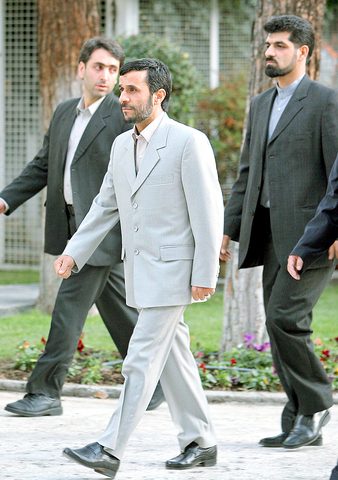
PHOTO: AP
But if the Russians fail to win over the Iranians, Washington and the Europeans hope Moscow and other key board members of the International Atomic Energy Agency now opposed to Security Council referral will moderate their opposition.
The comments on Monday by the diplomats and US and European government officials came three days before the IAEA board meets to ponder options on Iran that at least formally still included a decision on Security Council action.
But the diplomats and US and European government officials said referral was now off the table at the meeting.
Instead, they said Washington as well as Britain, France and Germany -- representing the EU -- would probably settle for a statement critical of recent IAEA findings showing the Iranians in possession of what appeared to be drawings of the core of an atomic warhead and of other worrying nuclear activities.
Iran says it only wants to enrich to lower levels to generate energy. Still, it has resisted the plan to move enrichment to Russia since it was floated several weeks ago, insisting it has the right to all aspects of the nuclear fuel cycle.
Iran in August resumed uranium reprocessing, which is one step before uranium enrichment.
EU foreign ministers urged Iran on Monday to live up to "clear obligations" to allow UN inspectors to see its nuclear facilities. On Sunday, Iran's parliament voted to require the government to block any in-depth UN inspections of its nuclear facilities if Iran is referred to the Security Council.
EU foreign policy chief Javier Solana said he hoped to avoid a showdown with Tehran. "We still have time to continue work."
The EU ministers were working on a common position before Thursday's meeting at the IAEA headquarters.
Russia, Iran's key partner in building Tehran's first nuclear power plant, has considerable clout with Tehran, but the officials and diplomats said other considerations also went into the decision to postpone a showdown on referral at the board meeting opening on Thursday.
Belarus, Cuba and Syria joined Venezuela on the IAEA board in September. With those anti-US nations on board, any vote on referral would be more strongly opposed than the resolution passed at the last board meeting two months ago that cleared the path for hauling Iran before the council by declaring its past activities in violation of the Nuclear Nonproliferation Treaty.
A vote with fewer nations in support of referral than in September "would look like a step backward," the US official said.
Nearly half of China’s major cities are suffering “moderate to severe” levels of subsidence, putting millions of people at risk of flooding, especially as sea levels rise, according to a study of nationwide satellite data released yesterday. The authors of the paper, published by the journal Science, found that 45 percent of China’s urban land was sinking faster than 3mm per year, with 16 percent at more than 10mm per year, driven not only by declining water tables, but also the sheer weight of the built environment. With China’s urban population already in excess of 900 million people, “even a small portion
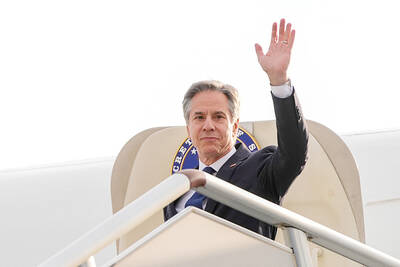
‘IN A DIFFERENT PLACE’: The envoy first visited Shanghai, where he attended a Chinese basketball playoff match, and is to meet top officials in Beijing tomorrow US Secretary of State Antony Blinken yesterday arrived in China on his second visit in a year as the US ramps up pressure on its rival over its support for Russia while also seeking to manage tensions with Beijing. The US diplomat tomorrow is to meet China’s top brass in Beijing, where he is also expected to plead for restraint as Taiwan inaugurates president-elect William Lai (賴清德), and to raise US concerns on Chinese trade practices. However, Blinken is also seeking to stabilize ties, with tensions between the world’s two largest economies easing since his previous visit in June last year. At the

UNSETTLING IMAGES: The scene took place in front of TV crews covering the Trump trial, with a CNN anchor calling it an ‘emotional and unbelievably disturbing moment’ A man who doused himself in an accelerant and set himself on fire outside the courthouse where former US president Donald Trump is on trial has died, police said yesterday. The New York City Police Department (NYPD) said the man was declared dead by staff at an area hospital. The man was in Collect Pond Park at about 1:30pm on Friday when he took out pamphlets espousing conspiracy theories, tossed them around, then doused himself in an accelerant and set himself on fire, officials and witnesses said. A large number of police officers were nearby when it happened. Some officers and bystanders rushed

Beijing is continuing to commit genocide and crimes against humanity against Uyghurs and other Muslim minorities in its western Xinjiang province, U.S. Secretary of State Antony Blinken said in a report published on Monday, ahead of his planned visit to China this week. The State Department’s annual human rights report, which documents abuses recorded all over the world during the previous calendar year, repeated language from previous years on the treatment of Muslims in Xinjiang, but the publication raises the issue ahead of delicate talks, including on the war in Ukraine and global trade, between the top U.S. diplomat and Chinese


 RSS
RSS