


The CIA leak probe on Wednesday ensnared Washington Post journalist Bob Woodward, who disclosed that he was told about CIA operative Valerie Plame nearly a month before her secret identity was revealed and apologized to his editor for keeping him in the dark.
The disclosure that Woodward gave a sworn deposition on Monday to special prosecutor Patrick Fitzgerald comes more than two weeks after the indictment and resignation of Vice President Dick Cheney's chief of staff, Lewis "Scooter" Libby, and after Fitzgerald said the bulk of his probe was complete.
In his testimony to Fitzgerald, Woodward said he revealed under oath that a senior Bush administration official casually told him in mid-June 2003 about Plame's position at the CIA. That appeared to contradict Fitzgerald's contention that Libby was the first official to leak to reporters.
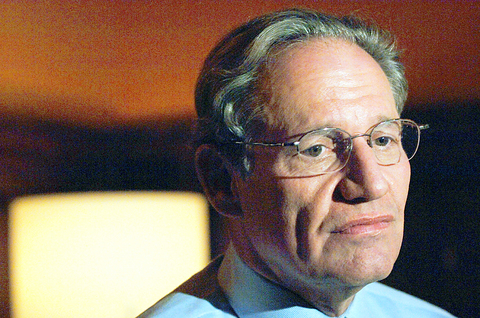
PHOTO: AFP
The testimony was a sign prosecutors are exploring new leads in the investigation that has reached into the top levels of the White House. It also prompted the Post's executive editor to publicly chastise one of the best-known journalists in the US for withholding the information from him.
One of the two Post reporters who led the newspaper's coverage of the 1970s Watergate scandal that brought down President Richard Nixon, Woodward had dismissed the leak investigation in television and radio appearances as laughable and referred to Fitzgerald as "a junkyard dog."
On the eve of Libby's indictment, Woodward said he saw no evidence of criminal intent, without disclosing his earlier conversations with Libby and others.
Woodward wrote in a first-person account in the Post on Wednesday that he met with Libby on June 27, 2003, and told Fitzgerald it was possible that Plame was discussed. But Woodward testified, "I had no recollection of doing so."
Libby's attorney, Ted Wells, called Woodward's disclosure a "bombshell" that undermined Fitzgerald's criminal case.
"We are very grateful to Mr. Woodward for coming forward," Wells said outside the federal courthouse, where Libby and his legal team spent several hours reviewing documents in the case.
Plame's husband, former diplomat Joseph Wilson, said he was "perplexed" by Woodward's testimony and explanation. Woodward said his testimony centered on interviews for his book about events leading to the Iraq war. But Wilson said there were no references to the leak in his book, Plan of Attack.
Wilson has accused the White House of leaking Plame's identity to punish him for accusing the Bush administration of twisting prewar intelligence on Iraq.
Woodward, who did not tell Washington Post Executive Editor Leonard Downie for more than two years about his role, apologized to Downie on Wednesday. Downie, who was informed by Woodward late last month, said Woodward acknowledged that he made a mistake by not informing him sooner.
Woodward issued an apology to the Post's executive editor but insisted he had kept quiet for more than two years to protect his sources.
"I apologized because I should have told him [Downie] about this much sooner," Woodward told the Post. "I explained in detail that I was trying to protect my sources. That's Job No. 1 in a case like this."
He added, "I hunkered down. I'm in the habit of keeping secrets. I didn't want anything out there that was going to get me subpoenaed."
At issue were Woodward's interviews with three current or former Bush administration officials in June 2003.
Woodward said he was first contacted by Fitzgerald's office on Nov. 3, one week after Libby's indictment, "after one of these officials went to Fitzgerald to discuss an interview with me in mid-June 2003 during which the person told me Wilson's wife worked for the CIA on weapons of mass destruction as a WMD analyst."
Woodward said he testified for more than two hours on Monday about the interviews, including a telephone conversation on June 23, 2003 and a meeting on June 27, 2003 with Libby, who resigned on Oct. 28 upon being indicted on obstruction of justice and perjury charges.
In addition to Libby, Woodward talked to White House chief of staff Andrew Card on June 20, 2003, but said that conversation did not involve Plame, according to the Post.
The remaining official refused to give Woodward permission to reveal his or her identity publicly. Woodward said his deposition was conducted in a law office, instead of under subpoena before a grand jury.
Woodward's disclosure cast doubt on Fitzgerald's assertion that Libby was the first government official to have told a reporter about Plame. Fitzgerald was referring to a June 23, 2003, meeting that Libby had with then-New York Times reporter Judith Miller. In his testimony, Woodward cited interviews that took place earlier that month.
Woodward's account raised fresh questions about the CIA leak case and prompted speculation that the federal investigation is still very much alive.
Bush's top advisor, Karl Rove, is also under investigation in the probe.

Republican US lawmakers on Friday criticized US President Joe Biden’s administration after sanctioned Chinese telecoms equipment giant Huawei unveiled a laptop this week powered by an Intel artificial intelligence (AI) chip. The US placed Huawei on a trade restriction list in 2019 for contravening Iran sanctions, part of a broader effort to hobble Beijing’s technological advances. Placement on the list means the company’s suppliers have to seek a special, difficult-to-obtain license before shipping to it. One such license, issued by then-US president Donald Trump’s administration, has allowed Intel to ship central processors to Huawei for use in laptops since 2020. China hardliners
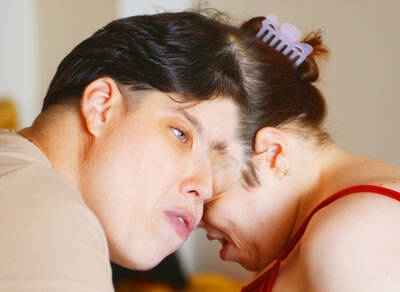
Conjoined twins Lori and George Schappell, who pursued separate careers, interests and relationships during lives that defied medical expectations, died this month in Pennsylvania, funeral home officials said. They were 62. The twins, listed by Guinness World Records as the oldest living conjoined twins, died on April 7 at the Hospital of the University of Pennsylvania, obituaries posted by Leibensperger Funeral Homes of Hamburg said. The cause of death was not detailed. “When we were born, the doctors didn’t think we’d make 30, but we proved them wrong,” Lori said in an interview when they turned 50, the Philadelphia Inquirer reported. The

RAMPAGE: A Palestinian man was left dead after dozens of Israeli settlers searching for a missing 14-year-old boy stormed a village in the Israeli-occupied West Bank US President Joe Biden on Friday said he expected Iran to attack Israel “sooner, rather than later” and warned Tehran not to proceed. Asked by reporters about his message to Iran, Biden simply said: “Don’t,” underscoring Washington’s commitment to defend Israel. “We are devoted to the defense of Israel. We will support Israel. We will help defend Israel and Iran will not succeed,” he said. Biden said he would not divulge secure information, but said his expectation was that an attack could come “sooner, rather than later.” Israel braced on Friday for an attack by Iran or its proxies as warnings grew of
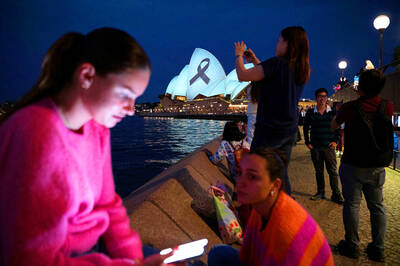
A prominent Christian leader has allegedly been stabbed at the altar during a Mass yesterday in southwest Sydney. Bishop Mar Mari Emmanuel was saying Mass at Christ The Good Shepherd Church in Wakeley just after 7pm when a man approached him at the altar and allegedly stabbed toward his head multiple times. A live stream of the Mass shows the congregation swarm forward toward Emmanuel before it was cut off. The church leader gained prominence during the COVID-19 pandemic, amassing a large online following, Officers attached to Fairfield City police area command attended a location on Welcome Street, Wakeley following reports a number


 RSS
RSS