


The US and Europe have agreed on a compromise plan to accept expanded nuclear activities by Iran, but only if the enrichment process -- a possible pathway to nuclear arms -- is moved to Russia, senior officials and diplomats said on Thursday.
If accepted by Iran, the proposal could end a tug-of-war over whether to refer the Islamic republic to the UN Security Council for possible sanctions.
The officials and diplomats, who demanded anonymity in exchange for discussing the strategy, said the plan would allow Iran to continue converting raw uranium into the gas that is spun by centrifuges into enriched uranium.
But actual enrichment would take place in Russia, they said.
Depending on its level, enrichment can be used to generate energy -- Iran's stated interest -- or make nuclear weapons -- something the US and its allies say Tehran wants to do.
US Secretary of State Condoleezza Rice expressed hopes that a deal with Iran could be reached over its nuclear program. But she would not confirm that the US would back the deal with Europe as described by the officials and diplomats.
"There is no US-European proposal to the Iranians," Rice said. "I want to say that categorically. There isn't and there won't be."
"We do hope that if there is a way for the Iranians to accept a way forward that would give confidence that they are not in fact trying to seek nuclear weapons under cover of civilian nuclear power that they would take that," Rice said.
In August, Iran resumed uranium conversion. That prompted Britain, France and Germany to break off talks with Tehran meant to dispel fears about its nuclear agenda. It also led a September meeting of the International Atomic Energy Agency's (IAEA) 35-nation board to approve a resolution clearing the way for Iran's referral to the UN Security Council at a Nov. 24 board session.
Rice predicted the US has sufficient support at the IAEA to send Iran before the Security Council for possible sanctions, but a deal ahead of the session later this month could avert a vote. The IAEA is probing nearly 18 years of covert Iranian nuclear activities, including experiments that could be used in weapons development, which were revealed more than three years ago.
Tehran recently agreed to accelerate cooperation with IAEA inspectors to blunt the threat of Security Council action.
Publicly, the US and France, Britain and Germany, which are representing the 25-nation EU in the talks, have insisted Iran needs to stop all enrichment-related activity -- including uranium conversion -- to banish the prospect of Security Council referral.
Nearly half of China’s major cities are suffering “moderate to severe” levels of subsidence, putting millions of people at risk of flooding, especially as sea levels rise, according to a study of nationwide satellite data released yesterday. The authors of the paper, published by the journal Science, found that 45 percent of China’s urban land was sinking faster than 3mm per year, with 16 percent at more than 10mm per year, driven not only by declining water tables, but also the sheer weight of the built environment. With China’s urban population already in excess of 900 million people, “even a small portion

UNSETTLING IMAGES: The scene took place in front of TV crews covering the Trump trial, with a CNN anchor calling it an ‘emotional and unbelievably disturbing moment’ A man who doused himself in an accelerant and set himself on fire outside the courthouse where former US president Donald Trump is on trial has died, police said yesterday. The New York City Police Department (NYPD) said the man was declared dead by staff at an area hospital. The man was in Collect Pond Park at about 1:30pm on Friday when he took out pamphlets espousing conspiracy theories, tossed them around, then doused himself in an accelerant and set himself on fire, officials and witnesses said. A large number of police officers were nearby when it happened. Some officers and bystanders rushed
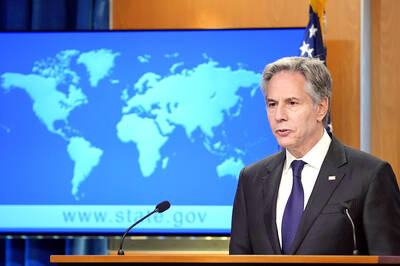
Beijing is continuing to commit genocide and crimes against humanity against Uyghurs and other Muslim minorities in its western Xinjiang province, U.S. Secretary of State Antony Blinken said in a report published on Monday, ahead of his planned visit to China this week. The State Department’s annual human rights report, which documents abuses recorded all over the world during the previous calendar year, repeated language from previous years on the treatment of Muslims in Xinjiang, but the publication raises the issue ahead of delicate talks, including on the war in Ukraine and global trade, between the top U.S. diplomat and Chinese
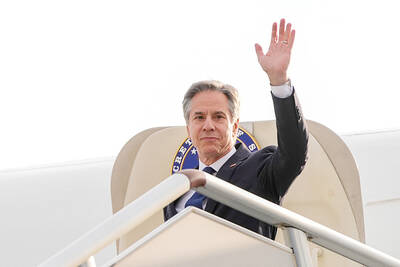
‘IN A DIFFERENT PLACE’: The envoy first visited Shanghai, where he attended a Chinese basketball playoff match, and is to meet top officials in Beijing tomorrow US Secretary of State Antony Blinken yesterday arrived in China on his second visit in a year as the US ramps up pressure on its rival over its support for Russia while also seeking to manage tensions with Beijing. The US diplomat tomorrow is to meet China’s top brass in Beijing, where he is also expected to plead for restraint as Taiwan inaugurates president-elect William Lai (賴清德), and to raise US concerns on Chinese trade practices. However, Blinken is also seeking to stabilize ties, with tensions between the world’s two largest economies easing since his previous visit in June last year. At the


 RSS
RSS