


There is an air of El Dorado about Gwadar, a fishing village on the Persian Sea with dreams of becoming a glittering metropolis.
Advertising billboards along the rubbish-strewn streets feature digitized images of skyscrapers and tourist-clogged beaches. Offices with names like Gold Mine Investments and New World City have sprung up overnight. Property prices have risen up to 30-fold, turning poor fishermen into small-time tycoons with four-wheel drives and second wives.
Dealers such as Kamran Ali, 25, have flooded in from the big cities.
"In five years this will be like Dubai, or parts of Europe," he said.
Or, possibly, Beijing. Gwadar's ambitious plans hinge on a giant deepwater port whose money, bricks and mortar come from China.
Last year 400 Chinese laborers worked 24-hour shifts to complete the project, intended to serve Afghanistan and Central Asia. Through cheap loans and generous grants, Beijing covered 80 percent of the US$250m cost.
Now a dredger is out in the bay carving a deep channel that will accommodate cargo ships, oil tankers and, if necessary, warships.
A high-stakes geopolitical game is sweeping Asia. Triggered by a roaring economy, propelled by swelling confidence and funded by check-book diplomacy, Beijing is projecting its new might across the continent -- and setting off alarm bells from Washington to Tokyo.
"There is a cauldron of anxiety about China," US Deputy Secretary of State Robert Zoellick said in September.
In May China signed a US$600m deal with Uzbek President Islam Karimov, 12 days after his troops killed hundreds and Russian troops took part in a joint military exercise.
In Pakistan an old friendship is being rekindled. China helped to build Pakistan's weapons plants and, according to Western intelligence, had a hand in its nuclear bomb. The two countries' friendship is "higher than the Himalayas and deeper than the ocean," according to popular cliche.
Now it is driven by a fresh impetus -- increased cooperation between Islamabad's enemy, India, and China's rival, the US.
"It's a classic case of the enemy of my enemy is my friend," said Rifaat Hussain, director of the army-run Institute for Strategic Studies and Research Analysis in Islamabad.
This year, the two countries signed 22 trade agreements, including the joint production of a jet fighter, and the sale of four Chinese navy frigates to Pakistan. But in Gwadar, China insists, its interest is purely commercial.
The port has a great commercial attraction. It lies 2,000km from Xinjiang, a latecomer to China's economic boom. From next year Beijing hopes for a fresh flow of traffic across the Himalayas and down to the Persian Sea.
But Gwadar also has an immense strategic lure. It lies close to the Straits of Hormuz, the gateway to the Gulf through which 40 percent of the world's oil passes. Gwadar is the first pearl in a line that stretches to Bangladesh, Cambodia and into the South China Sea.
The Pentagon is watching uneasily. China's military is modernizing rapidly. One US military report claimed the Chinese navy was beefing up to "deter the potential disruption of its energy supplies from potential threats, including the US navy, especially in the case of a conflict with Taiwan."
China dismisses such talk as scaremongering. The dragon does not breathe fire, Premier Wen Jiabao
"Even if we become stronger and more developed, we will not stand in the way of others, still less become a threat," he said.
Other analysts say a purely military analysis ignores the wider picture of China's political reforms, embrace of international trade and normalization of relations with the west.
When the first ships sail into Gwadar by the end of next year, it will not be used by any military, Chinese or otherwise, said Akbar Ali Pesnani, chairman of the Gwadar port authority. "It's a strictly commercial venture," he said.
Chinese officials brush aside claims they will use Gwadar to monitor sea traffic passing into the Middle East. Their main future involvement with the port is an offer of help in building a railway link across Pakistan towards their own borders, they say.
Even then, there is no guarantee Gwadar will succeed. Most access roads are still on the drawing board; property development has been marred by fraud and speculation; land prices dipped sharply recently causing some estate agents to leave.
"We give it a 50-50 chance of success," said one Western diplomat in Islamabad.
However, China's enthusiasm is undiminished, despite running into bloody local opposition. In May last year a car bomb in Gwadar killed three Chinese engineers working on the port and injured 11.
Nearly half of China’s major cities are suffering “moderate to severe” levels of subsidence, putting millions of people at risk of flooding, especially as sea levels rise, according to a study of nationwide satellite data released yesterday. The authors of the paper, published by the journal Science, found that 45 percent of China’s urban land was sinking faster than 3mm per year, with 16 percent at more than 10mm per year, driven not only by declining water tables, but also the sheer weight of the built environment. With China’s urban population already in excess of 900 million people, “even a small portion

UNSETTLING IMAGES: The scene took place in front of TV crews covering the Trump trial, with a CNN anchor calling it an ‘emotional and unbelievably disturbing moment’ A man who doused himself in an accelerant and set himself on fire outside the courthouse where former US president Donald Trump is on trial has died, police said yesterday. The New York City Police Department (NYPD) said the man was declared dead by staff at an area hospital. The man was in Collect Pond Park at about 1:30pm on Friday when he took out pamphlets espousing conspiracy theories, tossed them around, then doused himself in an accelerant and set himself on fire, officials and witnesses said. A large number of police officers were nearby when it happened. Some officers and bystanders rushed
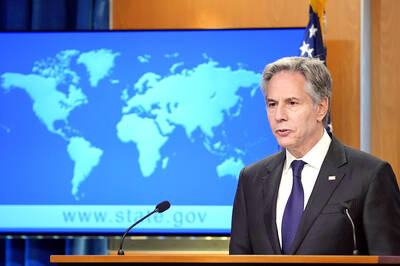
Beijing is continuing to commit genocide and crimes against humanity against Uyghurs and other Muslim minorities in its western Xinjiang province, U.S. Secretary of State Antony Blinken said in a report published on Monday, ahead of his planned visit to China this week. The State Department’s annual human rights report, which documents abuses recorded all over the world during the previous calendar year, repeated language from previous years on the treatment of Muslims in Xinjiang, but the publication raises the issue ahead of delicate talks, including on the war in Ukraine and global trade, between the top U.S. diplomat and Chinese

HYPOCRISY? The Chinese Ministry of Foreign Affairs yesterday asked whether Biden was talking about China or the US when he used the word ‘xenophobic’ US President Joe Biden on Wednesday called for a hike in steel tariffs on China, accusing Beijing of cheating as he spoke at a campaign event in Pennsylvania. Biden accused China of xenophobia, too, in a speech to union members in Pittsburgh. “They’re not competing, they’re cheating. They’re cheating and we’ve seen the damage here in America,” Biden said. Chinese steel companies “don’t need to worry about making a profit because the Chinese government is subsidizing them so heavily,” he said. Biden said he had called for the US Trade Representative to triple the tariff rates for Chinese steel and aluminum if Beijing was


 RSS
RSS