


The community noticeboard in Nusa is conspicuously underemployed. There are no updates on reconstruction programs and the only bulletin on livelihood is a dog-eared one from June. The only recent notice advertises monthly distribution of rice, cooking oil, noodles and sardines to those who lost their homes in last December's tsunami.
Nearby, on the wall of a temporary barrack are five designs from which the refugees must choose their replacement homes.
But there are no details about when building might start on the 162 planned homes, let alone when Care International, the charity coordinating reconstruction, expects people to move in.
This paucity of progress is typical of the situation across the devastated Indonesian province of Aceh, where 132,000 people died in the Dec. 26 tragedy and almost 500,000 are homeless.
Reconstruction and recovery programs have not stopped but there is an overriding atmosphere that the honeymoon, when aid agencies met almost all needs pretty rapidly, has ended.
For most people the future is at best uncertain and more usually bleak.
"I reckon about 10 percent [of the men] are in skilled work in town and others might have one or two days' work a week, if they're lucky," said Mohammed Yassin, who runs a village shop.
"We're still alive because we're still getting rice. If we weren't getting rice there would be a very serious problem," he said.
Exacerbating matters is the government's failure to pay the refugees their 90,000 rupiah (US$9) monthly fish allowance.
There are some success stories. Nelly Nurila, whose bakery was wiped out in the tsunami, has just taken delivery of 21 million rupiahs' worth of bread-making equipment from Bogasari, one of the nation's biggest flour mills. Operating in the three remaining rooms of her otherwise destroyed house, Nelly and her nine staff make 600 loaves a day.
The sewing cooperative, set up for 33 women by Mercy Corps, is also thriving, thanks to the tradition of buying new clothes to celebrate Id al-Fitr at the end of the Moslem holy month of Ramadan.
"We're flat out at the moment," said cooperative leader Muliana Nazruddin. "But I'm sure it will slow down after Id al-Fitr."
Some farmers are starting to earn money from the chilli shrubs they planted a few months ago, but crops like cassava will not be ready to harvest for months. Most are suffering added stress because they missed the rice-planting season due to a damaged floodgate that has not been repaired.
The scene at the floodgate, 2km from the village, is a snapshot of reconstruction across the province. The gate's five rusty, twisted panels stand forlornly at varying angles as people fish from the concrete supports. Nobody from the public works ministry has come to assess the damage.
In stark contrast, less than 10m away, four men were finishing a new 4km-long pipe that will deliver fresh water to Nusa.
"This is an international project," said Mohammad, one of the workers. "I think the Swiss, Italians and Germans paid for it."
Such government inertia extends to the district administrations. The World Bank recently surveyed 10 of the 12 districts affected by the tsunami and found all but two cut their capital expenditure budgets for this year and raised spending on items such as wages, buildings and staff cars.

Republican US lawmakers on Friday criticized US President Joe Biden’s administration after sanctioned Chinese telecoms equipment giant Huawei unveiled a laptop this week powered by an Intel artificial intelligence (AI) chip. The US placed Huawei on a trade restriction list in 2019 for contravening Iran sanctions, part of a broader effort to hobble Beijing’s technological advances. Placement on the list means the company’s suppliers have to seek a special, difficult-to-obtain license before shipping to it. One such license, issued by then-US president Donald Trump’s administration, has allowed Intel to ship central processors to Huawei for use in laptops since 2020. China hardliners

Conjoined twins Lori and George Schappell, who pursued separate careers, interests and relationships during lives that defied medical expectations, died this month in Pennsylvania, funeral home officials said. They were 62. The twins, listed by Guinness World Records as the oldest living conjoined twins, died on April 7 at the Hospital of the University of Pennsylvania, obituaries posted by Leibensperger Funeral Homes of Hamburg said. The cause of death was not detailed. “When we were born, the doctors didn’t think we’d make 30, but we proved them wrong,” Lori said in an interview when they turned 50, the Philadelphia Inquirer reported. The
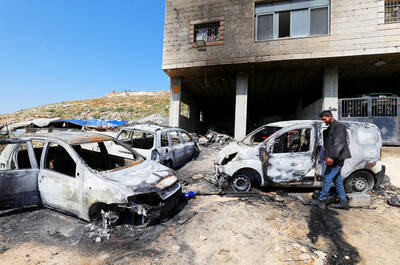
RAMPAGE: A Palestinian man was left dead after dozens of Israeli settlers searching for a missing 14-year-old boy stormed a village in the Israeli-occupied West Bank US President Joe Biden on Friday said he expected Iran to attack Israel “sooner, rather than later” and warned Tehran not to proceed. Asked by reporters about his message to Iran, Biden simply said: “Don’t,” underscoring Washington’s commitment to defend Israel. “We are devoted to the defense of Israel. We will support Israel. We will help defend Israel and Iran will not succeed,” he said. Biden said he would not divulge secure information, but said his expectation was that an attack could come “sooner, rather than later.” Israel braced on Friday for an attack by Iran or its proxies as warnings grew of

A prominent Christian leader has allegedly been stabbed at the altar during a Mass yesterday in southwest Sydney. Bishop Mar Mari Emmanuel was saying Mass at Christ The Good Shepherd Church in Wakeley just after 7pm when a man approached him at the altar and allegedly stabbed toward his head multiple times. A live stream of the Mass shows the congregation swarm forward toward Emmanuel before it was cut off. The church leader gained prominence during the COVID-19 pandemic, amassing a large online following, Officers attached to Fairfield City police area command attended a location on Welcome Street, Wakeley following reports a number


 RSS
RSS