


A longtime Chinese dissident committed to a psychiatric hospital after displaying a banner in Tiananmen Square on the third anniversary of the 1989 pro-democracy demonstrations has been freed after 13 years, a human rights group said yesterday.
Wang Wanxing (
The group said the release was timed ahead of a visit to China in late August by the UN High Commissioner for Human Rights Louise Arbour.
Wang was warned not to speak of his experiences or he would be returned to the asylum, Human Rights Watch said.
Wang, a Beijing worker, was arrested in Tiananmen Square on June 3, 1992, when he tried to unfurl a protest banner. He was asking the ruling Communist Party to reevaluate its condemnation of the 1989 democracy movement and to compensate him for past political persecution for criticizing the radical leaders of the 1966-1976 Cultural Revolution.
Wang was diagnosed with paranoia when he entered Ankang, a facility run by Beijing police, but family and independent observers have said he is lucid and stable.
He was released briefly in 1999 but was forced to return to Ankang after he said he might publicly discuss his confinement with foreign reporters.
"Wang's release is welcome news, but it highlights the fate of hundreds of other political detainees forced into psychiatric care in China for no good medical reason," said Brad Adams, Asia director for Human Rights Watch, in a statement. "It is time for China's leaders to decide that their `modernization' drive should include an end to barbaric practices such as using psychiatric facilities and medically unnecessary drugs to punish those with different political views."
According to Human Rights Watch, Wang had kind words for some of the doctors and nurses at the asylum, but described others as being "basically sadistic" in nature.
For the first seven years, Wang said he was held in a general ward with 50 to 70 inmates but was moved to one with "severely psychotically disturbed inmates, most of whom had committed murder" during the last five years of his stay.
"The extent of patient-on-patient violence in this ward was terrifying," Human Rights Watch said in a statement, citing Wang's testimony. "He frequently had to force himself to stay awake all night to avoid sudden and unprovoked inmate attacks."
Staff would use shock treatment to punish difficult patients and make other inmates watch, the group said.
"These reports are credible and disturbing," Adams said.

Republican US lawmakers on Friday criticized US President Joe Biden’s administration after sanctioned Chinese telecoms equipment giant Huawei unveiled a laptop this week powered by an Intel artificial intelligence (AI) chip. The US placed Huawei on a trade restriction list in 2019 for contravening Iran sanctions, part of a broader effort to hobble Beijing’s technological advances. Placement on the list means the company’s suppliers have to seek a special, difficult-to-obtain license before shipping to it. One such license, issued by then-US president Donald Trump’s administration, has allowed Intel to ship central processors to Huawei for use in laptops since 2020. China hardliners

Conjoined twins Lori and George Schappell, who pursued separate careers, interests and relationships during lives that defied medical expectations, died this month in Pennsylvania, funeral home officials said. They were 62. The twins, listed by Guinness World Records as the oldest living conjoined twins, died on April 7 at the Hospital of the University of Pennsylvania, obituaries posted by Leibensperger Funeral Homes of Hamburg said. The cause of death was not detailed. “When we were born, the doctors didn’t think we’d make 30, but we proved them wrong,” Lori said in an interview when they turned 50, the Philadelphia Inquirer reported. The

RAMPAGE: A Palestinian man was left dead after dozens of Israeli settlers searching for a missing 14-year-old boy stormed a village in the Israeli-occupied West Bank US President Joe Biden on Friday said he expected Iran to attack Israel “sooner, rather than later” and warned Tehran not to proceed. Asked by reporters about his message to Iran, Biden simply said: “Don’t,” underscoring Washington’s commitment to defend Israel. “We are devoted to the defense of Israel. We will support Israel. We will help defend Israel and Iran will not succeed,” he said. Biden said he would not divulge secure information, but said his expectation was that an attack could come “sooner, rather than later.” Israel braced on Friday for an attack by Iran or its proxies as warnings grew of
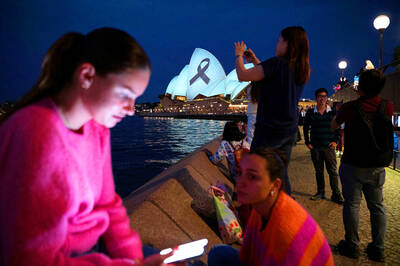
A prominent Christian leader has allegedly been stabbed at the altar during a Mass yesterday in southwest Sydney. Bishop Mar Mari Emmanuel was saying Mass at Christ The Good Shepherd Church in Wakeley just after 7pm when a man approached him at the altar and allegedly stabbed toward his head multiple times. A live stream of the Mass shows the congregation swarm forward toward Emmanuel before it was cut off. The church leader gained prominence during the COVID-19 pandemic, amassing a large online following, Officers attached to Fairfield City police area command attended a location on Welcome Street, Wakeley following reports a number


 RSS
RSS