


Syria on Saturday said it was setting up its own inquiry into the murder of Lebanese ex-premier Rafiq Hariri in a move apparently aimed at heading off the threat of UN sanctions.
The state news agency said that the new inquiry would work in cooperation with the UN's own probe, whose initial report last week implicated Syrian officials in the February killing of the anti-Damascus Hariri.
"Syrian President Bashar al-Assad has ordered the setting up of a special commission of inquiry ... which will directly lead the investigation with Syrians -- civilians or military -- in all respects that concern the [UN] probe," SANA said.
The announcement was made days before the UN Security Council votes on a resolution threatening sanctions against Damascus over the regime's perceived lack of cooperation with the UN probe.
According to the presidential decree, "the special Syrian commission will cooperate with the commission of inquiry of the UN and with the Lebanese judicial authorities."
It said that the probe would be presided over by the public prosecutor and consist of the military prosecutor and a judge appointed by the ministry of justice.
The move comes amid threats of sanctions and pressure on Damascus to step up cooperation with the UN probe after an initial report implicated top security officials in both Lebanon and Syrian in the murder.
Assad has maintained that no Syrian official played a role in the murder, but anyone found to have done so would be punished as a traitor and possibly sent to an international court.
cooperation
He pledged his cooperation earlier this week, writing in a letter to Washington, London and Paris that "I am ready to follow up action to bring to trial any Syrian who could be proved by concrete evidence to have had connection with this crime."
The beleaguered leader also warned that any international pressure on Syria would have serious repercussions in the region.
A top Syrian official had said on Tuesday that Damascus was ready to cooperate with the UN inquiry, while criticizing the way German prosecutor Detlev Mehlis conducted his probe.
"Mehlis wants a special Syrian inquiry. We are ready to do that but Mr. Mehlis, who has not made such a request before, must tell us exactly what type of cooperation he is looking for," said Riad Daudi, legal advisor for the Syrian foreign ministry.
The UN Security Council is expected to vote today on a draft resolution from the US, France and Britain which threatens Damascus with economic and diplomatic sanctions if it does not fully cooperate with the probe.
compliance
According to the draft, the Security Council "expresses its intention to consider further measures pursuant to Article 41 of the [UN] Charter, if needed to ensure compliance by Syria."
Article 41 permits the council to decide what measures other than the use of force may be used to assure compliance with its decisions, such as economic and diplomatic sanctions.
However, holding out the threat of economic or diplomatic sanctions against the Syrian state -- as opposed to individuals -- remains controversial within the council and could face opposition from Algeria, China and Russia.
A confidential version of the UN report released last week contained witness testimony linking Assef Shawkat, Assad's brother-in-law and head of military intelligence, to the murder.
In the aftermath of the report's publication, Syria had hit back at its findings, which it claimed were biased and false. Foreign ministry advisor Dawdi said in remarks published on Friday that Syria would not arrest top security agents implicated by the UN murder probe unless there is serious proof of their involvement.
"It is impossible to put in prison the head of the security service, who is one of the top officials in our country, just because Mehlis wants to jail him," Daudi told the pan-Arab daily Asharq al-Awsat.

Republican US lawmakers on Friday criticized US President Joe Biden’s administration after sanctioned Chinese telecoms equipment giant Huawei unveiled a laptop this week powered by an Intel artificial intelligence (AI) chip. The US placed Huawei on a trade restriction list in 2019 for contravening Iran sanctions, part of a broader effort to hobble Beijing’s technological advances. Placement on the list means the company’s suppliers have to seek a special, difficult-to-obtain license before shipping to it. One such license, issued by then-US president Donald Trump’s administration, has allowed Intel to ship central processors to Huawei for use in laptops since 2020. China hardliners

Conjoined twins Lori and George Schappell, who pursued separate careers, interests and relationships during lives that defied medical expectations, died this month in Pennsylvania, funeral home officials said. They were 62. The twins, listed by Guinness World Records as the oldest living conjoined twins, died on April 7 at the Hospital of the University of Pennsylvania, obituaries posted by Leibensperger Funeral Homes of Hamburg said. The cause of death was not detailed. “When we were born, the doctors didn’t think we’d make 30, but we proved them wrong,” Lori said in an interview when they turned 50, the Philadelphia Inquirer reported. The
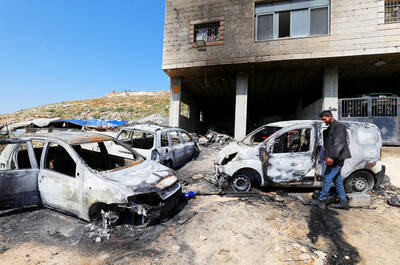
RAMPAGE: A Palestinian man was left dead after dozens of Israeli settlers searching for a missing 14-year-old boy stormed a village in the Israeli-occupied West Bank US President Joe Biden on Friday said he expected Iran to attack Israel “sooner, rather than later” and warned Tehran not to proceed. Asked by reporters about his message to Iran, Biden simply said: “Don’t,” underscoring Washington’s commitment to defend Israel. “We are devoted to the defense of Israel. We will support Israel. We will help defend Israel and Iran will not succeed,” he said. Biden said he would not divulge secure information, but said his expectation was that an attack could come “sooner, rather than later.” Israel braced on Friday for an attack by Iran or its proxies as warnings grew of

A prominent Christian leader has allegedly been stabbed at the altar during a Mass yesterday in southwest Sydney. Bishop Mar Mari Emmanuel was saying Mass at Christ The Good Shepherd Church in Wakeley just after 7pm when a man approached him at the altar and allegedly stabbed toward his head multiple times. A live stream of the Mass shows the congregation swarm forward toward Emmanuel before it was cut off. The church leader gained prominence during the COVID-19 pandemic, amassing a large online following, Officers attached to Fairfield City police area command attended a location on Welcome Street, Wakeley following reports a number


 RSS
RSS