


Japanese opposition parties and local officials yesterday criticized a new military agreement with the US, with one politician calling it "extremely dangerous."
The agreement on a major realignment of the alliance "is a radical change in security policies," said Seiji Mataichi, secretary-general of the Social Democratic Party of Japan.
"It has gone beyond the contents of the [1960] Japan-US Security Treaty. We cannot accept that," Mataichi said in a statement.
"The report, which authorizes Japan's support and commitment for military action by the United States, is extremely dangerous," he said.
On Saturday the two governments adopted an interim report designed to cut US forces in the Japanese island of Okinawa, deploy a powerful missile defense radar in Japan and bind their militaries more closely together.
Seiji Maehara, head of the Democratic Party of Japan, said in a television interview that the report would lift limits on Japan's military support for the US.
"If there is no explanation about how the government wants to make a change, [the limit] will be chipped away gradually," Maehara said. "The government must ask people if the government can go ahead with redefinition" of the treaty.
Under the 1960 treaty, Japan's support for the US military is limited to activities contributing to peace and stability in the "Far East."
The plan to realign US military forces in Japan also triggered plans for protest rallies and drew harsh opposition from local officials and citizens' groups, who say the burden of hosting the troops is just being shifted from one community to another.
"It's a mere shift of the problem," said Sekinari Nii, governor of Yamaguchi prefecture in western Japan. It has been designated as the next base of the US Carrier Air Wing currently stationed at the US Atsugi Air Base in Kanagawa, southwest of Tokyo.
"At present we are not willing to accept the plan," Nii told a news conference, saying the central government should notify local communities of the accord first.
Iwakuni's Mayor Katsusuke Ihara saying his city and others had not been included in the decision-making process.
"Japan and the US have made a unilateral decision, with no consultation whatsoever with local communities," Ihara said. "I urge the Japanese government to provide an explanation, open its ears to local opinion, and enter into talks."
"The US is simply playing a trick with numbers," said activist Takashi Kishimoto of the Okinawan Peace Movement Center, on plans to transfer about 7,000 Marines from Okinawa to the US Pacific island territory of Guam. "The actual functions of US bases in Okinawa, as well as risks to the local community, won't be reduced at all."
Okinawa prefecture's Governor Keiichi Inamine had earlier criticized plans to transfer the Futenma Marine Corps Air Station from one part of Okinawa's main island to reclaimed land off another part.
Inamine said he wanted to see US bases moved off Okinawa altogether.
Environmentalists have said the planned project, using a landfill to create a runway, would destroy part of a coral reef area that's home to the dugong, an endangered marine mammal.
US Defense Secretary Donald Rumsfeld has said the two countries would work together to reduce the impact of the US military on Japanese communities.
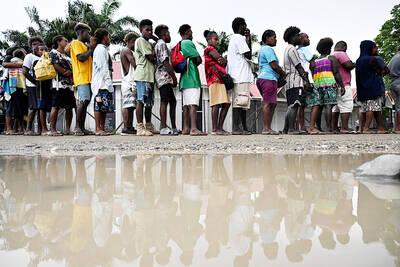
SEEKING CHANGE: A hospital worker said she did not vote in previous elections, but ‘now I can see that maybe my vote can change the system and the country’ Voting closed yesterday across the Solomon Islands in the south Pacific nation’s first general election since the government switched diplomatic allegiance from Taiwan to Beijing and struck a secret security pact that has raised fears of the Chinese navy gaining a foothold in the region. The Solomon Islands’ closer relationship with China and a troubled domestic economy weighed on voters’ minds as they cast their ballots. As many as 420,000 registered voters had their say across 50 national seats. For the first time, the national vote also coincided with elections for eight of the 10 local governments. Esther Maeluma cast her vote in the
Nearly half of China’s major cities are suffering “moderate to severe” levels of subsidence, putting millions of people at risk of flooding, especially as sea levels rise, according to a study of nationwide satellite data released yesterday. The authors of the paper, published by the journal Science, found that 45 percent of China’s urban land was sinking faster than 3mm per year, with 16 percent at more than 10mm per year, driven not only by declining water tables, but also the sheer weight of the built environment. With China’s urban population already in excess of 900 million people, “even a small portion

UNSETTLING IMAGES: The scene took place in front of TV crews covering the Trump trial, with a CNN anchor calling it an ‘emotional and unbelievably disturbing moment’ A man who doused himself in an accelerant and set himself on fire outside the courthouse where former US president Donald Trump is on trial has died, police said yesterday. The New York City Police Department (NYPD) said the man was declared dead by staff at an area hospital. The man was in Collect Pond Park at about 1:30pm on Friday when he took out pamphlets espousing conspiracy theories, tossed them around, then doused himself in an accelerant and set himself on fire, officials and witnesses said. A large number of police officers were nearby when it happened. Some officers and bystanders rushed

HYPOCRISY? The Chinese Ministry of Foreign Affairs yesterday asked whether Biden was talking about China or the US when he used the word ‘xenophobic’ US President Joe Biden on Wednesday called for a hike in steel tariffs on China, accusing Beijing of cheating as he spoke at a campaign event in Pennsylvania. Biden accused China of xenophobia, too, in a speech to union members in Pittsburgh. “They’re not competing, they’re cheating. They’re cheating and we’ve seen the damage here in America,” Biden said. Chinese steel companies “don’t need to worry about making a profit because the Chinese government is subsidizing them so heavily,” he said. Biden said he had called for the US Trade Representative to triple the tariff rates for Chinese steel and aluminum if Beijing was


 RSS
RSS