


The Hubble Space Telescope, which normally surveys the edges of the universe, has turned its attention to the Moon and found mineral concentrations that might prove to be sources of oxygen for human visitors, researchers said on Wednesday.
In an unusual use of the Hubble, astronomers in August trained the large Earth-orbiting telescope on the Moon to take the first high-resolution ultraviolet images of certain geologically interesting areas.
The images allow scientists to see areas of mineral variation within the crust and could help identify the most valuable sites for sending robotic and human missions.
"This allowed us to look at the Moon with new eyes," James Garvin, chief scientist at the Goddard Space Flight Center of NASA and principal investigator for the project, said at a news conference. "We haven't had ultraviolet vision before to do this."
The Hubble Advanced Camera for Surveys took ultraviolet and visible-light images of geologically diverse areas on the side of the Moon nearest Earth, including the Aristarchus impact crater and the adjacent Schroter's Valley rille.
The camera also photographed the Apollo 15 and 17 landing sites, where astronauts collected rock and soil samples in 1971 and 1972.
The Aristarchus plateau has long been of interest to geologists because of its volcanic vents, collapsed lava tubes called rilles, ejected volcanic material and recent impact craters.
The Aristarchus crater, 26 miles (42 kilometers) wide and two miles (3.2 kilometers) deep, could be as young as 100 million years old and has a sharp rim and other fresh features that reveal the varied geology of the area, said Mark Robinson, a planetary geologist at Northwestern University in Evanston, Illinois.
There are no plans to use Hubble for further lunar observations.

Republican US lawmakers on Friday criticized US President Joe Biden’s administration after sanctioned Chinese telecoms equipment giant Huawei unveiled a laptop this week powered by an Intel artificial intelligence (AI) chip. The US placed Huawei on a trade restriction list in 2019 for contravening Iran sanctions, part of a broader effort to hobble Beijing’s technological advances. Placement on the list means the company’s suppliers have to seek a special, difficult-to-obtain license before shipping to it. One such license, issued by then-US president Donald Trump’s administration, has allowed Intel to ship central processors to Huawei for use in laptops since 2020. China hardliners

DISADVANTAGE: Erin O’Toole, who led the Conservatives during the election campaign in 2021, estimated that the interference cost his party as many as nine legislative seats Canada’s domestic spy agency on Monday concluded that China interfered in the past two elections, an official probe heard, the firmest evidence so far of suspected Chinese meddling in Canadian politics. Canadian Prime Minister Justin Trudeau’s Liberal Party won both the elections, held in 2019 and 2021. Under pressure from opposition lawmakers unhappy about media reports on China’s possible role, Trudeau set up a commission into foreign interference. The commission was shown a slide on Monday containing an extract of a briefing in February last year from the Canadian Security Intelligence Service (CSIS). “We know that the PRC [People’s Republic of China] clandestinely
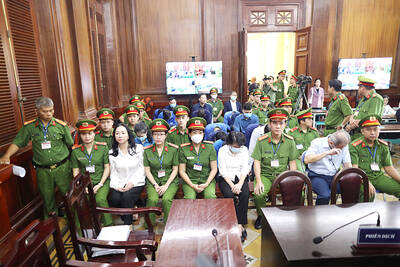
A top Vietnamese property tycoon was on Thursday sentenced to death in one of the biggest corruption cases in history, with an estimated US$27 billion in damages. A panel of three hand-picked jurors and two judges rejected all defense arguments by Truong My Lan, chair of major developer Van Thinh Phat, who was found guilty of swindling cash from Saigon Commercial Bank (SCB) over a decade. “The defendant’s actions ... eroded people’s trust in the leadership of the [Communist] Party and state,” read the verdict at the trial in Ho Chi Minh City. After the five-week trial, 85 others were also sentenced on

‘DELUSIONAL’: Targeting the families of Hamas’ leaders would not push the group to change its position or to give up its demands for Palestinians, Ismail Haniyeh said Israeli aircraft on Wednesday killed three sons of Hamas’ top political leader in the Gaza Strip, striking high-stakes targets at a time when Israel is holding delicate ceasefire negotiations with the militant group. Hamas said four of the leader’s grandchildren were also killed. Ismail Haniyeh’s sons are among the highest-profile figures to be killed in the war so far. Israel said they were Hamas operatives, and Haniyeh accused Israel of acting in “the spirit of revenge and murder.” The deaths threatened to strain the internationally mediated ceasefire talks, which appeared to gain steam in recent days even as the sides remain far


 RSS
RSS