


The stage is set, the actors are ready, but the audience is distracted. Former Iraqi president Saddam Hussein's trial starts today, trailing words such as momentous and historic, a courtroom drama with a gallows in the wings.
He is expected to play his part, defiant and confident even if denied a tie lest he make a premature noose. The prosecution and defense have studied transcripts from Nuremberg and The Hague and rehearsed their lines. Five judges will determine the final act.
Iraq, however, does not quite fit the bill of a nation thirsting for justice. The man who ruled like an Arab Stalin for two decades, whose persona invaded his citizens' thoughts more effectively than his troops invaded neighboring countries, has shrunk. The ragged fugitive dragged from a spider hole near Tikrit in December 2003 was physically diminished -- Saddam lost weight on the run -- and the subsequent incarceration and near invisibility whittled his relevance.
"People here don't think it will be a fair trial. But they will do nothing because they don't care about him," said Fawzi Mohammad, 48, a cement plant manager in Fallujah, a city of ruins and a symbol of resistance to the Americans.
"Saddam now is the past for us. He is like an old currency, worthless," Mohammad said.
Abbas Ali Hassan, secretary of Fallujah's City Council, bristled at the name.
"Forget him. We want to develop. We don't want to remain on the shore. We want to go deeper into the sea," Hassan said.
Saddam packed his regime with fellow Sunni Arabs, perpetuating the sect's historic dominance over Shiites and Kurds, but that did not purchase loyalty from Fallujah's tribal sheikhs, said Lieutenant Colonel Pat Carroll, a US Marine political officer based in the city.
"They never bring him up. He is yesterday's man. They have too many other things to worry about," Carroll said.
In Kurdistan and Shiite cities such as Najaf and Basra people, when prompted, express satisfaction, sometimes glee, when imagining the despot in the dock. When not prompted they discuss the lack of jobs, electricity and security.
It is not that the pain is forgotten. How can survivors from Halabja, the Kurdish town gassed in 1988, forget losing 5,000 friends and relatives? How can Shiites forget those executed in the 1991 uprising while mass graves are being excavated in the desert? President Jalal Talabani spoke for many when he said Saddam could not be hanged enough times.
But there is little sense of anticipation. Iraqis understood he was finished when the statue fell in April 2003. His capture eight months later was anti-climactic; TV crews sent to film cheering crowds struggled to find them.
His face disappeared from banknotes, portraits and murals. The legions who wore that Baathist badge of honor, the bushy moustache, thinned. Videos of his speeches are now hard to find at Bab al-Sharqi market, unlike grainy insurgent propaganda videos or "romances" recorded from porn channels.
Outsiders might view the last two-and-a-half years as a bloody stalemate but Iraqis feel they are at warp speed: occupation, notional sovereignty, two governments, an election, a constitutional referendum, another election in December.
Cars, mobile phones and access to satellite TV have proliferated as has the number of women wearing headscarves. Saddam is unfinished business, a relic from another era.
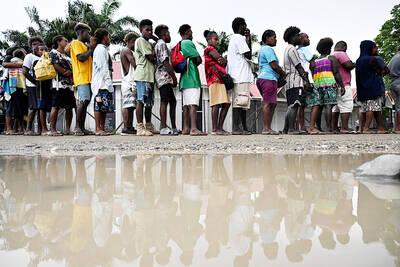
SEEKING CHANGE: A hospital worker said she did not vote in previous elections, but ‘now I can see that maybe my vote can change the system and the country’ Voting closed yesterday across the Solomon Islands in the south Pacific nation’s first general election since the government switched diplomatic allegiance from Taiwan to Beijing and struck a secret security pact that has raised fears of the Chinese navy gaining a foothold in the region. The Solomon Islands’ closer relationship with China and a troubled domestic economy weighed on voters’ minds as they cast their ballots. As many as 420,000 registered voters had their say across 50 national seats. For the first time, the national vote also coincided with elections for eight of the 10 local governments. Esther Maeluma cast her vote in the
Nearly half of China’s major cities are suffering “moderate to severe” levels of subsidence, putting millions of people at risk of flooding, especially as sea levels rise, according to a study of nationwide satellite data released yesterday. The authors of the paper, published by the journal Science, found that 45 percent of China’s urban land was sinking faster than 3mm per year, with 16 percent at more than 10mm per year, driven not only by declining water tables, but also the sheer weight of the built environment. With China’s urban population already in excess of 900 million people, “even a small portion

UNSETTLING IMAGES: The scene took place in front of TV crews covering the Trump trial, with a CNN anchor calling it an ‘emotional and unbelievably disturbing moment’ A man who doused himself in an accelerant and set himself on fire outside the courthouse where former US president Donald Trump is on trial has died, police said yesterday. The New York City Police Department (NYPD) said the man was declared dead by staff at an area hospital. The man was in Collect Pond Park at about 1:30pm on Friday when he took out pamphlets espousing conspiracy theories, tossed them around, then doused himself in an accelerant and set himself on fire, officials and witnesses said. A large number of police officers were nearby when it happened. Some officers and bystanders rushed

HYPOCRISY? The Chinese Ministry of Foreign Affairs yesterday asked whether Biden was talking about China or the US when he used the word ‘xenophobic’ US President Joe Biden on Wednesday called for a hike in steel tariffs on China, accusing Beijing of cheating as he spoke at a campaign event in Pennsylvania. Biden accused China of xenophobia, too, in a speech to union members in Pittsburgh. “They’re not competing, they’re cheating. They’re cheating and we’ve seen the damage here in America,” Biden said. Chinese steel companies “don’t need to worry about making a profit because the Chinese government is subsidizing them so heavily,” he said. Biden said he had called for the US Trade Representative to triple the tariff rates for Chinese steel and aluminum if Beijing was


 RSS
RSS