


■ China
Rights activist sentenced
A Shanghai court has sentenced local activist Xu Zhengqing, a campaigner against government land grabs and evictions, to three years in jail for disturbing the peace, court documents showed yesterday. Xu, who has been in custody for eight months, was prosecuted last month for "picking quarrels and provoking fights" after he travelled to Beijing to try to petition the government. "His behavior constitutes the crime of picking quarrels and provoking fights and should be punished according to the law," the court documents said. Xu's wife said they would appeal the sentence, describing it as "really, really tough."
■ China
Writer's jail term upheld
A court has upheld a five-year prison sentence for dissident writer Zhang Lin (張林), his wife and a rights body said yesterday. Zhang had been sentenced in July for subversion over his Internet essays. The Chinese Rights Defenders group said Zhang was re-tried behind closed doors following his appeal and the court later told Zhang's wife that the original verdict had been upheld. "The courts have not judged according to law. It's just pure vengeance," his wife told reporters by telephone. Zhang again pleaded his innocence in the second trial and said he planned to appeal to the Supreme Court, she said.
■ Papua New Guinea
Pfizer to help AIDS patients
The Australian branch of pharmaceutical giant Pfizer said yesterday it will provide free and unlimited supplies of an anti-fungal medication to help treat AIDS patients in Papua New Guinea. At a joint news conference in Brisbane, Australia held with visiting Papua New Guinea Prime Minister Michael Somare, Pfizer announced it would send free supplies of Diflucan, an anti-fungal medicine used to treat AIDS-related illnesses, to the island nation. Papua New Guinea is facing one of the largest AIDS epidemics in the Asia-Pacific region with an estimated 1.7 percent of the country's adults living with HIV. It is the only country in the region where the disease has moved into the general population and the only nation the UN fears will reach sub-Saharan Africa proportions.
■ Hong Kong
Tsang faults gay sex ruling
Chief Executive Donald Tsang (曾蔭權) has clashed with the territory's homosexual community by suggesting the age of consent for gay sex is a moral issue, a news report said yesterday. Tsang told students at the weekend that he disapproved of sex between males as young as 16 in response to a High Court ruling which lowered the age of consent. Tsang, a devout Catholic, told his audience he believed the "privatization" of moral standards had become a danger to society, implying he did not approve of the ruling. Joseph Cho, head of a Hong Kong gay pressure group, told yesterday's South China Morning Post: "Actions performed privately should not be criminalized.
■ Nepal
Journalists oppose new law
Journalists said yesterday they would fight a new law that increases the penalty for criticizing King Gyanendra to two years in jail. The law also bars private radio stations from broadcasting news and makes it a crime to criticize the royal family. "We are going to file the case at the Supreme Court on Tuesday. The new laws not only violate the press rights guaranteed by the Constitution but also several decisions held by the courts in favor of press freedom," Balram Baniya of the Federation of Nepalese Journalists said.
■ Italy
Prodi to lead opposition bid
Former European Commission president Romano Prodi was crowned yesterday as the opposition leader to take on Prime Minister Silvio Berlusconi at the next general election after triumphing at center-left primaries. Prodi won almost 75 percent of the vote, while his nearest rival among the six other candidates was veteran communist leader Fausto Bertinotti, who took 15 percent. Four million people voted, far more than anyone had expected, giving Prodi's leadership an overwhelming seal of approval ahead May's general election.
■ Turkey
Strong quake, little damage
A strong earthquake with a preliminary magnitude of 5.7 shook the western port city of Izmir yesterday, sending terrified residents running from their homes but causing only minor damage. The earthquake struck at 8:45am and was centered in the Aegean Sea off the coast of Izmir. Two aftershocks with preliminary magnitudes of 4.1 and 3.0 followed. Quakes are frequent in Turkey, which lies on an active fault.
■ Germany
Raccoons wipe out grapes
Authorities have stepped up efforts to cull raccoons amid reports that the ravenous American mammals have ruined wine-grape harvests in one region. Imported to Germany from North America before World War II, raccoons have multiplied throughout Germany and Central Europe. The mammals have become a health hazard in many cities, where they rummage through garbage bins and invade attics and cellars. Now, they are becoming a threat to agriculture. "Raccoons wiped out almost the entire harvest in a matter of days," vintner Werner Kothe said. "We have 540 vines and they have been stripped bare by these pesky animals."
■ Russia
Responsibility claimed
Top Chechen rebel leader Shamil Basayev claimed responsibility in an Internet message yesterday for raids on the southern Russian city of Nalchik that left more than 100 people dead. "I was responsible for the general operational guidance" of the attacks on Nalchik, a message posted on a Web site used by Chechen rebels quoted Basayev as saying. Russian officials said they killed 92 gunmen in two days of fighting in Nalchik, but the message attributed to Basayev said there had been only 41 fatalities among the militants. Basayev said the attacks had been carried out by 217 mujahidin of the rebel Caucasus Front and had targeted 15 "military objectives."
■ Saudi Arabia
Cinema opens for women
The country's first movie theater will open in Riyadh during the Id Al-Fitr holidays that mark the end of the Muslim fasting month of Ramadan, but will show only cartoon films for women and children. The movie theater will start screening on Nov. 3 tentatively, at the InterContinental Hotel in the capital. The 1,200-seat theater will hold three one-hour shows to screen foreign cartoon films dubbed in Arabic every evening. The project is a prelude to the start of real screenings for all in Saudi Arabia, given that cafes in main cities already show films, sports games and video clips on TV. Abdullah Dahlan, a writer, said he had not come across any law that bans running of movie theater in the kingdom. He said movie theaters existed in the country more than 50 years ago, but disappeared in the past 15 years due to religious extremism.
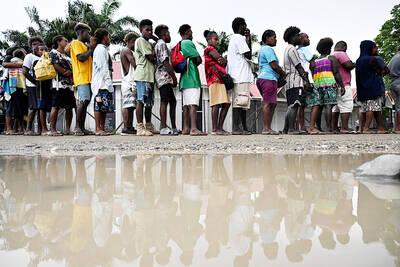
SEEKING CHANGE: A hospital worker said she did not vote in previous elections, but ‘now I can see that maybe my vote can change the system and the country’ Voting closed yesterday across the Solomon Islands in the south Pacific nation’s first general election since the government switched diplomatic allegiance from Taiwan to Beijing and struck a secret security pact that has raised fears of the Chinese navy gaining a foothold in the region. The Solomon Islands’ closer relationship with China and a troubled domestic economy weighed on voters’ minds as they cast their ballots. As many as 420,000 registered voters had their say across 50 national seats. For the first time, the national vote also coincided with elections for eight of the 10 local governments. Esther Maeluma cast her vote in the
Nearly half of China’s major cities are suffering “moderate to severe” levels of subsidence, putting millions of people at risk of flooding, especially as sea levels rise, according to a study of nationwide satellite data released yesterday. The authors of the paper, published by the journal Science, found that 45 percent of China’s urban land was sinking faster than 3mm per year, with 16 percent at more than 10mm per year, driven not only by declining water tables, but also the sheer weight of the built environment. With China’s urban population already in excess of 900 million people, “even a small portion

UNSETTLING IMAGES: The scene took place in front of TV crews covering the Trump trial, with a CNN anchor calling it an ‘emotional and unbelievably disturbing moment’ A man who doused himself in an accelerant and set himself on fire outside the courthouse where former US president Donald Trump is on trial has died, police said yesterday. The New York City Police Department (NYPD) said the man was declared dead by staff at an area hospital. The man was in Collect Pond Park at about 1:30pm on Friday when he took out pamphlets espousing conspiracy theories, tossed them around, then doused himself in an accelerant and set himself on fire, officials and witnesses said. A large number of police officers were nearby when it happened. Some officers and bystanders rushed

HYPOCRISY? The Chinese Ministry of Foreign Affairs yesterday asked whether Biden was talking about China or the US when he used the word ‘xenophobic’ US President Joe Biden on Wednesday called for a hike in steel tariffs on China, accusing Beijing of cheating as he spoke at a campaign event in Pennsylvania. Biden accused China of xenophobia, too, in a speech to union members in Pittsburgh. “They’re not competing, they’re cheating. They’re cheating and we’ve seen the damage here in America,” Biden said. Chinese steel companies “don’t need to worry about making a profit because the Chinese government is subsidizing them so heavily,” he said. Biden said he had called for the US Trade Representative to triple the tariff rates for Chinese steel and aluminum if Beijing was


 RSS
RSS