


A halt in heavy rains yesterday allowed helicopter relief flights to resume across Pakistan's quake zone, but fresh landslides hampered efforts to move supplies by road and officials estimated the death toll could now be more than 54,000.
Eight international medical teams took off from Muzaffarabad to outlying villages, as fears grew for millions of survivors without healthcare and shelter in the isolated mountains of Kashmir. US diplomat Geoffrey Krassy estimated that about one-fifth of populated areas had yet to be reached.
"There are serious patients with infected wounds and gangrene," said Sebastian Nouak of the International Committee of the Red Cross, after a team of its doctors landed in Chekar, about 60km east of Muzaffarabad, the capital of Pakistan's part of the divided Himalayan region.

PHOTO: AFP
He said about 200 people in the town had not received any medical help since the 7.6 magnitude quake struck on Oct. 8, and landing choppers there was dangerous because desperate villagers rushed into the landing area.
In the town of Bagh, the bodies of six soldiers killed when their MI-17 transport helicopter crashed in bad weather Saturday were lain into simple wooden coffins for transport back to Islamabad. The remains were located on Sunday but could not be flown back immediately because of the downpours.
On the Indian side of Kashmir, conditions were grim yesterday. Torrential rain and snow turned roads into rivers of mud, stranding trucks loaded with relief supplies for the worst-affected Uri and Tangdhar areas, officials said.
Two strong aftershocks struck early yesterday, including one with a magnitude of 4.5, but there were no immediate reports of damage.
There have been hundreds of aftershocks, and experts say they could continue for months.
Officials on Sunday sharply raised estimates of the dead. Abdul Khaliq Wasi, a spokesman for the local government of Pakistani Kashmir, which bore the brunt of the quake, said at least 40,000 people died there and that the toll could go much higher. Not all the bodies had been counted and the figure represented the "closest estimate," he said.
That pushed estimates of the total death toll to more than 54,000, including more than 13,000 in Pakistan's North West Frontier Province and about 1,350 in the part of divided Kashmir that India controls.
Confirmation of a final toll will be difficult because many bodies are buried beneath rubble.
UN officials said that, so far, they were adhering to the Pakistani government's confirmed casualty toll, which was 39,422 dead and 65,038 injured. The UN has estimated that 2 million are homeless.
Helicopter missions in Pakistan resumed yesterday after being grounded for most of Sunday because of heavy rain and thunderstorms, which piled on the distress for the homeless.
Nouak said one of its relief flights to Chekar had to turn back at the weekend because villagers were fighting each other for the supplies.
"They had sticks and they were fighting for relief goods. There was no perimeter security and we felt threatened. There must be a perimeter security while helicopters land," he said.
India gave Pakistan permission to send relief helicopters into the 1.6km-wide no-fly-zone on the Pakistani side of the ceasefire line that divides Kashmir.
also see story:

Republican US lawmakers on Friday criticized US President Joe Biden’s administration after sanctioned Chinese telecoms equipment giant Huawei unveiled a laptop this week powered by an Intel artificial intelligence (AI) chip. The US placed Huawei on a trade restriction list in 2019 for contravening Iran sanctions, part of a broader effort to hobble Beijing’s technological advances. Placement on the list means the company’s suppliers have to seek a special, difficult-to-obtain license before shipping to it. One such license, issued by then-US president Donald Trump’s administration, has allowed Intel to ship central processors to Huawei for use in laptops since 2020. China hardliners
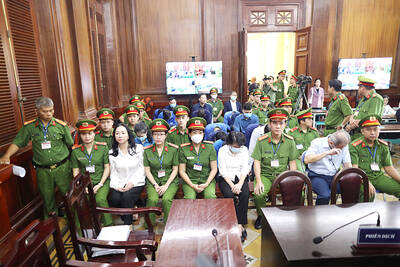
A top Vietnamese property tycoon was on Thursday sentenced to death in one of the biggest corruption cases in history, with an estimated US$27 billion in damages. A panel of three hand-picked jurors and two judges rejected all defense arguments by Truong My Lan, chair of major developer Van Thinh Phat, who was found guilty of swindling cash from Saigon Commercial Bank (SCB) over a decade. “The defendant’s actions ... eroded people’s trust in the leadership of the [Communist] Party and state,” read the verdict at the trial in Ho Chi Minh City. After the five-week trial, 85 others were also sentenced on

‘DELUSIONAL’: Targeting the families of Hamas’ leaders would not push the group to change its position or to give up its demands for Palestinians, Ismail Haniyeh said Israeli aircraft on Wednesday killed three sons of Hamas’ top political leader in the Gaza Strip, striking high-stakes targets at a time when Israel is holding delicate ceasefire negotiations with the militant group. Hamas said four of the leader’s grandchildren were also killed. Ismail Haniyeh’s sons are among the highest-profile figures to be killed in the war so far. Israel said they were Hamas operatives, and Haniyeh accused Israel of acting in “the spirit of revenge and murder.” The deaths threatened to strain the internationally mediated ceasefire talks, which appeared to gain steam in recent days even as the sides remain far
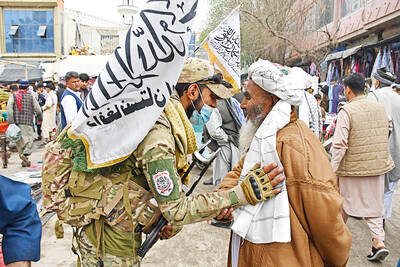
The Taliban’s reclusive supreme leader made a rare public appearance yesterday, an Afghan government spokesman said, leading thousands of worshipers in prayers marking Eid al-Fitr. Hibatullah Akhundzada has made only a handful of public appearances since inheriting the leadership of the Taliban in 2016 and leading the movement back to power with the withdrawal of US forces in 2021. Taliban government spokesman Zabihullah Mujahid said prayer in the largest mosque in Kandahar was “performed under the leadership of the supreme leader.” In a statement on X, he said the early-morning service “was attended by thousands of compatriots” in the southern province considered the


 RSS
RSS