


Two years ago, in an uncharacteristic nod toward multilateralism, the administration of US President George W. Bush ended a 19-year-long US boycott of UNESCO. Today, the US risks isolation in the 191-member organization as the sole country opposing a new convention on cultural diversity.
Until recently, differences had focused on obscure diplomatic phrases. But in the countdown to a final vote next week, negotiations have grown increasingly bitter, with the dispute now assuming political significance and even raising questions about the future role of the US at UNESCO.
The convention's supporters argue that the treaty will protect and promote cultural diversity in the face of cultural globalization, but the US believes it is intended to restrict exports of American audio-visual products, particularly movies and television programs.
On Thursday next week, when the convention is finally to be put to a vote at the headquarters of the UN Educational, Scientific and Cultural Organization in Paris, everything suggests that the US will be the only country to vote against it.
In fact, the US has already stood alone. On three recent procedural votes related to the convention, it was successively defeated by 54-1, 53-1 and 158-1.
Last-minute lobbying is still under way to avoid a one-against-all outcome, with the 25-nation EU, whose current president is Britain, urging the US to join the consensus. Embarrassed to be at loggerheads with Washington, Britain insists the convention poses none of the dangers identified by the Bush administration.
But Washington is not convinced. Last week, Secretary of State Condoleezza Rice wrote to member governments expressing "deep concern" about the convention, calling for postponement of its adoption and warning that it "will only undermine UNESCO's image and sow confusion and conflict rather than cooperation."
Sponsored by France and Canada, two countries that have long used subsidies and quotas to help their movie, television and radio industries to hold back US popular culture, the convention was inspired by a desire to shield culture from international agreements to liberalize trade.
But the final draft falls short of original intentions. Indeed, without "teeth" to enforce its principles, many experts expect the convention to have little impact on what is already a globalized market for cultural products, one in which India's Bollywood, Japanese animation movies and Brazilian and Mexican television soap operas have a place alongside Hollywood blockbusters.
The US nonetheless believes that the final draft is open to misunderstandings that could allow governments to control culture and to block the free flow of ideas and information, its euphemism for Hollywood's exports.
Nearly half of China’s major cities are suffering “moderate to severe” levels of subsidence, putting millions of people at risk of flooding, especially as sea levels rise, according to a study of nationwide satellite data released yesterday. The authors of the paper, published by the journal Science, found that 45 percent of China’s urban land was sinking faster than 3mm per year, with 16 percent at more than 10mm per year, driven not only by declining water tables, but also the sheer weight of the built environment. With China’s urban population already in excess of 900 million people, “even a small portion

UNSETTLING IMAGES: The scene took place in front of TV crews covering the Trump trial, with a CNN anchor calling it an ‘emotional and unbelievably disturbing moment’ A man who doused himself in an accelerant and set himself on fire outside the courthouse where former US president Donald Trump is on trial has died, police said yesterday. The New York City Police Department (NYPD) said the man was declared dead by staff at an area hospital. The man was in Collect Pond Park at about 1:30pm on Friday when he took out pamphlets espousing conspiracy theories, tossed them around, then doused himself in an accelerant and set himself on fire, officials and witnesses said. A large number of police officers were nearby when it happened. Some officers and bystanders rushed

HYPOCRISY? The Chinese Ministry of Foreign Affairs yesterday asked whether Biden was talking about China or the US when he used the word ‘xenophobic’ US President Joe Biden on Wednesday called for a hike in steel tariffs on China, accusing Beijing of cheating as he spoke at a campaign event in Pennsylvania. Biden accused China of xenophobia, too, in a speech to union members in Pittsburgh. “They’re not competing, they’re cheating. They’re cheating and we’ve seen the damage here in America,” Biden said. Chinese steel companies “don’t need to worry about making a profit because the Chinese government is subsidizing them so heavily,” he said. Biden said he had called for the US Trade Representative to triple the tariff rates for Chinese steel and aluminum if Beijing was
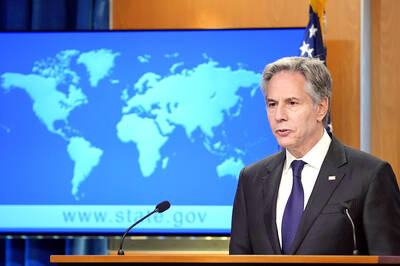
Beijing is continuing to commit genocide and crimes against humanity against Uyghurs and other Muslim minorities in its western Xinjiang province, U.S. Secretary of State Antony Blinken said in a report published on Monday, ahead of his planned visit to China this week. The State Department’s annual human rights report, which documents abuses recorded all over the world during the previous calendar year, repeated language from previous years on the treatment of Muslims in Xinjiang, but the publication raises the issue ahead of delicate talks, including on the war in Ukraine and global trade, between the top U.S. diplomat and Chinese


 RSS
RSS