


Weather forecasters at the National Hurricane Center have struggled for more than a decade to issue accurate storm reports using broken equipment, an overbooked airplane fleet and tight budgets, a newspaper reported on Sunday.
Key forecasting equipment that was used by the center has broken down or been unavailable for nearly half of the 45 hurricanes that have struck land since 1992, the Miami Herald found after an eight-month investigation.
"It's almost like we're forecasting blind," said Pablo Santos, a science officer at the National Weather Service's Miami office, which assists the hurricane center during storms. "We've never really had the equipment to do it."
Hurricane Center director Max Mayfield and four former directors said that equipment gaps have compromised forecasts, including those for Hurricane Andrew in 1992, Erin in 1995 and Mitch in 1998.
The equipment problems include broken devices such as data-transmitting buoys, weather balloons, radar installations and ground sensors, as well as hurricane hunting airplanes that are overbooked and unavailable to fly weather-observation missions.
"We need help," Mayfield said. "We need more observation [equipment]. There's no question."
National Weather Service officials cited the expense of the equipment and its maintenance. They also said there was an overlap, so if a radar installation or buoy fails, another one a few hundred kilometers away can help.
"Could the Hurricane Center do a better job? Yes ... But we're working within a resources-available environment," Weather Service chief D.L. Johnson said.
After last year's hurricanes, the US Congress approved US$8.8 million to fix damaged equipment, add more buoys, upgrade hurricane hunter planes and bolster research.
The Herald reviewed audits, e-mails, government databases, maintenance records, accounting reports and congressional testimony, as well as flight logs and interviews. It found that data buoys have been broken for months, and weather balloons are inoperable or missing in some areas, especially in the Caribbean.
Also, despite nearly US$2 billion spent in the 1990s for Doppler radar installations and electronic weather sensors, they often fail during lightning and power outages in severe weather. The weather sensors shut down more than 60 times during the four hurricanes that struck Florida last year.
Further, they found that the National Oceanic and Atmospheric Administration's two hurricane-hunting turboprop planes are sometimes sent on missions during hurricane season that have little to do with tropical storms. And the budget for the agency's Gulfstream jet isn't enough to fly continuous missions during storms.

Republican US lawmakers on Friday criticized US President Joe Biden’s administration after sanctioned Chinese telecoms equipment giant Huawei unveiled a laptop this week powered by an Intel artificial intelligence (AI) chip. The US placed Huawei on a trade restriction list in 2019 for contravening Iran sanctions, part of a broader effort to hobble Beijing’s technological advances. Placement on the list means the company’s suppliers have to seek a special, difficult-to-obtain license before shipping to it. One such license, issued by then-US president Donald Trump’s administration, has allowed Intel to ship central processors to Huawei for use in laptops since 2020. China hardliners

Conjoined twins Lori and George Schappell, who pursued separate careers, interests and relationships during lives that defied medical expectations, died this month in Pennsylvania, funeral home officials said. They were 62. The twins, listed by Guinness World Records as the oldest living conjoined twins, died on April 7 at the Hospital of the University of Pennsylvania, obituaries posted by Leibensperger Funeral Homes of Hamburg said. The cause of death was not detailed. “When we were born, the doctors didn’t think we’d make 30, but we proved them wrong,” Lori said in an interview when they turned 50, the Philadelphia Inquirer reported. The
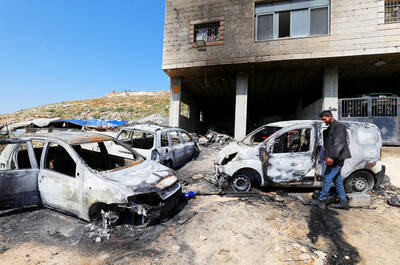
RAMPAGE: A Palestinian man was left dead after dozens of Israeli settlers searching for a missing 14-year-old boy stormed a village in the Israeli-occupied West Bank US President Joe Biden on Friday said he expected Iran to attack Israel “sooner, rather than later” and warned Tehran not to proceed. Asked by reporters about his message to Iran, Biden simply said: “Don’t,” underscoring Washington’s commitment to defend Israel. “We are devoted to the defense of Israel. We will support Israel. We will help defend Israel and Iran will not succeed,” he said. Biden said he would not divulge secure information, but said his expectation was that an attack could come “sooner, rather than later.” Israel braced on Friday for an attack by Iran or its proxies as warnings grew of

IN PURSUIT: Israel’s defense minister said the revenge attacks by Israeli settlers would make it difficult for security forces to find those responsible for the 14-year-old’s death Israeli Prime Minister Benjamin Netanyahu on Saturday condemned the “heinous murder” of an Israeli teenager in the occupied West Bank as attacks on Palestinian villages intensified following news of his death. After Benjamin Achimeir, 14, was reported missing near Ramallah on Friday, hundreds of Jewish settlers backed by Israeli forces raided nearby Palestinian villages, torching vehicles and homes, leaving at least one villager dead and dozens wounded. The attacks escalated in several villages on Saturday after Achimeir’s body was found near the Malachi Hashalom outpost. Agence France-Presse correspondents saw smoke rising from burned houses and fields. Mayor Amin Abu Alyah, of the


 RSS
RSS