


Violence threatened a crucial summit meeting intended to promote Middle East peace efforts when Israeli soldiers shot and killed three Palestinians next to the Gaza-Israel border fence.
The military said soldiers spotted the three crawling toward the border fence near the Kissufim crossing point late on Sunday carrying a bag -- apparently planning to plant a bomb. Soldiers opened fire, the military said.
Palestinian officials said that the three were killed, and contacts were underway with the Israelis to turn over their bodies. It was the most serious incident of its kind since Israel completed its Gaza pullout last month.

PHOTO: EPA
The clash came as Palestinian negotiator Saeb Erekat was to sit with Dov Weisglass, a top aide to Israeli Prime Minister Ariel Shar-on, a day before the scheduled summit between Sharon and Palestinian leader Mahmoud Abbas. It was not immediately known whether the talks would proceed.
Though both sides had reasons to hold a well-publicized summit to symbolize continued progress toward peace after Israel's pullout from Gaza and part of the West Bank, Israel balked at making gestures it said would harm its security.
Palestinians said there was no point in a summit just for the pictures -- concrete results were needed. Abbas himself came under criticism last year when he was prime minister under the late Yasser Arafat for meeting Sharon but coming away empty-handed.
Abbas is to travel to Washington later this month to meet with US President George W. Bush, and he would be reluctant to arrive without any concrete achievements from a meeting with Sharon.
The Palestinian demands are familiar -- release of prisoners Israel is holding, hand-over of West Bank towns to Palestinian control, removal of army roadblocks and reopening the Gaza-Egypt border crossing. Israel appeared prepared to discuss the border, remove some roadblocks and free some prisoners, but not enough to satisfy the Palestinians. An Erekat-Weisglass meeting on Sunday ended without agreement.
Sharon told his Cabinet on Sunday that he didn't know if the meeting will take place, stressing that he will not make moves that he believes threaten Israel's security.
"There are gestures that Israel can and will make, and there are gestures that it won't," he said, according to meeting participants.
Abbas has said that one of his goals will be to persuade Israel to carry out pledges it already has made, including pulling its troops out of five West Bank towns.
Israel agreed to the pullback as part of a February ceasefire. But the process stalled after two towns, Jericho and Tulkarem, were handed over, with Israel accusing the Palestinians of failing to take action against militants in those towns. Israel later retook Tulkarem after a suicide bomber from the area attacked an Israeli city.
Defense Minister Shaul Mofaz opposes any further hand-overs of Palestinian towns, the Defense Ministry said on Sunday. Mofaz also objects to supplying Abbas' security forces with new weapons.
The Palestinians say their security forces need better equipment to restore law and order in the chaotic Palestinian areas. Abbas has resisted international calls to disarm militant groups, fearing it would provoke civil war, though he recently banned armed groups from displaying weapons.
The militants have repeatedly ignored the ban, while leaders of Abbas' Fatah movement called a news conference in Gaza late on Sunday to reaffirm their commitment to it.
Israel reopened a cargo crossing on its border with Gaza on Sunday, and Palestinians said this would alleviate a shortage of fruit and dairy products in the territory. The Karni passage and others in the Palestinian area had been closed almost continuously since Sept. 24, after dozens of rockets were fired from Gaza into Israel.

Republican US lawmakers on Friday criticized US President Joe Biden’s administration after sanctioned Chinese telecoms equipment giant Huawei unveiled a laptop this week powered by an Intel artificial intelligence (AI) chip. The US placed Huawei on a trade restriction list in 2019 for contravening Iran sanctions, part of a broader effort to hobble Beijing’s technological advances. Placement on the list means the company’s suppliers have to seek a special, difficult-to-obtain license before shipping to it. One such license, issued by then-US president Donald Trump’s administration, has allowed Intel to ship central processors to Huawei for use in laptops since 2020. China hardliners
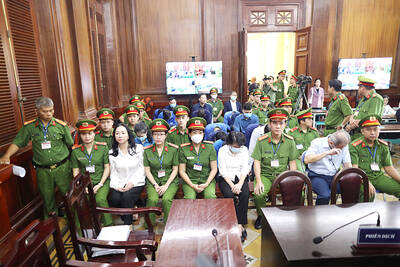
A top Vietnamese property tycoon was on Thursday sentenced to death in one of the biggest corruption cases in history, with an estimated US$27 billion in damages. A panel of three hand-picked jurors and two judges rejected all defense arguments by Truong My Lan, chair of major developer Van Thinh Phat, who was found guilty of swindling cash from Saigon Commercial Bank (SCB) over a decade. “The defendant’s actions ... eroded people’s trust in the leadership of the [Communist] Party and state,” read the verdict at the trial in Ho Chi Minh City. After the five-week trial, 85 others were also sentenced on

Conjoined twins Lori and George Schappell, who pursued separate careers, interests and relationships during lives that defied medical expectations, died this month in Pennsylvania, funeral home officials said. They were 62. The twins, listed by Guinness World Records as the oldest living conjoined twins, died on April 7 at the Hospital of the University of Pennsylvania, obituaries posted by Leibensperger Funeral Homes of Hamburg said. The cause of death was not detailed. “When we were born, the doctors didn’t think we’d make 30, but we proved them wrong,” Lori said in an interview when they turned 50, the Philadelphia Inquirer reported. The

RAMPAGE: A Palestinian man was left dead after dozens of Israeli settlers searching for a missing 14-year-old boy stormed a village in the Israeli-occupied West Bank US President Joe Biden on Friday said he expected Iran to attack Israel “sooner, rather than later” and warned Tehran not to proceed. Asked by reporters about his message to Iran, Biden simply said: “Don’t,” underscoring Washington’s commitment to defend Israel. “We are devoted to the defense of Israel. We will support Israel. We will help defend Israel and Iran will not succeed,” he said. Biden said he would not divulge secure information, but said his expectation was that an attack could come “sooner, rather than later.” Israel braced on Friday for an attack by Iran or its proxies as warnings grew of


 RSS
RSS