


UN Secretary-General Kofi Annan recommended to the Security Council on Friday that talks begin without delay on the future of Kosovo, with independence as an option.
"The question of independence is on the table, the question of autonomy is on the table," he told reporters in Bern, Switzerland. "We will discuss all that with Belgrade, with Pristina, with neighboring countries and other interested countries."
He said he was acting after receiving a report three days ago from his special envoy to Kosovo, Kai Eide of Norway, on the province's progress in meetings standards of democracy and minority rights.
Eide's report said progress had been made in establishing civic, judicial and legislative bodies, public services and economic structures. But it said property rights, which it identified as a key element in settling Kosovo's ethnically divided society, "are neither respected nor ensured."
Debilitating ethnic tensions remain high, with the majority ethnic Albanians doing little to reassure minority Serbs, the report said.
"The Kosovo Serbs fear that they will become a decoration to any central-level political institution with little ability to yield tangible results," the report said. "The Kosovo Albanians have done little to dispel it." Kosovo is a province of Serbia now under UN supervision.
Nevertheless, the report says, "There will not be any good moment for addressing Kosovo's future status; it will continue to be a highly sensitive political issue. Nevertheless, an overall assessment leads to the conclusion that the time has come to commence this process."
Annan said he would be naming "in a very short time" a person to lead the coming talks. "What's important," he said, "is that talks begin soon." The Security Council is to take up the question on Oct. 24, and diplomats predicted that the talks would begin before the end of the year.
Kosovo's UN governor, Soren Jessen-Petersen of Denmark, has indicated that negotiations would be conducted on a shuttle basis between Belgrade, the capital of Serbia-Montenegro, and Pristina, the provincial capital of Kosovo.
Kosovo has been run by the UN and protected by NATO peacekeepers since 1999, when a NATO bombing campaign halted Serbia's repression of ethnic Albanians, which followed an uprising by Albanian guerrillas.
Ethnic Albanians, who make up 90 percent of Kosovo's 2 million people, hope that the discussions will mark the final step toward seceding from Serbia-Montenegro, the union that joins the remaining republics of the former Yugoslavia.
Serbia is adamantly opposed. Half of Kosovo's 100,000 Serbs live in NATO-protected enclaves, and Serbian officials have argued that this is evidence that there have not been sufficient advances in minority rights.
They also point to mass rioting in March 2004, when 50,000 ethnic Albanians took part in a three-day wave of attacks on Serbs and other minorities, resulting in 19 deaths. Four thousand people were driven from their homes.
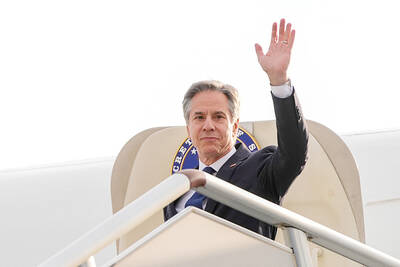
‘IN A DIFFERENT PLACE’: The envoy first visited Shanghai, where he attended a Chinese basketball playoff match, and is to meet top officials in Beijing tomorrow US Secretary of State Antony Blinken yesterday arrived in China on his second visit in a year as the US ramps up pressure on its rival over its support for Russia while also seeking to manage tensions with Beijing. The US diplomat tomorrow is to meet China’s top brass in Beijing, where he is also expected to plead for restraint as Taiwan inaugurates president-elect William Lai (賴清德), and to raise US concerns on Chinese trade practices. However, Blinken is also seeking to stabilize ties, with tensions between the world’s two largest economies easing since his previous visit in June last year. At the
Nearly half of China’s major cities are suffering “moderate to severe” levels of subsidence, putting millions of people at risk of flooding, especially as sea levels rise, according to a study of nationwide satellite data released yesterday. The authors of the paper, published by the journal Science, found that 45 percent of China’s urban land was sinking faster than 3mm per year, with 16 percent at more than 10mm per year, driven not only by declining water tables, but also the sheer weight of the built environment. With China’s urban population already in excess of 900 million people, “even a small portion

UNSETTLING IMAGES: The scene took place in front of TV crews covering the Trump trial, with a CNN anchor calling it an ‘emotional and unbelievably disturbing moment’ A man who doused himself in an accelerant and set himself on fire outside the courthouse where former US president Donald Trump is on trial has died, police said yesterday. The New York City Police Department (NYPD) said the man was declared dead by staff at an area hospital. The man was in Collect Pond Park at about 1:30pm on Friday when he took out pamphlets espousing conspiracy theories, tossed them around, then doused himself in an accelerant and set himself on fire, officials and witnesses said. A large number of police officers were nearby when it happened. Some officers and bystanders rushed
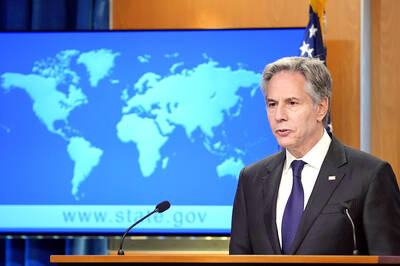
Beijing is continuing to commit genocide and crimes against humanity against Uyghurs and other Muslim minorities in its western Xinjiang province, U.S. Secretary of State Antony Blinken said in a report published on Monday, ahead of his planned visit to China this week. The State Department’s annual human rights report, which documents abuses recorded all over the world during the previous calendar year, repeated language from previous years on the treatment of Muslims in Xinjiang, but the publication raises the issue ahead of delicate talks, including on the war in Ukraine and global trade, between the top U.S. diplomat and Chinese


 RSS
RSS