


Armed assailants opened fire on a mosque belonging to a small Muslim sect in eastern Pakistan early yesterday, killing at least eight people and wounding 19 others, police and a doctor said.
The attack on the mosque belonging to Ahmadiyya sect happened in the village of Mong, about 400km northeast of Multan, a main city in eastern Punjab province, said Mohammed Arif, an area police officer.
"So far we only know that three men riding on a motorcycle suddenly came in the village [yesterday] morning. Two of them went inside the mosque and started firing," he said.
Arshad Nawaz, a doctor at a government hospital in the area, confirmed that the death toll from the mosque attack had risen to eight, while 19 people were still being treated. Some were in critical condition.
An estimated 150 people from Ahmadiyya sect live in Mong, which has 18,000 people.
Masood Ahmed Raja, a cardiologist who belongs to the sect, said he was going to the Baitul Hamad mosque when he saw three masked men fleeing on a motorcycle.
"I had no idea who these men were, but when I reached the mosque, I heard cries and saw blood everywhere," he said. "I don't know who attacked our mosque, but it seems to be an act of religious terrorism."
Waqar Haider, the district police chief, said police had started searching areas near the village. He refused to speculate on who was responsible, but previous attacks have been blamed on outlawed Islamic militant groups.
Yesterday's attack coincided with the second anniversary of the death of Maulana Azam Tariq, the head of the outlawed Sipah-e-Sahaba group, which has been blamed for the killings of hundreds of minority Shiite Muslims, Christians and some people from Ahmadiyya.
It came weeks after Pakistan said it had foiled terrorist attacks by arresting Asif Chotto, the reputed head of Lashkar-e-Jhangvi group, who had ties with followers of Tariq.
The head of the All Pakistan Minorities Alliance, which promotes the rights of minorities in mainly Sunni Muslim Pakistan, condemned the attack yesterday. Shahbaz Bhatti, the alliance chief, said the government had failed to protect minorities.
The Ahmadiyya sect was founded in 1889 by Mirza Ghulam Ahmad, a 19th century Indian religious leader who claimed to be a prophet seeking Islam's renewal. The religious group differs with other mainstream Muslim groups over the definition of Islam's founder Mohammad as the "final" prophet.
Ahmadiyas have been persecuted and ostracized in many countries. Pakistani law forbids them from calling themselves Muslim.
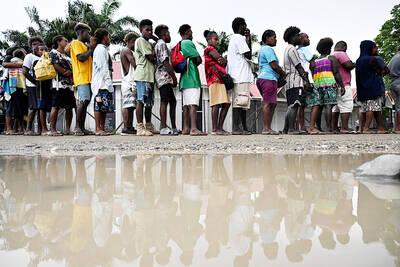
SEEKING CHANGE: A hospital worker said she did not vote in previous elections, but ‘now I can see that maybe my vote can change the system and the country’ Voting closed yesterday across the Solomon Islands in the south Pacific nation’s first general election since the government switched diplomatic allegiance from Taiwan to Beijing and struck a secret security pact that has raised fears of the Chinese navy gaining a foothold in the region. The Solomon Islands’ closer relationship with China and a troubled domestic economy weighed on voters’ minds as they cast their ballots. As many as 420,000 registered voters had their say across 50 national seats. For the first time, the national vote also coincided with elections for eight of the 10 local governments. Esther Maeluma cast her vote in the
Nearly half of China’s major cities are suffering “moderate to severe” levels of subsidence, putting millions of people at risk of flooding, especially as sea levels rise, according to a study of nationwide satellite data released yesterday. The authors of the paper, published by the journal Science, found that 45 percent of China’s urban land was sinking faster than 3mm per year, with 16 percent at more than 10mm per year, driven not only by declining water tables, but also the sheer weight of the built environment. With China’s urban population already in excess of 900 million people, “even a small portion

UNSETTLING IMAGES: The scene took place in front of TV crews covering the Trump trial, with a CNN anchor calling it an ‘emotional and unbelievably disturbing moment’ A man who doused himself in an accelerant and set himself on fire outside the courthouse where former US president Donald Trump is on trial has died, police said yesterday. The New York City Police Department (NYPD) said the man was declared dead by staff at an area hospital. The man was in Collect Pond Park at about 1:30pm on Friday when he took out pamphlets espousing conspiracy theories, tossed them around, then doused himself in an accelerant and set himself on fire, officials and witnesses said. A large number of police officers were nearby when it happened. Some officers and bystanders rushed

HYPOCRISY? The Chinese Ministry of Foreign Affairs yesterday asked whether Biden was talking about China or the US when he used the word ‘xenophobic’ US President Joe Biden on Wednesday called for a hike in steel tariffs on China, accusing Beijing of cheating as he spoke at a campaign event in Pennsylvania. Biden accused China of xenophobia, too, in a speech to union members in Pittsburgh. “They’re not competing, they’re cheating. They’re cheating and we’ve seen the damage here in America,” Biden said. Chinese steel companies “don’t need to worry about making a profit because the Chinese government is subsidizing them so heavily,” he said. Biden said he had called for the US Trade Representative to triple the tariff rates for Chinese steel and aluminum if Beijing was


 RSS
RSS