


Bustling cities throughout the Middle East fell eerily quiet on Tuesday as the sun fell below the horizon on the first day of the Muslim holy month of Ramadan. Muslims had hurried home to gather with family and friends to share iftar, the meal that breaks the dawn-to-dusk fast.
For the coming four weeks, Muslims are expected to abstain from food, drink, smoking and sex during daylight hours to focus on spiritual introspection. In much of the Islamic world religious officials had announced spotting the first sliver of the crescent moon on Monday night, signaling the start of the holy month.
Muslims believe God began to reveal the Koran, the Islamic holy book, to the prophet Mohammed more than 1,400 years ago during Ramadan. Along with fasting, many Muslims spend long periods in mosques and attempt to read the entire Koran during the month. It is believed that during Ramadan, good deeds are rewarded 10 times.

PHOTO: AFP
In Baghdad, Iraq, the first day of Ramadan for minority Sunnis was marred by a car bomb at the main entrance to the heavily fortified Green Zone, a district of Iraqi government buildings and the US and British embassies. The powerful blast killed two policemen.
Al-Qaeda in Iraq has issued a call for its followers to step up attacks against US and Iraqi forces and make it a "month of victory for Muslims and a month of defeat for the hypocrites and polytheists."
Previous Ramadans since the US-led invasion of the country have seen a spike in violence -- especially suicide attacks, in part because some Islamic extremists believe those who die in combat for a holy cause during the period are especially blessed.
Shiite Muslims, the majority sect in Iraq, began fasting yesterday as do co-religionists in neighboring Iran. Oman also began Ramadan yesterday.
"Few people come to the market because of instability. People fear of car bombs, kidnapping and theft. The streets are empty," complained Marwan Hamid, a shopkeeper in Baghdad's Shorja food market.
Elsewhere, however, the first night of the holiest month of the Muslim lunar calendar was marked more traditionally, with special meals, sweets and charity giving to the poor and homeless.
In Cairo, traffic jammed the streets in mid-afternoon as people headed home for iftar. Under a bridge in the affluent neighborhood of Zamalek -- and in other areas across Cairo -- tables were set up outdoors by local businessmen to feed the needy. By the end of the evening prayer, few cars were moving, as people sat down to special meals at home or public squares.
There was some tension in Egypt, however, after an Islamic group that previously claimed responsibility for this summer's attacks at Sharm el-Sheik vowed to launch an all-out war against Israelis, Americans and Egyptian police. An Egyptian security official said security was high across the country. Israel has urged its citizens not to travel to Egypt's Sinai peninsula during the Jewish New Year holiday, which began on Monday, because Arab militants were planning to kidnap Israeli tourists there.
Iranians didn't begin their fast until yesterday, but families were busy shopping for dates and zoulbia and bamiye -- special holiday sweets -- for the first evening Ramadan meal.
One secondary school reminded passers-by of the season with a banner that read: "You are welcome to be God's guest in the fasting month."
Students' essays about the holy month were posted on one outside wall.
"Let's purify our soul by refusing to eat and drink from dawn to dusk," one student urged.
Amman, the Jordanian capital, came to a standstill at sundown, with almost all businesses closed. People crowded Amman restaurants for a sundown meal to break the fast, as coffee shops prepared traditional apricot and tamarind juices, walnut-stuffed pancakes and water pipes for customers who would spend most of the night playing backgammon.
Kuwaitis set up so-called Ramadan tents to entertain guests, hiring singers and making food and juice plentiful late into the night. Businesses adjusted their morning hours to open an hour or two later to allow residents to rest after they eat sohour, the pre-dawn meal.
In Lebanon, which is 60 percent Muslim, the Sunnis waited for the army cannon to fire blank at sunset, announcing the beginning of the iftar. The country's Shiite Muslims, however, start fasting a day later.
Ramadan comes at a time of high tension as a UN-mandated probe into former prime minister Rafik Hariri's assassination nears its end. The Lebanese fear the continuation of a series of bombings that have rattled the country since Hariri was killed.
Nevertheless, the bustling sidewalk cafes, restaurants and shops in downtown Beirut were jammed with local residents and tourists from other Middle East countries who come to dine, smoke water pipes or just stroll through the district. After iftar, people jammed Arabic sweet shops to enjoy special Ramadan desserts.
Many others preferred to stay at home, watching special television programs produced for Ramadan.
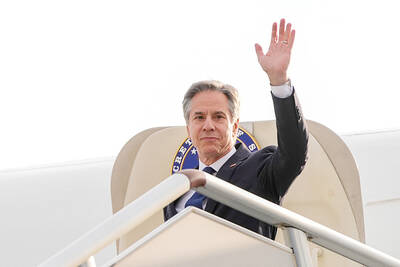
‘IN A DIFFERENT PLACE’: The envoy first visited Shanghai, where he attended a Chinese basketball playoff match, and is to meet top officials in Beijing tomorrow US Secretary of State Antony Blinken yesterday arrived in China on his second visit in a year as the US ramps up pressure on its rival over its support for Russia while also seeking to manage tensions with Beijing. The US diplomat tomorrow is to meet China’s top brass in Beijing, where he is also expected to plead for restraint as Taiwan inaugurates president-elect William Lai (賴清德), and to raise US concerns on Chinese trade practices. However, Blinken is also seeking to stabilize ties, with tensions between the world’s two largest economies easing since his previous visit in June last year. At the
Nearly half of China’s major cities are suffering “moderate to severe” levels of subsidence, putting millions of people at risk of flooding, especially as sea levels rise, according to a study of nationwide satellite data released yesterday. The authors of the paper, published by the journal Science, found that 45 percent of China’s urban land was sinking faster than 3mm per year, with 16 percent at more than 10mm per year, driven not only by declining water tables, but also the sheer weight of the built environment. With China’s urban population already in excess of 900 million people, “even a small portion

UNSETTLING IMAGES: The scene took place in front of TV crews covering the Trump trial, with a CNN anchor calling it an ‘emotional and unbelievably disturbing moment’ A man who doused himself in an accelerant and set himself on fire outside the courthouse where former US president Donald Trump is on trial has died, police said yesterday. The New York City Police Department (NYPD) said the man was declared dead by staff at an area hospital. The man was in Collect Pond Park at about 1:30pm on Friday when he took out pamphlets espousing conspiracy theories, tossed them around, then doused himself in an accelerant and set himself on fire, officials and witnesses said. A large number of police officers were nearby when it happened. Some officers and bystanders rushed

Beijing is continuing to commit genocide and crimes against humanity against Uyghurs and other Muslim minorities in its western Xinjiang province, U.S. Secretary of State Antony Blinken said in a report published on Monday, ahead of his planned visit to China this week. The State Department’s annual human rights report, which documents abuses recorded all over the world during the previous calendar year, repeated language from previous years on the treatment of Muslims in Xinjiang, but the publication raises the issue ahead of delicate talks, including on the war in Ukraine and global trade, between the top U.S. diplomat and Chinese


 RSS
RSS