


For more than six years, this small Balkan province has been the subject of one of the most ambitious nation-building projects in recent history.
A UN mission, exercising near absolute authority and backed up by a NATO-led peacekeeping force, has been trying to forge a modern democratic system in this region, torn by decades of bitter ethnic tension between an ever more assertive Albanian majority and an isolated Serbian minority.
At a cost of about US$1.3 billion a year, international civil servants and police officers -- some 11,000 at the peak -- helped to build ministries, a parliament, local councils, a bureaucracy, courts, customs and police services, as well as news media.

PHOTO: NY TIMES
Now, as the UN appears to be ready to broker a deal between Serbs and ethnic Albanians and to end its mission in Kosovo, judging the result of that long, expensive effort is not easy.
At first glance, the province appears relatively thriving -- particularly when compared with the war devastation of 1999. New houses can be seen everywhere, a result of a postwar construction boom.
In the regional capital, Pristina, the streets are filled with cafes, restaurants and stores. Only the ubiquitous white four-wheel-drive vehicles of the UN mission and the infrequent military checkpoints hint at another reality.
In truth, the region remains in limbo -- the poorest part of the Balkans, and the most unstable. Enmity between the Serbs and Albanians still runs deep. The hostilities boiled over in March of last year, when up to 50,000 ethnic Albanians took part in a three-day wave of attacks on Serbs and other minorities, as well as on UN buildings and other property. Nineteen people were killed and 4,000 were forced from their homes.
Today, most Kosovo Serbs remain in enclaves and in small rural communities, often fearful of venturing out. Albanians steer clear of the Serb-dominated northern part of the province, for fear of attack.
Estimates of unemployment range from 30 percent to 70 percent. The regional government is close to bankrupt, and the UN expects the economy to shrink by 2 percent this year.
For many, including UN experts and Kosovars, talks expected to begin soon on the province's political status -- and whether it will remain part of Serbia -- stand a chance of solving problems that the UN mission could not. Once the issue of Kosovo's sovereignty is resolved, they say, progress can be made on political and economic issues.
But others say there is a deeper lesson to be learned: The model of nation-building adopted here -- a government staffed and directed by foreign officials -- was too narrow and too authoritarian.
"The focus of the international mission from the start was on security and politics," said Gerald Knaus, director of the European Stability Initiative, a nongovernmental political research group with offices in Kosovo. International bureaucrats, he said, ignored economic needs -- the World Bank estimates that 37 percent of the population lives on less than US$1.75 a day. He said they built institutions "almost as an end in itself."
Larry Rossin, a retired US diplomat who is the deputy leader of the UN Interim Administrative Mission in Kosovo, said, "I think the development of their institutions is somewhat retarded by our continuing role."
From June 1999, when the UN arrived in the wake of NATO bombs that helped drive Serbian forces from Kosovo, until 2001 or so, the mission's efforts were held up as an example for building democracy elsewhere.
But then the process stalled, at least in the eyes of international officials and observers, and of Kosovo's Albanians. Those critics said the international administration here became unproductive.
Kosovo's Albanian politicians came to accuse the mission of a deliberately slow transfer of power to local authorities.
Veton Surroi, an ethnic Albanian publisher in the regional parliament, said, "The focus has been on buying time, and that's the only focus there has been."
In the next few days -- possibly yesterday or today -- a Norwegian diplomat, Kai Eide, is expected to give the UN Security Council the results of a study commissioned by Secretary-General Kofi Annan on whether to move forward with the talks on Kosovo's future, even though the enmities remain.
Javier Solana, the European Union's foreign policy chief, has said he believes Eide will come out in favor of the talks, and pave the way for the UN' withdrawal.
The ethnic Albanians, who make up an estimated 90 percent of Kosovo's 2 million people, hope the talks will be the final step toward seceding from Serbia. But Serbs, in Kosovo and in Serbia, see in such a secession the loss of their homeland and some of Serbia's most treasured Serbian Orthodox churches and monasteries to an Albanian-controlled state.
The negotiations among the Albanians, the Kosovo Serbs and the Serbian government will require international oversight, and almost certainly will result in some kind of international presence remaining in the province.
A decision on Kosovo's status would help solve one part of its economic problem, Rossin said: With its current ambiguous status, the province cannot borrow money internationally.
"We are in a situation where we are living off, almost entirely, customs revenues and donations from donors," Rossin said. "The budget is extremely tight; school construction is nearly nil in the year 2005 because there is just no money in the capital budget to do it in a place that has crying needs in a whole range of social areas."
What money has been invested in economic development appears to have had a marginal impact. The province's two power stations suffer daily interruptions, despite more than US$700 million in capital spending.
Kosovo's banking and payments authority report for last year states that the economy has been disinvesting since 2000, despite substantial international aid.
Nearly half of China’s major cities are suffering “moderate to severe” levels of subsidence, putting millions of people at risk of flooding, especially as sea levels rise, according to a study of nationwide satellite data released yesterday. The authors of the paper, published by the journal Science, found that 45 percent of China’s urban land was sinking faster than 3mm per year, with 16 percent at more than 10mm per year, driven not only by declining water tables, but also the sheer weight of the built environment. With China’s urban population already in excess of 900 million people, “even a small portion

UNSETTLING IMAGES: The scene took place in front of TV crews covering the Trump trial, with a CNN anchor calling it an ‘emotional and unbelievably disturbing moment’ A man who doused himself in an accelerant and set himself on fire outside the courthouse where former US president Donald Trump is on trial has died, police said yesterday. The New York City Police Department (NYPD) said the man was declared dead by staff at an area hospital. The man was in Collect Pond Park at about 1:30pm on Friday when he took out pamphlets espousing conspiracy theories, tossed them around, then doused himself in an accelerant and set himself on fire, officials and witnesses said. A large number of police officers were nearby when it happened. Some officers and bystanders rushed

HYPOCRISY? The Chinese Ministry of Foreign Affairs yesterday asked whether Biden was talking about China or the US when he used the word ‘xenophobic’ US President Joe Biden on Wednesday called for a hike in steel tariffs on China, accusing Beijing of cheating as he spoke at a campaign event in Pennsylvania. Biden accused China of xenophobia, too, in a speech to union members in Pittsburgh. “They’re not competing, they’re cheating. They’re cheating and we’ve seen the damage here in America,” Biden said. Chinese steel companies “don’t need to worry about making a profit because the Chinese government is subsidizing them so heavily,” he said. Biden said he had called for the US Trade Representative to triple the tariff rates for Chinese steel and aluminum if Beijing was
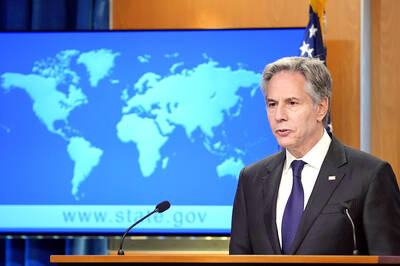
Beijing is continuing to commit genocide and crimes against humanity against Uyghurs and other Muslim minorities in its western Xinjiang province, U.S. Secretary of State Antony Blinken said in a report published on Monday, ahead of his planned visit to China this week. The State Department’s annual human rights report, which documents abuses recorded all over the world during the previous calendar year, repeated language from previous years on the treatment of Muslims in Xinjiang, but the publication raises the issue ahead of delicate talks, including on the war in Ukraine and global trade, between the top U.S. diplomat and Chinese


 RSS
RSS