


Germany celebrates 15 years of reunification today as a woman who grew up in the communist East looks likely to become the country's first female chancellor.
Voters in the German city of Dresden were casting the last ballots in the inconclusive national election yesterday in what is expected to help end a bitter political power struggle.
Some 220,000 registered voters in Dresden's district 160 will decide the final make-up of the Bundestag, with three seats at stake here.
The voting here, two weeks late because of the death of a neo-Nazi candidate, has brought Chancellor Gerhard Schroeder and his conservative rival Angela Merkel back on the campaign trail, though the result will not change the outcome of the national vote.
Three seats
Merkel's Christian Democrats claimed just three seats more in the Bundestag in the general election two weeks ago than Schroeder's Social Democrats, far short of a ruling majority.
The photo-finish left both Merkel and Schroeder claiming a mandate to lead the next government, which is now expected to be a so-called "grand coalition" grouping the Christian Democrats and the Social Democrats.
If yesterday's election cannot tip the balance of power in parliament, it could have a psychological impact on the intense horse-trading to come before a new government is formed.
The clarity offered by the Dresden vote is expected to prompt the two parties to end the deadlock that has created political uncertainty in Europe's biggest economy as it struggles with more than 11 percent unemployment and mounting public debt.
The chancellor's insistence on a third term is seen by many as a bargaining bluff in the coalition talks, and there have been suggestions that he would bow out after the Dresden vote.
Coalition talks
But Social Democratic Party (SPD) leader Franz Muentefering said in an interview yesterday that the issue of the chancellery would only be put on the table after coalition talks had begun in earnest.
"The SPD is of the opinion that it would be optimal, the best solution, if such a government were led by Gerhard Schroeder," he told Deutschlandfunk public radio.
The deputy leader of the Christian Democrats, North Rhine-Westphalia state premier Juergen Ruettgers, underscored that Schroeder was unacceptable to the conservatives as chancellor.
"It is clear that the coalition will be formed with the SPD as an equal partner but without Schroeder," he told the Berlin tabloid B.Z.
The parties have had two rounds of exploratory talks on forming a left-right grand coalition, last seen in Germany in the late 1960s.
They are to meet again on Wednesday and there has been rampant media speculation that there would be movement on the core issue of the chancellery in the wake of the Dresden vote yesterday.
The Christian Democrats can at worst only lose one seat after the Dresden election because of the complex electoral system which is a mixture of the majority and proportional systems.
also see story:
Election highlights Germany's divisions after reunification

‘IN A DIFFERENT PLACE’: The envoy first visited Shanghai, where he attended a Chinese basketball playoff match, and is to meet top officials in Beijing tomorrow US Secretary of State Antony Blinken yesterday arrived in China on his second visit in a year as the US ramps up pressure on its rival over its support for Russia while also seeking to manage tensions with Beijing. The US diplomat tomorrow is to meet China’s top brass in Beijing, where he is also expected to plead for restraint as Taiwan inaugurates president-elect William Lai (賴清德), and to raise US concerns on Chinese trade practices. However, Blinken is also seeking to stabilize ties, with tensions between the world’s two largest economies easing since his previous visit in June last year. At the
Nearly half of China’s major cities are suffering “moderate to severe” levels of subsidence, putting millions of people at risk of flooding, especially as sea levels rise, according to a study of nationwide satellite data released yesterday. The authors of the paper, published by the journal Science, found that 45 percent of China’s urban land was sinking faster than 3mm per year, with 16 percent at more than 10mm per year, driven not only by declining water tables, but also the sheer weight of the built environment. With China’s urban population already in excess of 900 million people, “even a small portion

UNSETTLING IMAGES: The scene took place in front of TV crews covering the Trump trial, with a CNN anchor calling it an ‘emotional and unbelievably disturbing moment’ A man who doused himself in an accelerant and set himself on fire outside the courthouse where former US president Donald Trump is on trial has died, police said yesterday. The New York City Police Department (NYPD) said the man was declared dead by staff at an area hospital. The man was in Collect Pond Park at about 1:30pm on Friday when he took out pamphlets espousing conspiracy theories, tossed them around, then doused himself in an accelerant and set himself on fire, officials and witnesses said. A large number of police officers were nearby when it happened. Some officers and bystanders rushed
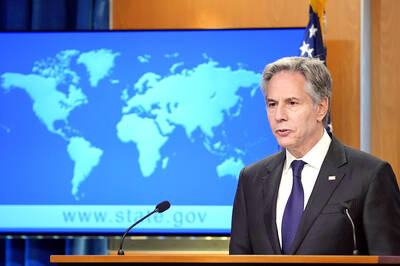
Beijing is continuing to commit genocide and crimes against humanity against Uyghurs and other Muslim minorities in its western Xinjiang province, U.S. Secretary of State Antony Blinken said in a report published on Monday, ahead of his planned visit to China this week. The State Department’s annual human rights report, which documents abuses recorded all over the world during the previous calendar year, repeated language from previous years on the treatment of Muslims in Xinjiang, but the publication raises the issue ahead of delicate talks, including on the war in Ukraine and global trade, between the top U.S. diplomat and Chinese


 RSS
RSS