


German Chancellor Gerhard Schroeder and his conservative rival Angela Merkel slugged it out till the last vote in the inconclusive national election on Friday ahead of a delayed ballot in Dresden.
The voting in a district of the eastern city today will decide the final seats in the Bundestag lower house of parliament after the messy elections on Sept. 18 which gave Merkel's Christian Democrats a three-seat advantage over Schroeder's Social Democrats, but no governing majority.
The election was delayed for two weeks in Dresden by the death of a neo-Nazi candidate during the election campaign, but the results will not change the overall picture from the general election.
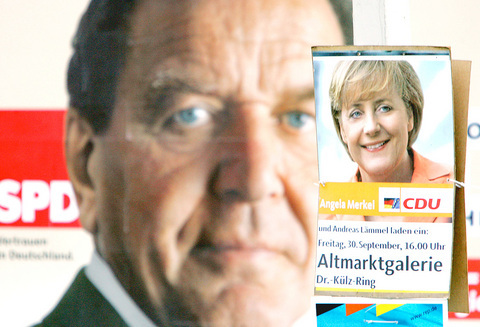
PHOTO: AFP
However they could have an impact on negotiations to form a grand coalition government encompassing both of the main parties which increasingly seems the likeliest way out of the deadlock.
Campaigning on Friday, Merkel relaunched her attack on Schroeder's record of seven years in government, telling a crowd that the country could no longer afford to lose more than 1,000 jobs a day.
"We want to give young people a chance to have a career and people over 50 the hope of staying employed or finding a new job," a tired-looking Merkel said to lukewarm applause.
Three days ahead of the anniversary of German reunification, Merkel said "much has been achieved in 15 years" since east and west were sewn back together but the country has failed to seize all its opportunities under the Social Democrats.
The chancellor, who is refusing to bow out despite losing to Merkel by a fraction of a percentage on Sept. 18, retorted in a speech elsewhere in Dresden that Germany needed his party back in power to pursue its policies, notably its economic reforms.
He accused his rival of spreading pessimism, saying the Social Democrats were a "counter to this nonsense".
While the idea of a grand coalition appears more likely by the day, the burning question remains of who will lead the biggest country in the EU.
Schroeder claims he still has a mandate for a third term as chancellor, but Merkel said her alliance won the election and therefore she should govern.
"The biggest political party in a coalition has the prerogative to put forward a chancellor," she said in an interview with the Saechsische Zeitung newspaper on Friday.
Merkel added that the negotiations to form a grand coalition would only begin once a decision had been made on who will be chancellor.
Schroeder however told the same newspaper that the chancellery issue should form part of the bargaining.
"We cannot say that the negotiations will only begin once we have made concessions," he said.
The Social Democrats meanwhile poured cold water on claims from the conservatives that Schroeder would stand aside after the Dresden vote.
And it was announced that Schroeder is to visit Spanish Prime Minister Jose Luis Rodriguez Zapatero on Wednesday, suggesting he intends to still be head of government at that point.
Although three seats are at stake in the district of Dresden concerned by today's voting, the Christian Democrats can at worst only lose one seat because of the complex electoral system which is a mixture of the majority and proportional systems.
Nearly half of China’s major cities are suffering “moderate to severe” levels of subsidence, putting millions of people at risk of flooding, especially as sea levels rise, according to a study of nationwide satellite data released yesterday. The authors of the paper, published by the journal Science, found that 45 percent of China’s urban land was sinking faster than 3mm per year, with 16 percent at more than 10mm per year, driven not only by declining water tables, but also the sheer weight of the built environment. With China’s urban population already in excess of 900 million people, “even a small portion

UNSETTLING IMAGES: The scene took place in front of TV crews covering the Trump trial, with a CNN anchor calling it an ‘emotional and unbelievably disturbing moment’ A man who doused himself in an accelerant and set himself on fire outside the courthouse where former US president Donald Trump is on trial has died, police said yesterday. The New York City Police Department (NYPD) said the man was declared dead by staff at an area hospital. The man was in Collect Pond Park at about 1:30pm on Friday when he took out pamphlets espousing conspiracy theories, tossed them around, then doused himself in an accelerant and set himself on fire, officials and witnesses said. A large number of police officers were nearby when it happened. Some officers and bystanders rushed

Beijing is continuing to commit genocide and crimes against humanity against Uyghurs and other Muslim minorities in its western Xinjiang province, U.S. Secretary of State Antony Blinken said in a report published on Monday, ahead of his planned visit to China this week. The State Department’s annual human rights report, which documents abuses recorded all over the world during the previous calendar year, repeated language from previous years on the treatment of Muslims in Xinjiang, but the publication raises the issue ahead of delicate talks, including on the war in Ukraine and global trade, between the top U.S. diplomat and Chinese

HYPOCRISY? The Chinese Ministry of Foreign Affairs yesterday asked whether Biden was talking about China or the US when he used the word ‘xenophobic’ US President Joe Biden on Wednesday called for a hike in steel tariffs on China, accusing Beijing of cheating as he spoke at a campaign event in Pennsylvania. Biden accused China of xenophobia, too, in a speech to union members in Pittsburgh. “They’re not competing, they’re cheating. They’re cheating and we’ve seen the damage here in America,” Biden said. Chinese steel companies “don’t need to worry about making a profit because the Chinese government is subsidizing them so heavily,” he said. Biden said he had called for the US Trade Representative to triple the tariff rates for Chinese steel and aluminum if Beijing was


 RSS
RSS