


The International Atomic Energy Agency (IAEA) on Friday unanimously called for a nuclear-weapons-free zone in the Middle East but rejected an Arab call to denounce Israel as a nuclear threat.
Israeli atomic energy chief Gideon Frank welcomed the idea of such a zone but said Israel advocates "achieving regional peace and security, not arms control per se."
Egyptian ambassador Ramzy Ezzeldin Ramzy told the conference that the resolution on a weapons-free zone invites Israel, believed to be the only nuclear-armed state in the Middle East, "to join the nuclear Non-Proliferation Treaty [NPT] and to accept that its various facilities be subject to the IAEA safeguards system."
Israel has not signed the NPT and neither confirms nor denies reports that it has some 200 atom bombs.
Jordanian ambassador Shebab Madi said: "Unfortunately this resolution will not be sufficient to ensure ... the denuclearization of this region. A policy of double standards will continue throughout the world."
Libyan representative Matouq Mohamed Matouq said: "We should urge Israel to renounce these weapons," and Syrian I. Othman, head of the country's atomic energy commission, said "the first step is for Israel to join the NPT."
Frank said that while Israel thought a weapons-free zone "could eventually serve as a complement to overall efforts to peace and security in the region" it first wanted a general peace agreement.
Frank said Israeli actions, such as its withdrawal from Gaza, had created a "window of opportunity to advancing peace and security in the region."
Confidence-building, as in creating a nuclear-weapons-free zone, "is a long and enduring process," Frank said and should be done in "a manner that does not hamper the security of any participant."
The IAEA conference rejected discussion of "Israeli nuclear capabilities and threat," as proposed in a resolution by Oman, despite a strong push for this by 15 Arab states plus the Palestinian Authority.
The agenda item was put off until next year as part of a compromise that has taken place annually since 1998 in which Arab states drop this agenda request in order to coax Israeli support for a nuclear weapons-free zone.
Emotions were higher this year, however, after the IAEA's 35-nation board of governors found Iran guilty of violating the NPT and threatened to take Tehran to the UN Security Council.
Arab states resent that the IAEA is cracking down on Iran for what the US charges is a covert nuclear weapons program, while US ally Israel avoids such scrutiny.
Meanwhile, Iran may respond by holding back on oil sales if its nuclear program is referred to the UN Security Council, Iranian President Mahmoud Ahmadinejad said in an interview published yesterday.
"But if Iran's case is sent to the Security Council, we will respond by many ways, for example by holding back on oil sales," he told the United Arab Emirates' daily, the Khaleej Times.
"We have been extremely cooperative, we have had more than 1,200 man days of inspections, monitoring cameras are everywhere in our facilities," he said.
The IAEA passed a resolution a week ago Saturday recommending Iran be reported in the future to the council for possible sanctions.
Analysts had predicted Iran could use oil as a lever against countries seeking to send Iran to the council.

Republican US lawmakers on Friday criticized US President Joe Biden’s administration after sanctioned Chinese telecoms equipment giant Huawei unveiled a laptop this week powered by an Intel artificial intelligence (AI) chip. The US placed Huawei on a trade restriction list in 2019 for contravening Iran sanctions, part of a broader effort to hobble Beijing’s technological advances. Placement on the list means the company’s suppliers have to seek a special, difficult-to-obtain license before shipping to it. One such license, issued by then-US president Donald Trump’s administration, has allowed Intel to ship central processors to Huawei for use in laptops since 2020. China hardliners
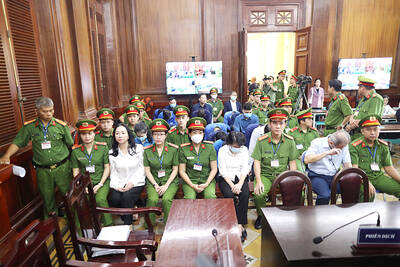
A top Vietnamese property tycoon was on Thursday sentenced to death in one of the biggest corruption cases in history, with an estimated US$27 billion in damages. A panel of three hand-picked jurors and two judges rejected all defense arguments by Truong My Lan, chair of major developer Van Thinh Phat, who was found guilty of swindling cash from Saigon Commercial Bank (SCB) over a decade. “The defendant’s actions ... eroded people’s trust in the leadership of the [Communist] Party and state,” read the verdict at the trial in Ho Chi Minh City. After the five-week trial, 85 others were also sentenced on

‘DELUSIONAL’: Targeting the families of Hamas’ leaders would not push the group to change its position or to give up its demands for Palestinians, Ismail Haniyeh said Israeli aircraft on Wednesday killed three sons of Hamas’ top political leader in the Gaza Strip, striking high-stakes targets at a time when Israel is holding delicate ceasefire negotiations with the militant group. Hamas said four of the leader’s grandchildren were also killed. Ismail Haniyeh’s sons are among the highest-profile figures to be killed in the war so far. Israel said they were Hamas operatives, and Haniyeh accused Israel of acting in “the spirit of revenge and murder.” The deaths threatened to strain the internationally mediated ceasefire talks, which appeared to gain steam in recent days even as the sides remain far
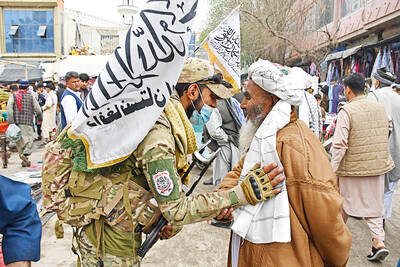
The Taliban’s reclusive supreme leader made a rare public appearance yesterday, an Afghan government spokesman said, leading thousands of worshipers in prayers marking Eid al-Fitr. Hibatullah Akhundzada has made only a handful of public appearances since inheriting the leadership of the Taliban in 2016 and leading the movement back to power with the withdrawal of US forces in 2021. Taliban government spokesman Zabihullah Mujahid said prayer in the largest mosque in Kandahar was “performed under the leadership of the supreme leader.” In a statement on X, he said the early-morning service “was attended by thousands of compatriots” in the southern province considered the


 RSS
RSS