


Widespread public transport strikes and street protests erupted across the country yesterday, hours after the Indonesian government announced a drastic hike in fuel prices of an average of 126 percent.
Despite two days of protest and clashes between police and protestors in major cities, the government announced shortly before midnight on Friday the amount of its increases.
Gasoline nearly doubled to 4,500 rupiah (US$0.44) per liter, diesel rose 105 percent to 4,300 rupiah a liter and household kerosene, the main source of energy for the majority of Indonesia's 220 million people for cooking and lighting, rose nearly three-fold to 2,000 rupiah per liter.
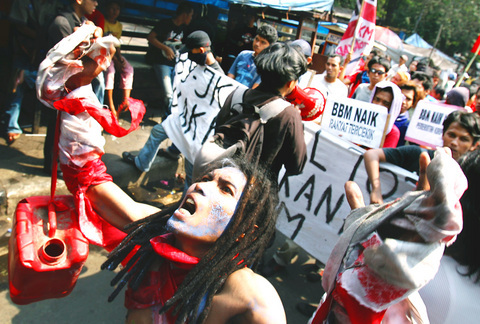
PHOTO: AP
The transport strikes stranded tens of thousands of laborers and civil servants across the vast archipelago nation and forced many to walk to work, local media reports said.
Reports from several district towns on crowded Java island said the strike had forced school children to return home after they failed to find public transportation.
Analysts and economic experts gave mixed reactions to the drastic increase.
Noted economist Faisal Basri condemned the hikes, describing them as "exceeding, illogical," on the grounds that they were beyond the capacity of most Indonesians, whom he claimed would only able to afford a 50 percent increase.
Basri questioned the government's economic team behind the price hike decision.
"I see that they have no heart," a leading Kompas daily quoted Basri as saying, adding that the decision was "very dangerous," as the new policy would have a long impact on the economy -- particularly since the fuel price hike was done so close to the Muslim fasting month of Ramadan, due to start on October 3, which typically triggers inflation anyway.
"I can't think about the future of such industries as textiles, garments, shoes and electronics. They will be hemmed between the increased prices of raw material, laborer fees, as well as demands of annual fees ahead of the Eid-el Fitr," Basri said, referring to the bonuses typically given to workers for the end of fasting holiday.
Hours before the increases were unveiled, President Susilo Bambang Yudhoyono, popularly known by his initials SBY, said, "This is no easy choice. It's a bitter pill but I have to save the future, save the national economy, while trying to tackle the effects of the hike by easing the burden of the poor."
Analysts warned of the impact the fuel hikes would have on inflation. Many analysts had expected the normally cautious Yudhoyono to stick to the 50 percent rise.
More protests were expected in the coming days, but few expected rallies to bring down Yudhoyono, who was overwhelming elected by some 60 percent of voters nearly a year ago with promises not to raise fuel prices.
Protestors have accused the president of breaking these promises and ignoring the plight of the poor. But similar protests broke out after the government's first price hike this year, which averaged 29 percent and ended after a few days.
In the Central Java capital of Semarang, dozens of students took to the streets on Saturday morning, carrying a coffin with the initials SBY-JK, for Vice President Jusuf Kalla. A brief scuffle with police occurred when protesters burned the coffin.
To help the poor cope, the government is preparing a cash compensation package for 15.5 million families, or 62 million people, representing nearly a quarter of the population. High world oil prices have ratcheted up Indonesia's fuel subsidies, which will eat up nearly a fifth of this year's budget. While Indonesia produces oil, declining output has forced it to sell rupiah for dollars to pay for oil imports, hitting the currency and hurting the economy.
Indonesia, the only Southeast Asian member of the Organization of Petroleum Exporting Countries (OPEC), has in fact become a net oil importer.
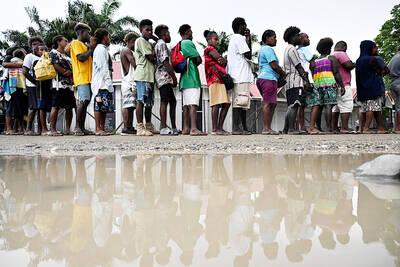
SEEKING CHANGE: A hospital worker said she did not vote in previous elections, but ‘now I can see that maybe my vote can change the system and the country’ Voting closed yesterday across the Solomon Islands in the south Pacific nation’s first general election since the government switched diplomatic allegiance from Taiwan to Beijing and struck a secret security pact that has raised fears of the Chinese navy gaining a foothold in the region. The Solomon Islands’ closer relationship with China and a troubled domestic economy weighed on voters’ minds as they cast their ballots. As many as 420,000 registered voters had their say across 50 national seats. For the first time, the national vote also coincided with elections for eight of the 10 local governments. Esther Maeluma cast her vote in the
Nearly half of China’s major cities are suffering “moderate to severe” levels of subsidence, putting millions of people at risk of flooding, especially as sea levels rise, according to a study of nationwide satellite data released yesterday. The authors of the paper, published by the journal Science, found that 45 percent of China’s urban land was sinking faster than 3mm per year, with 16 percent at more than 10mm per year, driven not only by declining water tables, but also the sheer weight of the built environment. With China’s urban population already in excess of 900 million people, “even a small portion

UNSETTLING IMAGES: The scene took place in front of TV crews covering the Trump trial, with a CNN anchor calling it an ‘emotional and unbelievably disturbing moment’ A man who doused himself in an accelerant and set himself on fire outside the courthouse where former US president Donald Trump is on trial has died, police said yesterday. The New York City Police Department (NYPD) said the man was declared dead by staff at an area hospital. The man was in Collect Pond Park at about 1:30pm on Friday when he took out pamphlets espousing conspiracy theories, tossed them around, then doused himself in an accelerant and set himself on fire, officials and witnesses said. A large number of police officers were nearby when it happened. Some officers and bystanders rushed

HYPOCRISY? The Chinese Ministry of Foreign Affairs yesterday asked whether Biden was talking about China or the US when he used the word ‘xenophobic’ US President Joe Biden on Wednesday called for a hike in steel tariffs on China, accusing Beijing of cheating as he spoke at a campaign event in Pennsylvania. Biden accused China of xenophobia, too, in a speech to union members in Pittsburgh. “They’re not competing, they’re cheating. They’re cheating and we’ve seen the damage here in America,” Biden said. Chinese steel companies “don’t need to worry about making a profit because the Chinese government is subsidizing them so heavily,” he said. Biden said he had called for the US Trade Representative to triple the tariff rates for Chinese steel and aluminum if Beijing was


 RSS
RSS