


South Korea will keep sending food aid to the rival North despite the communist regime's demand that international donors halt emergency food shipments and provide development aid instead, an official said yesterday.
"Food aid is provided because food is vital and important ... for development of relations" between the two Koreas, said Vice Minister Rhee Bong-jo of the Unification Ministry.
In Geneva last week, North Korea's Deputy Foreign Minister Choe Su-hon said his country wanted international aid groups to stop all emergency humanitarian aid by the end of the year, and to start providing long-term development assistance. He didn't elaborate.
Some analysts, including Paik Hak-soon of Seoul's Sejong Institute, say Pyongyang is seeking to become less dependent on foreign help.
Others suggest its food shortages might have been eased by contributions from South Korea and China.
Rhee said "it is hard to accept" the claim that South Korean aid supplies are enough to compensate for the loss of foreign assistance.
"North Korea can't get out of chronic food shortages," Rhee said, citing a lack of fertilizer, and inefficient state-run collective farms. "The situation continues to be that humanitarian food assistance to the North is needed."
South Korea has periodically sent the North rice and fertilizer. This year it pledged 508,000 tonnes of rice and 355,600 tonnes of fertilizer, some of it already delivered.
Distribution of South Korean food aid -- made directly to the North rather than through international groups like the UN World Food Program (WFP) -- comes with less stringent monitoring requirements, raising concerns that it might be diverted to North Korea's 1 million-strong military or the country's elite.
Rhee stressed that South Korea's food donations were being delivered to ordinary citizens.
"We will continue exerting efforts on the issue of transparency," he said.
Despite being divided by the world's last Cold War frontier, the two Koreas have made strides toward reconciliation in recent years, especially after a June 2000 summit between their leaders.
Next month, the countries will open an office in North Korea's border city of Kaesong to handle inter-Korean economic projects.
Tomorrow, Pyongyang will host a seminar for South Korean firms wanting to invest in the North.
North Korea, with 22 million people, has relied heavily on foreign assistance since natural disasters and mismanagement caused its economy to collapse in the mid-1990s.
The Rome-based WFP, which provides assistance to about 6.5 million North Koreans, said it would end a decade of emergency food shipments by January and focus on development projects.
On Monday, a senior US official warned that they could no longer provide food to North Korea if it forbids UN monitors from overseeing distribution.
"Our program is dependent on the presence of WFP monitors," said Andrew Natsios, who heads the administration's foreign assistance office.
For the past 10 years, the US has provided over 2 million tonnes of food aid worth US$700 million, Natsios said. The most recent US contribution to North Korea, announced in recent weeks, was 50,800 tonnes.
Nearly half of China’s major cities are suffering “moderate to severe” levels of subsidence, putting millions of people at risk of flooding, especially as sea levels rise, according to a study of nationwide satellite data released yesterday. The authors of the paper, published by the journal Science, found that 45 percent of China’s urban land was sinking faster than 3mm per year, with 16 percent at more than 10mm per year, driven not only by declining water tables, but also the sheer weight of the built environment. With China’s urban population already in excess of 900 million people, “even a small portion

UNSETTLING IMAGES: The scene took place in front of TV crews covering the Trump trial, with a CNN anchor calling it an ‘emotional and unbelievably disturbing moment’ A man who doused himself in an accelerant and set himself on fire outside the courthouse where former US president Donald Trump is on trial has died, police said yesterday. The New York City Police Department (NYPD) said the man was declared dead by staff at an area hospital. The man was in Collect Pond Park at about 1:30pm on Friday when he took out pamphlets espousing conspiracy theories, tossed them around, then doused himself in an accelerant and set himself on fire, officials and witnesses said. A large number of police officers were nearby when it happened. Some officers and bystanders rushed

HYPOCRISY? The Chinese Ministry of Foreign Affairs yesterday asked whether Biden was talking about China or the US when he used the word ‘xenophobic’ US President Joe Biden on Wednesday called for a hike in steel tariffs on China, accusing Beijing of cheating as he spoke at a campaign event in Pennsylvania. Biden accused China of xenophobia, too, in a speech to union members in Pittsburgh. “They’re not competing, they’re cheating. They’re cheating and we’ve seen the damage here in America,” Biden said. Chinese steel companies “don’t need to worry about making a profit because the Chinese government is subsidizing them so heavily,” he said. Biden said he had called for the US Trade Representative to triple the tariff rates for Chinese steel and aluminum if Beijing was
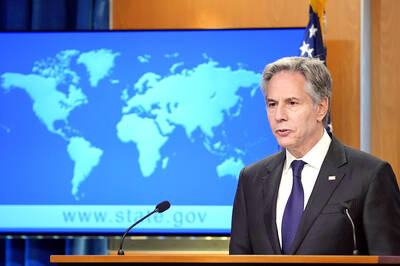
Beijing is continuing to commit genocide and crimes against humanity against Uyghurs and other Muslim minorities in its western Xinjiang province, U.S. Secretary of State Antony Blinken said in a report published on Monday, ahead of his planned visit to China this week. The State Department’s annual human rights report, which documents abuses recorded all over the world during the previous calendar year, repeated language from previous years on the treatment of Muslims in Xinjiang, but the publication raises the issue ahead of delicate talks, including on the war in Ukraine and global trade, between the top U.S. diplomat and Chinese


 RSS
RSS