


A polio outbreak that spread rapidly through Indonesia after a decade-long absence, crippling hundreds of children, has exposed weaknesses in the sprawling archipelago's long-neglected health care system, experts said yesterday.
Hampered by chronic funding shortages and chaotic decentralization efforts, local health clinics in the poorest parts of the country have been forced to scale back their operations, limiting the amount of time and money they spend on community outreach, health education and routine immunization programs.
As a result, experts say about 239 children under 5 have been infected by polio since March and cases of measles have increased tenfold since 2000.
Indonesia also saw its worst-ever dengue fever outbreak last year and there are fears bird flu, which has already killed six people nationwide, could mutate into a form that spreads easily among humans -- possibly triggering a global pandemic.
"The context for these events is a primary health care system that has suffered from a decrease in resources and is struggling to manage the expectations placed on it by the newly decentralized health systems," UNICEF's David Hipgrave said.
"What we're seeing is major inconsistencies between the rich and poor provinces," he said.
It was not always this way.
During the 32-year dictatorship of Suharto, the health system, like much of government, was highly centralized and services reached all the way down to the village level. Polio was eradicated in 1995 and key indicators like child malnutrition and poverty rates fell.
A key component was volunteer outreach efforts like the Family Education Program, where the wives of government officials would make the rounds to talk to mothers about nutrition and sanitation, while reminding them about national immunization days.
That program, like almost all others linked to Suharto, was abandoned after his ouster in 1998.
A radical decentralization program that was introduced in 2001 has added to the country's health care woes.
Almost overnight, the government handed control of public services to regional and local authorities. But their roles were often unclear, experts say, funding was inadequate and priorities left to the whims of inexperienced governments, mayors and village heads. The result, WHO and Ministry of Health officials say, is that immunization rates dropped in certain poor communities and services -- like monitoring the weight of babies or providing poor families with mosquito nets -- all but disappeared.
"We'd provide the needles and vaccines for immunization but some districts wouldn't have enough money for operations," said Jane Soepardi, who oversees immunizations at the Ministry of Health. "They could reach nearby areas but left out remote areas. So you'd find mothers who don't even know about immunization."
Money, too, remains a problem.
According to latest figures from the UN, Indonesia's public health spending in 2002 accounted for 1.2 percent of gross domestic product -- among the lowest in Asia. In contrast, impoverished East Timor spent 6.2 percent, Thailand 3.1 percent and Malaysia 2 percent.
And so when polio re-emerged in Indonesia -- likely by way of a migrant from the Middle East or Africa -- it took hold in overly poor, rural communities where entire villages were vulnerable having missed out on immunizations. "It was able to paralyze many, many kids," said Arun Thapa, the WHO Southeast Asia regional adviser.

Republican US lawmakers on Friday criticized US President Joe Biden’s administration after sanctioned Chinese telecoms equipment giant Huawei unveiled a laptop this week powered by an Intel artificial intelligence (AI) chip. The US placed Huawei on a trade restriction list in 2019 for contravening Iran sanctions, part of a broader effort to hobble Beijing’s technological advances. Placement on the list means the company’s suppliers have to seek a special, difficult-to-obtain license before shipping to it. One such license, issued by then-US president Donald Trump’s administration, has allowed Intel to ship central processors to Huawei for use in laptops since 2020. China hardliners
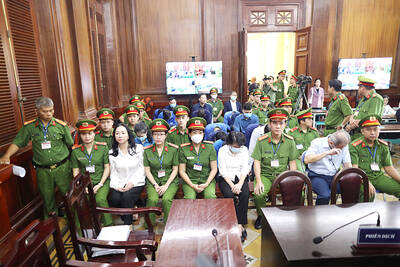
A top Vietnamese property tycoon was on Thursday sentenced to death in one of the biggest corruption cases in history, with an estimated US$27 billion in damages. A panel of three hand-picked jurors and two judges rejected all defense arguments by Truong My Lan, chair of major developer Van Thinh Phat, who was found guilty of swindling cash from Saigon Commercial Bank (SCB) over a decade. “The defendant’s actions ... eroded people’s trust in the leadership of the [Communist] Party and state,” read the verdict at the trial in Ho Chi Minh City. After the five-week trial, 85 others were also sentenced on

DISADVANTAGE: Erin O’Toole, who led the Conservatives during the election campaign in 2021, estimated that the interference cost his party as many as nine legislative seats Canada’s domestic spy agency on Monday concluded that China interfered in the past two elections, an official probe heard, the firmest evidence so far of suspected Chinese meddling in Canadian politics. Canadian Prime Minister Justin Trudeau’s Liberal Party won both the elections, held in 2019 and 2021. Under pressure from opposition lawmakers unhappy about media reports on China’s possible role, Trudeau set up a commission into foreign interference. The commission was shown a slide on Monday containing an extract of a briefing in February last year from the Canadian Security Intelligence Service (CSIS). “We know that the PRC [People’s Republic of China] clandestinely

‘DELUSIONAL’: Targeting the families of Hamas’ leaders would not push the group to change its position or to give up its demands for Palestinians, Ismail Haniyeh said Israeli aircraft on Wednesday killed three sons of Hamas’ top political leader in the Gaza Strip, striking high-stakes targets at a time when Israel is holding delicate ceasefire negotiations with the militant group. Hamas said four of the leader’s grandchildren were also killed. Ismail Haniyeh’s sons are among the highest-profile figures to be killed in the war so far. Israel said they were Hamas operatives, and Haniyeh accused Israel of acting in “the spirit of revenge and murder.” The deaths threatened to strain the internationally mediated ceasefire talks, which appeared to gain steam in recent days even as the sides remain far


 RSS
RSS