


Muslim terrorist suspects and others jailed without trial in Malaysia are treated as "less than human" at a notorious prison camp, where one inmate recounted being beaten, stripped naked and forced to crawl while being kicked on the buttocks, international watchdog Human Rights Watch says.
In a report that was released last Wednesday, the New York-based group called on the Malaysian government to repeal the Internal Security Act, which allows authorities to detain individuals indefinitely without charge, calling it a "recipe for abuse."
Instead, Malaysia should rely on its "robust criminal law and capable judiciary" to tackle security, said the report, based on handwritten statements from the detainees, and interviews with their family and lawyers.

PHOTO: AP
Sign of repression
"Malaysia aspires to be a leader in the region and a developed country by 2020," said Brad Adams, executive director of Human Rights Watch's Asia Division. "The ISA is not a sign of leadership or development, it is a sign of repression."
Malaysia rejected the criticism, and said even Britain and the US are tightening anti-terror laws to copy the ISA.
The rights group's report documents the stories of more than 25 detainees in Kamunting Detention Center, a compound of wooden and concrete buildings surrounded by a 4m-high fence topped by barbed wire, 250km north of Kuala Lumpur.
Al-qaeda-linked
Most of the 112 people currently detained there are alleged members of al-Qaeda-linked terrorist group Jemaah Islamiyah and another alleged militant organization, Kampulan Mujahideen Malaysia, who were arrested in a crackdown launched four years ago. None has been charged or tried.
"Those held under the ISA are defined as a group that has virtually no rights, so it is hardly surprising that prison guards treat them as less than human," Adams said.
The report cited the case of Mohamad Faiq bin Hafidh, who has been detained since January 2002.
No effective recourse
Describing the events of Dec. 8 and 9, 2004 to Human Rights Watch, Mohamad wrote: "I was handcuffed ... and my head was pushed down to waist level. My head was struck with a baton ... I was continuously beaten and then forced to strip naked, ordered to crawl while entering the room and then my buttocks were kicked and that was how I stumbled inside, naked."
The report said that ISA detainees have no effective recourse to challenge their detention because the law prevents the courts from reviewing the merits of ISA detentions.
Human Rights Watch said that even long-term critics of the ISA, notably the US, have been silent on its use since the Sept. 11, 2001 attacks in New York and Washington, DC.
Zainal Abidin, a ministerial ranking official in the Malaysian Foreign Ministry, said that strong laws are needed in the post-Sept. 11 climate.
ISA is "still very relevant to Malaysia especially in the face of the global threat of terrorism. Even other countries like the US and Britain are beginning to copy our ISA," he told reporters.
He declined to address specific allegations of abuse of prisoners.
"Our ministers and deputy ministers visit the camp from time to time to look into any complaints," Zainal said. "I don't think there is any abuse."

Republican US lawmakers on Friday criticized US President Joe Biden’s administration after sanctioned Chinese telecoms equipment giant Huawei unveiled a laptop this week powered by an Intel artificial intelligence (AI) chip. The US placed Huawei on a trade restriction list in 2019 for contravening Iran sanctions, part of a broader effort to hobble Beijing’s technological advances. Placement on the list means the company’s suppliers have to seek a special, difficult-to-obtain license before shipping to it. One such license, issued by then-US president Donald Trump’s administration, has allowed Intel to ship central processors to Huawei for use in laptops since 2020. China hardliners
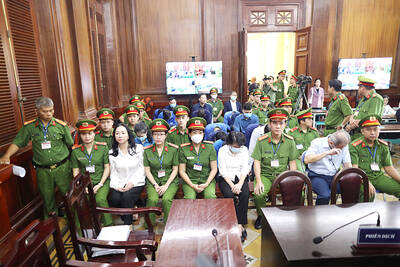
A top Vietnamese property tycoon was on Thursday sentenced to death in one of the biggest corruption cases in history, with an estimated US$27 billion in damages. A panel of three hand-picked jurors and two judges rejected all defense arguments by Truong My Lan, chair of major developer Van Thinh Phat, who was found guilty of swindling cash from Saigon Commercial Bank (SCB) over a decade. “The defendant’s actions ... eroded people’s trust in the leadership of the [Communist] Party and state,” read the verdict at the trial in Ho Chi Minh City. After the five-week trial, 85 others were also sentenced on

Conjoined twins Lori and George Schappell, who pursued separate careers, interests and relationships during lives that defied medical expectations, died this month in Pennsylvania, funeral home officials said. They were 62. The twins, listed by Guinness World Records as the oldest living conjoined twins, died on April 7 at the Hospital of the University of Pennsylvania, obituaries posted by Leibensperger Funeral Homes of Hamburg said. The cause of death was not detailed. “When we were born, the doctors didn’t think we’d make 30, but we proved them wrong,” Lori said in an interview when they turned 50, the Philadelphia Inquirer reported. The
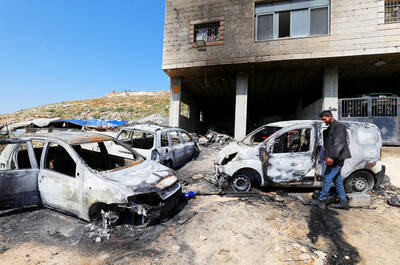
RAMPAGE: A Palestinian man was left dead after dozens of Israeli settlers searching for a missing 14-year-old boy stormed a village in the Israeli-occupied West Bank US President Joe Biden on Friday said he expected Iran to attack Israel “sooner, rather than later” and warned Tehran not to proceed. Asked by reporters about his message to Iran, Biden simply said: “Don’t,” underscoring Washington’s commitment to defend Israel. “We are devoted to the defense of Israel. We will support Israel. We will help defend Israel and Iran will not succeed,” he said. Biden said he would not divulge secure information, but said his expectation was that an attack could come “sooner, rather than later.” Israel braced on Friday for an attack by Iran or its proxies as warnings grew of


 RSS
RSS