


The bodies of more than 40 mostly elderly patients were found in a flooded-out hospital in the biggest known cluster of corpses to be discovered so far in hurricane-ravaged New Orleans.
The exact circumstances under which they died were unclear, with at least one hospital official saying on Monday that at least a few of the patients were dead before the storm, and another saying the rising temperature in the hospital afterward likely contributed to some of the deaths.
The announcement, which raised Louisiana's official death toll to nearly 280, came as US President George W. Bush got his first up-close look at the destruction in New Orleans and the embattled director of the Federal Emergency Management Agency (FEMA), Michael Brown, resigned after being recalled to Washington amid criticism of the federal response to Hurricane Katrina.

PHOTO: EPA
In an apparent nod to demands that Brown be replaced by someone with experience in emergency response, Bush replaced Brown with David Paulison, a veteran firefighter who now runs FEMA's preparedness division.
Paulison was also the Homeland Security official who urged Americans to stock up on duct tape and plastic sheeting in 2003 to protect against a biological or chemical attack, a recommendation that was widely ridiculed in the media.
Bush rode through New Orleans in an open truck with the governor and mayor, ducking under low-hanging tree limbs and electrical wires.
"My impression of New Orleans is this: That there is a recovery on the way," Bush said.
Despite kilometers of still-flooded streets, there were encouraging signs of recovery: Nearly two-thirds of southeastern Louisiana's water-treatment plants were up and running. Louis Armstrong New Orleans International Airport planned to resume limited passenger service yesterday. Forty-one of 174 permanent pumps were in operation, on pace to help drain the still half-flooded city by Oct. 8.
But that doesn't mean a quick return to normalcy for residents or for business owners, who were let back in on Monday to assess the damage and begin the slow process of starting over.
It will be at least three months before New Orleans' public water system is fully operational, said Sergeant John Zeller, a California National Guard engineer.
Some homes have running water now, but it's mostly untreated Mississippi River water -- for anyone wanting a bath, "It's like jumping in the river right now," he said.
Others will find their homes aren't even livable.
The death toll has also been rising as more bodies are recovered across the region.
At least 40 bodies were found on Sunday at the 317-bed Memorial Medical Center, but the exact number was unclear. Bob Johannesen, a spokesman for the state Department of Health and Hospitals, said 45 patients had been found; hospital assistant administrator David Goodson said there were 44, plus three on the grounds.
Also unclear was exactly how the patients died.
Steven Campanini, a spokesman for the hospital's owner, Tenet Healthcare Corp, said that some of the patients were dead before the storm arrived, and none of the deaths resulted from lack of food, water or electricity to power medical equipment. He said many had been seriously ill.
Goodson said that patients died while waiting to be evacuated over the four days after the hurricane hit, as temperatures inside the hospital reached 41?C.
"I would suggest that that had a lot to do with" the deaths, he said of the heat.

Republican US lawmakers on Friday criticized US President Joe Biden’s administration after sanctioned Chinese telecoms equipment giant Huawei unveiled a laptop this week powered by an Intel artificial intelligence (AI) chip. The US placed Huawei on a trade restriction list in 2019 for contravening Iran sanctions, part of a broader effort to hobble Beijing’s technological advances. Placement on the list means the company’s suppliers have to seek a special, difficult-to-obtain license before shipping to it. One such license, issued by then-US president Donald Trump’s administration, has allowed Intel to ship central processors to Huawei for use in laptops since 2020. China hardliners
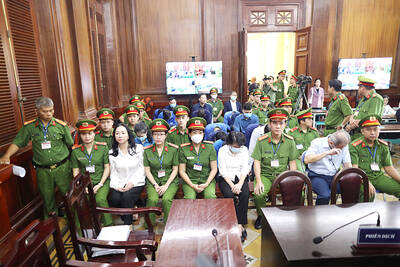
A top Vietnamese property tycoon was on Thursday sentenced to death in one of the biggest corruption cases in history, with an estimated US$27 billion in damages. A panel of three hand-picked jurors and two judges rejected all defense arguments by Truong My Lan, chair of major developer Van Thinh Phat, who was found guilty of swindling cash from Saigon Commercial Bank (SCB) over a decade. “The defendant’s actions ... eroded people’s trust in the leadership of the [Communist] Party and state,” read the verdict at the trial in Ho Chi Minh City. After the five-week trial, 85 others were also sentenced on

‘DELUSIONAL’: Targeting the families of Hamas’ leaders would not push the group to change its position or to give up its demands for Palestinians, Ismail Haniyeh said Israeli aircraft on Wednesday killed three sons of Hamas’ top political leader in the Gaza Strip, striking high-stakes targets at a time when Israel is holding delicate ceasefire negotiations with the militant group. Hamas said four of the leader’s grandchildren were also killed. Ismail Haniyeh’s sons are among the highest-profile figures to be killed in the war so far. Israel said they were Hamas operatives, and Haniyeh accused Israel of acting in “the spirit of revenge and murder.” The deaths threatened to strain the internationally mediated ceasefire talks, which appeared to gain steam in recent days even as the sides remain far
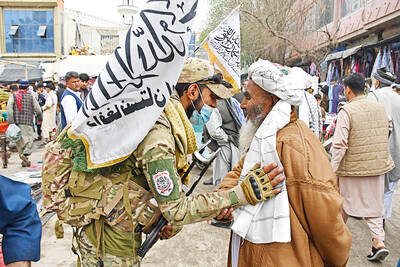
The Taliban’s reclusive supreme leader made a rare public appearance yesterday, an Afghan government spokesman said, leading thousands of worshipers in prayers marking Eid al-Fitr. Hibatullah Akhundzada has made only a handful of public appearances since inheriting the leadership of the Taliban in 2016 and leading the movement back to power with the withdrawal of US forces in 2021. Taliban government spokesman Zabihullah Mujahid said prayer in the largest mosque in Kandahar was “performed under the leadership of the supreme leader.” In a statement on X, he said the early-morning service “was attended by thousands of compatriots” in the southern province considered the


 RSS
RSS