


Northern Europe, Australia and New Zealand lead the world's 21 richest nations in a measure of development aid that factors policies on trade, the environment and immigration alongside amounts of aid provided.
Denmark topped the list, as it has since the first "Commitment to Development Index" was computed in 2003.
"Still, even number one Denmark scores only about average ... in four of seven policy areas," wrote David Roodman, the survey's director. "All countries could do much more to spread global prosperity."
After Denmark, the top four in order were the Netherlands, Sweden and Australia. Norway and New Zealand tied for fifth. The US, the largest aid donor in dollars but far below several other countries in per capita giving and other measures, was listed 12th.
The index, published by the Center for Global Development advocacy group with Foreign Policy magazine, ranks the countries "based on their dedication to policies that benefit the 5 billion people living in poorer nations worldwide," the center's Web site says. It grades countries on the basis of government policies, rewarding those judged to improve prospects of poor countries and punishing those that do not.
On basic aid, for instance, it rewards countries that let taxpayers write off charitable contributions on the assumption that some of the contributions would go to international development charities such as Oxfam or CARE. It punishes countries that write contracts for their cash aid to require the recipient to spend it for goods or services in the giver's country.
"The differences between countries in raw aid quantity are dramatic, and as a result they heavily influence the overall aid scores," Roodman wrote. "But quality matters, too. Denmark earns its big lead on aid by eschewing small projects."
The US would score higher, he said, if it did not tie 70 percent of its aid to US spending and "gave less to autocrats in Russia, Jordan, Pakistan and other countries."
Peter Toumanoff of the Institute of Global Economic Affairs at Marquette University said the validity of such surveys depends on the weight given to each element being measured. Also, he said, "I guess the biggest problem with trying to measure the effectiveness of aid, or even an aid project, is that the only thing it measures is inputs, not outcomes."
In addition to the quantity and quality of aid, the commitment index grades countries on openness to imports from poor countries; policies that influence investment in poor countries; migration, environmental and security policies; and support for the spread of new technologies.
Of the elements judged, the US did poorest in aid, 1.9, and did best in trade, 7.2. Its average was 5.0, the average for the group.
Among its poorest figures was 4.0 for environment. The only country that did worse was Japan.
"Britain and Germany top the environment standings, in no small part because they cut their greenhouse gas emissions by 10 percent during 1993-2003," Roodman wrote.
"Japan finishes last as a heavy subsidizer of its fishing industry and a big importer of tropical timber," hardwood harvested largely in violation of laws in developing countries.
Japan also lost points for being the only holdout of the 21 except for landlocked Switzerland against the UN Fisheries Agreement to limit overfishing in international waters.
"The US ratified that agreement but not the Kyoto Protocol, the most serious international effort yet to deal with climate change," Roodman wrote.

Republican US lawmakers on Friday criticized US President Joe Biden’s administration after sanctioned Chinese telecoms equipment giant Huawei unveiled a laptop this week powered by an Intel artificial intelligence (AI) chip. The US placed Huawei on a trade restriction list in 2019 for contravening Iran sanctions, part of a broader effort to hobble Beijing’s technological advances. Placement on the list means the company’s suppliers have to seek a special, difficult-to-obtain license before shipping to it. One such license, issued by then-US president Donald Trump’s administration, has allowed Intel to ship central processors to Huawei for use in laptops since 2020. China hardliners
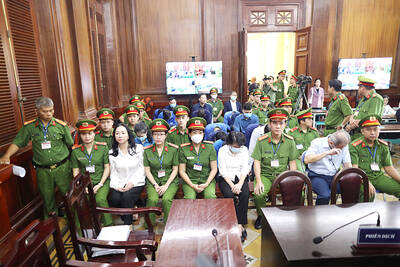
A top Vietnamese property tycoon was on Thursday sentenced to death in one of the biggest corruption cases in history, with an estimated US$27 billion in damages. A panel of three hand-picked jurors and two judges rejected all defense arguments by Truong My Lan, chair of major developer Van Thinh Phat, who was found guilty of swindling cash from Saigon Commercial Bank (SCB) over a decade. “The defendant’s actions ... eroded people’s trust in the leadership of the [Communist] Party and state,” read the verdict at the trial in Ho Chi Minh City. After the five-week trial, 85 others were also sentenced on

Conjoined twins Lori and George Schappell, who pursued separate careers, interests and relationships during lives that defied medical expectations, died this month in Pennsylvania, funeral home officials said. They were 62. The twins, listed by Guinness World Records as the oldest living conjoined twins, died on April 7 at the Hospital of the University of Pennsylvania, obituaries posted by Leibensperger Funeral Homes of Hamburg said. The cause of death was not detailed. “When we were born, the doctors didn’t think we’d make 30, but we proved them wrong,” Lori said in an interview when they turned 50, the Philadelphia Inquirer reported. The
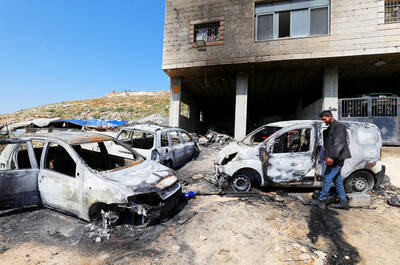
RAMPAGE: A Palestinian man was left dead after dozens of Israeli settlers searching for a missing 14-year-old boy stormed a village in the Israeli-occupied West Bank US President Joe Biden on Friday said he expected Iran to attack Israel “sooner, rather than later” and warned Tehran not to proceed. Asked by reporters about his message to Iran, Biden simply said: “Don’t,” underscoring Washington’s commitment to defend Israel. “We are devoted to the defense of Israel. We will support Israel. We will help defend Israel and Iran will not succeed,” he said. Biden said he would not divulge secure information, but said his expectation was that an attack could come “sooner, rather than later.” Israel braced on Friday for an attack by Iran or its proxies as warnings grew of


 RSS
RSS