


Al-Qaeda's Southeast Asian ally is sharing bomb-making expertise with Muslim militants in the Philippines, providing at least nine explosive designs and eight chemical recipes to help ragtag insurgents become more lethal, according to government reports.
The results: 116 people killed in the country's worst terror attack, a series of high-tech explosions and close cooperation among local and foreign militants using the southern Philippines as a training ground following the loss of al-Qaeda camps in Afghanistan.
While US-backed offensives have overrun established camps in the Mindanao region in the last couple of years, training by al-Qaeda-linked Jemaah Islamiyah's Indonesian operatives has continued on a limited basis with militants setting up classes and plotting attacks, police and military intelligence officers say.
`Terrorist academy'
One Philippine security official said Mindanao in the southern part of the country "is like a terrorist academy" with trainees taught how to make bombs, plant them, then set them off in test missions designed to help militants perfect their techniques to complete the course.
Jemaah Islamiyah militants appear to be continuously testing new designs and explosives mixtures, said officials, who spoke on condition of anonymity because of the secretive nature of the information. Previously, many Philippine militants, especially Abu Sayyaf rebels, had relied on simple hand and rocket-propelled grenades to attack civilian targets.
Investigators looking into Sunday's bombing of a passenger ferry while it was boarding on Basilan island, injuring 30 people, said it appeared to be designed more to sow panic than kill, but that it was too early to speculate on the design.
A number of recent bombs -- pieced together from fragments found at attack sites or recovered from Philippine rebel hideouts -- carry Jemaah Islamiyah's signature: the use of electronics, including Indonesian-designed integrated circuit boards, and cellphones that allow more efficiency and flexibility as triggers, according to several investigation reports.
Making detection difficult, the attackers use mundane items -- a TV set, egg cartons, a tin of cookies, even a tube of toothpaste, a roll-on deodorant or shampoo bottle -- to hide the bombs and their components.
Technology transfer
More powerful chemical mixtures not used before by local militants also have been detected at bombing scenes in recent years, the reports said.
The new mixtures give the militants more leeway in attaining a particular effect. Some spark fires to scare extortion targets; others are designed to kill and destroy.
Authorities said they have detected evidence of al-Qaeda and Jemaah Islamiyah "training and technology transfer" in bomb devices for the past four or five years.
Such international cooperation and terror technology exchanges is not entirely new.
When police in 1995 raided the Manila apartment of Ramzi Yousef, the convicted mastermind of the 1993 bombing of the World Trade Center in New York, they found several juice bottles filled with the same powerful explosives used in that attack and a brand of quartz alarm clock later used in a bombing in Iraq.
Bomb experts
Most of the bombs used in attacks in the Philippines and Indonesia are believed to have been designed by Jemaah Islamiyah's top experts, including Pitono, a Bali bombing suspect and electronics expert also known as Dulmatin, the reports said.
Philippine authorities have detected mostly cellphone-triggered explosives while poring over bloody scenes of attacks by the Abu Sayyaf and the Moro Islamic Liberation Front in the last five years, according to investigation reports.
The Indonesians also have passed on the formulas of at least eight powerful explosive chemical mixtures, the reports said, and authorities in both countries have found identical bombs rigged the same way in the metal frames of two strikingly similar bicycles.
Local militants -- many young peasants with limited schooling -- appear to be struggling with the new technology.
Blunders have fouled up some attacks, including a homemade bomb that prematurely exploded in a backpack two years ago, killing the rebel toting it.
Filipino militants have not yet undertaken suicide missions, although there is evidence that they have acquired knowledge to make body-worn explosives and truck and car bombs. Car bombs used in an attack at Manila's airport in December 2000 and an airport in southern Cotabato city in February 2003 appear to have been set off by timers, security officials said.
`Baby al-Qaedas'
"We call them `baby al-Qaedas,'" said Ric Blancaflor, executive director of the government's anti-terrorist task force. "We have no reason to believe that they are already experts."
A 5kg TNT firebomb crammed in a TV set that went off on a passenger ferry in Manila Bay last year, killing 116 people in the Philippines' worst terror attack, employed a Jemaah Islamiyah bomb design that could be set off by an alarm clock or a cellphone.
The clock was set to trigger the bomb in seven hours but it went off sooner, leading investigators to believe that a cellphone was used to trigger the blast, the reports said.
Philippine authorities arrested and charged the suspected attacker -- Habil Dellosa, a Filipino Muslim convert who authorities say is an Abu Sayyaf member trained by Indonesian militants.
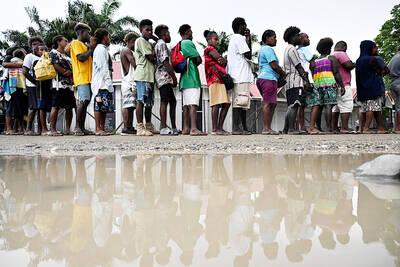
SEEKING CHANGE: A hospital worker said she did not vote in previous elections, but ‘now I can see that maybe my vote can change the system and the country’ Voting closed yesterday across the Solomon Islands in the south Pacific nation’s first general election since the government switched diplomatic allegiance from Taiwan to Beijing and struck a secret security pact that has raised fears of the Chinese navy gaining a foothold in the region. The Solomon Islands’ closer relationship with China and a troubled domestic economy weighed on voters’ minds as they cast their ballots. As many as 420,000 registered voters had their say across 50 national seats. For the first time, the national vote also coincided with elections for eight of the 10 local governments. Esther Maeluma cast her vote in the
Nearly half of China’s major cities are suffering “moderate to severe” levels of subsidence, putting millions of people at risk of flooding, especially as sea levels rise, according to a study of nationwide satellite data released yesterday. The authors of the paper, published by the journal Science, found that 45 percent of China’s urban land was sinking faster than 3mm per year, with 16 percent at more than 10mm per year, driven not only by declining water tables, but also the sheer weight of the built environment. With China’s urban population already in excess of 900 million people, “even a small portion

UNSETTLING IMAGES: The scene took place in front of TV crews covering the Trump trial, with a CNN anchor calling it an ‘emotional and unbelievably disturbing moment’ A man who doused himself in an accelerant and set himself on fire outside the courthouse where former US president Donald Trump is on trial has died, police said yesterday. The New York City Police Department (NYPD) said the man was declared dead by staff at an area hospital. The man was in Collect Pond Park at about 1:30pm on Friday when he took out pamphlets espousing conspiracy theories, tossed them around, then doused himself in an accelerant and set himself on fire, officials and witnesses said. A large number of police officers were nearby when it happened. Some officers and bystanders rushed

HYPOCRISY? The Chinese Ministry of Foreign Affairs yesterday asked whether Biden was talking about China or the US when he used the word ‘xenophobic’ US President Joe Biden on Wednesday called for a hike in steel tariffs on China, accusing Beijing of cheating as he spoke at a campaign event in Pennsylvania. Biden accused China of xenophobia, too, in a speech to union members in Pittsburgh. “They’re not competing, they’re cheating. They’re cheating and we’ve seen the damage here in America,” Biden said. Chinese steel companies “don’t need to worry about making a profit because the Chinese government is subsidizing them so heavily,” he said. Biden said he had called for the US Trade Representative to triple the tariff rates for Chinese steel and aluminum if Beijing was


 RSS
RSS