


Chinese President Hu Jintao (
They urged President George W. Bush to raise with Hu an array of human rights concerns in China, such as lack of religious and media freedom, political crackdown in Tibet, forced repatriation of North Korean refugees and bloody suppression of protests over rising social problems in the countryside.
Immediately after Washington announced last week that Bush would meet Hu on September 7, Amnesty International sought and secured police permission to hold protests outside the White House during the summit talks.
"As the only superpower, the United States has a duty and responsibility to raise this very important issue of human rights in China," said T. Kumar, Amnesty's director of advocacy in Washington.
Bush should press from Hu a "timetable with specific benchmarks" for improvement on human rights in China in the run up to the Olympics in Beijing in 2008, he said.
Among Amnesty's key concerns was the whereabout of a boy picked by the Dalai Lama as the second-highest figure in Tibetan Buddhism and missing since 1995, Kumar said.
Gedhun Choekyi Nyima has not been seen since he disappeared as a six-year-old and is reportedly put under house arrest by China. Beijing denies he is under detention but refuses to reveal his whereabouts.
Kumar also said the political crackdown in Tibet and the Xinjiang Uighur Autonomous Region had led to "arbitrary detention and imprisonment, incommunicado detention, unfair trials, and sweeping restrictions on religious, cultural and social rights."
Human Rights Watch, a US-based rights group, said that civil liberties had taken a heavy blow despite China's rapid economic progress.
There is increasing pressure from Beijing on Web sites and newspapers and so-called petitioners' movements highlighting problems among the poor, said Sam Zarifi, deputy director of Human Rights Watch's Asia Division.
"Mr Hu's visit is a chance for the US to indicate whether it is going to really raise human rights issues with China or whether China is simply too important of an economic player for the US to hold to the same position in terms of support for human rights that it does in other countries," he said.
Hu has been warning that large-scale protests and riots, which have become common among Chinese frustrated over land seizures, evictions, poor working conditions, graft and environmental damage, would not be tolerated, Zarifi said.
Human rights is a key stumbling bloc in US-China ties.
President Bush began his second term at the White House earlier this year with a tough inauguration speech, pledging to overthrow tyranny and spread freedom and democracy to the "darkest corners" of the world.
But analysts say Bush cannot act tough with China at a time when he was banking heavily on Beijing to help end North Korea's nuclear weapons drive and back his "war on terror."
Many however believe that Bush, whose key constituency is the Christian right, would be compelled to raise the question over the lack of religious freedom in China.

Republican US lawmakers on Friday criticized US President Joe Biden’s administration after sanctioned Chinese telecoms equipment giant Huawei unveiled a laptop this week powered by an Intel artificial intelligence (AI) chip. The US placed Huawei on a trade restriction list in 2019 for contravening Iran sanctions, part of a broader effort to hobble Beijing’s technological advances. Placement on the list means the company’s suppliers have to seek a special, difficult-to-obtain license before shipping to it. One such license, issued by then-US president Donald Trump’s administration, has allowed Intel to ship central processors to Huawei for use in laptops since 2020. China hardliners
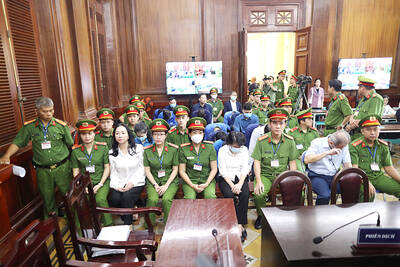
A top Vietnamese property tycoon was on Thursday sentenced to death in one of the biggest corruption cases in history, with an estimated US$27 billion in damages. A panel of three hand-picked jurors and two judges rejected all defense arguments by Truong My Lan, chair of major developer Van Thinh Phat, who was found guilty of swindling cash from Saigon Commercial Bank (SCB) over a decade. “The defendant’s actions ... eroded people’s trust in the leadership of the [Communist] Party and state,” read the verdict at the trial in Ho Chi Minh City. After the five-week trial, 85 others were also sentenced on

‘DELUSIONAL’: Targeting the families of Hamas’ leaders would not push the group to change its position or to give up its demands for Palestinians, Ismail Haniyeh said Israeli aircraft on Wednesday killed three sons of Hamas’ top political leader in the Gaza Strip, striking high-stakes targets at a time when Israel is holding delicate ceasefire negotiations with the militant group. Hamas said four of the leader’s grandchildren were also killed. Ismail Haniyeh’s sons are among the highest-profile figures to be killed in the war so far. Israel said they were Hamas operatives, and Haniyeh accused Israel of acting in “the spirit of revenge and murder.” The deaths threatened to strain the internationally mediated ceasefire talks, which appeared to gain steam in recent days even as the sides remain far
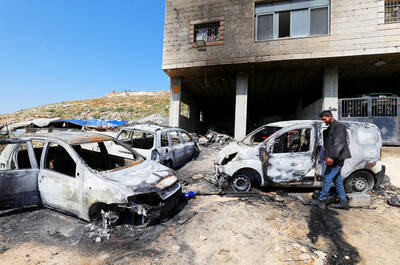
RAMPAGE: A Palestinian man was left dead after dozens of Israeli settlers searching for a missing 14-year-old boy stormed a village in the Israeli-occupied West Bank US President Joe Biden on Friday said he expected Iran to attack Israel “sooner, rather than later” and warned Tehran not to proceed. Asked by reporters about his message to Iran, Biden simply said: “Don’t,” underscoring Washington’s commitment to defend Israel. “We are devoted to the defense of Israel. We will support Israel. We will help defend Israel and Iran will not succeed,” he said. Biden said he would not divulge secure information, but said his expectation was that an attack could come “sooner, rather than later.” Israel braced on Friday for an attack by Iran or its proxies as warnings grew of


 RSS
RSS