


A radical Shiite cleric called on his followers yesterday to end clashes with Shiite rivals so that stalled talks on a new constitution can proceed. Clashes continued for a second day after the cleric's office in Najaf was burned and four of his supporters were killed.
Following the appeal by cleric Muqtada al-Sadr, leaders of the country's political factions met in Baghdad's Green Zone to try to hammer out an agreement on the draft constitution on the final day of an extension granted on Monday night by parliament after Sunni Arabs blocked a vote on the accord accepted by Shiite and Kurdish negotiators.
However, negotiators involved in drafting the constitution warned that the eruption of violence between rival militia groups in Shiite-dominated parts of southern Iraq could affect the parliament vote.
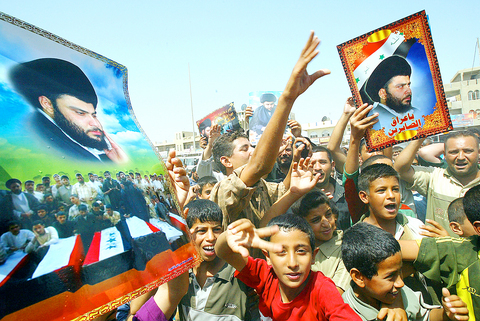
PHOTO: AFP
Seven people have been killed and dozens wounded since late Wednesday when supporters of al-Sadr clashed with the rival Supreme Council for the Islamic Revolution in Iraq (SCIRI), a powerful Shiite party led by Abdel Aziz al-Hakim.
"The Shiite clashes have come at an awkward time. It threatens today's constitutional approval as 22 MPs [members of parliament] and two Cabinet ministers are close to Sadr and if they do not vote it will be a tough call," said Kurdish constitution committee member Mahmud Othman.
"We need to unite and maintain peace as this incident can divert Iraq from the constitution to violence," President Jalal Talabani told Sadr, according to a statement from his office.

PHOTO: AP
Sadr himself, who launched two uprisings last year against US forces which left hundreds of US soldiers and his militants dead and is now a critic of the current draft constitution, appealed for calm.
"I call upon the people of Iraq ... the believers ... to preserve Muslim blood and go back home. I call upon them to maintain calm," he told reporters.
Clashes flared in Baghdad and several southern cities after fighting between Sadr's Mehdi army and the SCIRI militia Badr in Najaf killed five people on Wednesday.
The violence erupted after traders in the old city of Najaf, which houses the revered Imam Ali shrine, demonstrated against Sadr supporters who were attempting to reopen their local office which was shut down after last year's uprising. The office was gutted in Wednesday's clashes.
Within hours violence spread to Baghdad and other southern cities, including Nasiriyah and Diwaniyah where two men were killed and many wounded overnight.
In Baghdad, the Mehdi army took control of Shiite stronghold of Sadr City. Though unarmed, militiamen were seen moving on the streets with no sign of Iraqi security forces.
"The security situation has raised doubts as Sadr has always maintained that he will not agree to any constitution under the American occupation and he is also against federalism," Othman said.
Although Sadr's movement officially boycotted January's historic elections, it has about two dozen sympathizers in parliament, mostly within the ranks of the dominant Shiite United Iraqi Alliance.
The Sunni Arabs maintained their opposition to the draft charter. The charter -- which the government hopes will help stem the bloody Sunni-led insurgency -- was presented incomplete Monday with unresolved differences over crucial issues such as federalism, the role of Islam and sharing of oil wealth.
But Sunnis warned that even if the charter wins parliamentary approval, it would fail in a referendum due in October, ahead of elections in December.
The constitution fails if two-third people of any three provinces vote against it. The Sunnis are majority in Al-Anbar, Nineveh and Salaheddin.
Nearly half of China’s major cities are suffering “moderate to severe” levels of subsidence, putting millions of people at risk of flooding, especially as sea levels rise, according to a study of nationwide satellite data released yesterday. The authors of the paper, published by the journal Science, found that 45 percent of China’s urban land was sinking faster than 3mm per year, with 16 percent at more than 10mm per year, driven not only by declining water tables, but also the sheer weight of the built environment. With China’s urban population already in excess of 900 million people, “even a small portion

UNSETTLING IMAGES: The scene took place in front of TV crews covering the Trump trial, with a CNN anchor calling it an ‘emotional and unbelievably disturbing moment’ A man who doused himself in an accelerant and set himself on fire outside the courthouse where former US president Donald Trump is on trial has died, police said yesterday. The New York City Police Department (NYPD) said the man was declared dead by staff at an area hospital. The man was in Collect Pond Park at about 1:30pm on Friday when he took out pamphlets espousing conspiracy theories, tossed them around, then doused himself in an accelerant and set himself on fire, officials and witnesses said. A large number of police officers were nearby when it happened. Some officers and bystanders rushed

HYPOCRISY? The Chinese Ministry of Foreign Affairs yesterday asked whether Biden was talking about China or the US when he used the word ‘xenophobic’ US President Joe Biden on Wednesday called for a hike in steel tariffs on China, accusing Beijing of cheating as he spoke at a campaign event in Pennsylvania. Biden accused China of xenophobia, too, in a speech to union members in Pittsburgh. “They’re not competing, they’re cheating. They’re cheating and we’ve seen the damage here in America,” Biden said. Chinese steel companies “don’t need to worry about making a profit because the Chinese government is subsidizing them so heavily,” he said. Biden said he had called for the US Trade Representative to triple the tariff rates for Chinese steel and aluminum if Beijing was

Beijing is continuing to commit genocide and crimes against humanity against Uyghurs and other Muslim minorities in its western Xinjiang province, U.S. Secretary of State Antony Blinken said in a report published on Monday, ahead of his planned visit to China this week. The State Department’s annual human rights report, which documents abuses recorded all over the world during the previous calendar year, repeated language from previous years on the treatment of Muslims in Xinjiang, but the publication raises the issue ahead of delicate talks, including on the war in Ukraine and global trade, between the top U.S. diplomat and Chinese


 RSS
RSS