


France could face its worst period of social unrest for a decade, analysts and commentators warned, as Dominique de Villepin's center-right government returned yesterday from its summer break.
With gasoline prices soaring, economic growth hesitant, trade unions furious, public confidence in the country and its political leaders at rock-bottom and a string of unpopular reforms still lying ahead, conditions are ripe for what one analyst, Gerard Mermet, called "genuine social upheaval."
The first Cabinet meeting of the new political year will be chaired by President Jacques Chirac, whose approval ratings have barely budged since the cataclysm of France's "no" vote to the EU constitution in May, when he became the most unpopular French head of state ever.
De Villepin, the prime minister, saw his personal popularity surge by an encouraging 11 points to 48 percent last month as voters learned that a man widely dismissed as an incomprehensible aristocrat could, when he chose, speak, listen and act like an ordinary mortal.
It is those acts, however, that are most likely to fuel September's looming protest. Just before the summer recess earlier this month the prime minister pushed through, by decree, a series of measures aimed at slashing France's stubborn 10 percent-plus unemployment rate, which the government sees as its top priority.
The most important part of the package is the "new employee contract" or CNE, which will allow companies to fire new staff without justification at any time within their first two years.
Existing redundancy procedures are so complex and expensive that they often discourage many companies from taking on new staff at all.
The CNE has been hailed by businessmen as introducing some much-needed flexibility into France's over-regulated labor market. The country's powerful public sector unions are fiercely opposed, seeing it as the first step towards a liberalized "Anglo-Saxon" labor market with zero job security.
"We may not have the 2112 Olympic games, but I can assure you there is going to be plenty of sport in France starting in September," Bernard Thibault, secretary general of the Communist-led CGT union federation, warned earlier this month.
Union organizers are planning this year's "rentree chaude," traditionally France's main strike season as the nation returns to work after the summer holidays, as a gradual build-up of protest rather than a sudden call to arms.
"We are all aware of the need for a collective response across all classes and sectors," said Jean-Christophe le Duigou of the CGT.
"It is also essential that the response be meticulously organized. That all takes time," he said.
The first mass day of action will be in late September and will mobilise more than 1 million French workers, he said -- although the first teachers' strike is scheduled for next week.
Such protests can take dramatic turns in France: a massive public campaign against some relatively mild economic reforms in 1995 brought the country to a standstill for several weeks, leading ultimately to the downfall of the previous center-right government headed by the then prime minister, Alain Juppe.
In addition to the jobs problem, de Villepin -- who marks 100 days in office on Sept. 8, by which time, he has pledged, he will have "restored the nation's confidence" -- also faces widespread discontent at falling spending power (exacerbated by rising fuel prices), as well as stiff opposition to planned education, civil service and health reforms.
With economic growth standing at just 0.1 percent in the second quarter, and Paris under strong pressure from Brussels to bring its deficit back to below the EU's 3 percent ceiling, the prime minister will also find it almost impossible to finalize a state budget for next year without big cuts in public spending -- each provoking further unrest.
Le Monde warned in a recent editorial that the "rentree" will de Villepin's "first real test."
Mermet was more pessimistic: "Things will radicalize," he said.
"There is a real risk of explosion: we are in a pre-revolutionary situation."

Republican US lawmakers on Friday criticized US President Joe Biden’s administration after sanctioned Chinese telecoms equipment giant Huawei unveiled a laptop this week powered by an Intel artificial intelligence (AI) chip. The US placed Huawei on a trade restriction list in 2019 for contravening Iran sanctions, part of a broader effort to hobble Beijing’s technological advances. Placement on the list means the company’s suppliers have to seek a special, difficult-to-obtain license before shipping to it. One such license, issued by then-US president Donald Trump’s administration, has allowed Intel to ship central processors to Huawei for use in laptops since 2020. China hardliners
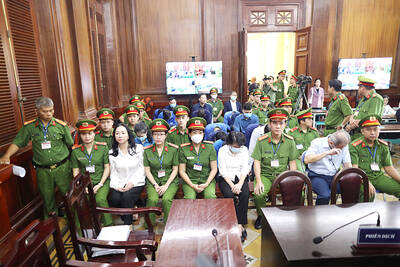
A top Vietnamese property tycoon was on Thursday sentenced to death in one of the biggest corruption cases in history, with an estimated US$27 billion in damages. A panel of three hand-picked jurors and two judges rejected all defense arguments by Truong My Lan, chair of major developer Van Thinh Phat, who was found guilty of swindling cash from Saigon Commercial Bank (SCB) over a decade. “The defendant’s actions ... eroded people’s trust in the leadership of the [Communist] Party and state,” read the verdict at the trial in Ho Chi Minh City. After the five-week trial, 85 others were also sentenced on

Conjoined twins Lori and George Schappell, who pursued separate careers, interests and relationships during lives that defied medical expectations, died this month in Pennsylvania, funeral home officials said. They were 62. The twins, listed by Guinness World Records as the oldest living conjoined twins, died on April 7 at the Hospital of the University of Pennsylvania, obituaries posted by Leibensperger Funeral Homes of Hamburg said. The cause of death was not detailed. “When we were born, the doctors didn’t think we’d make 30, but we proved them wrong,” Lori said in an interview when they turned 50, the Philadelphia Inquirer reported. The
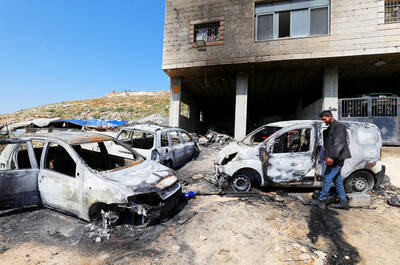
RAMPAGE: A Palestinian man was left dead after dozens of Israeli settlers searching for a missing 14-year-old boy stormed a village in the Israeli-occupied West Bank US President Joe Biden on Friday said he expected Iran to attack Israel “sooner, rather than later” and warned Tehran not to proceed. Asked by reporters about his message to Iran, Biden simply said: “Don’t,” underscoring Washington’s commitment to defend Israel. “We are devoted to the defense of Israel. We will support Israel. We will help defend Israel and Iran will not succeed,” he said. Biden said he would not divulge secure information, but said his expectation was that an attack could come “sooner, rather than later.” Israel braced on Friday for an attack by Iran or its proxies as warnings grew of


 RSS
RSS