


Taliban fighters, to avoid killing civilians, will not attack polling places during parliamentary elections next month, but will continue to attack US and Afghan government forces, a spokesman for the group said on Monday.
"We have decided not to target polling stations in civilian areas," the spokesman, Abdul Latif Hakimi, was reported as saying by Reuters. "US and Afghan forces are setting up polling stations in crowded areas, which if attacked will cause big losses."
He was reported to have called several news agencies.
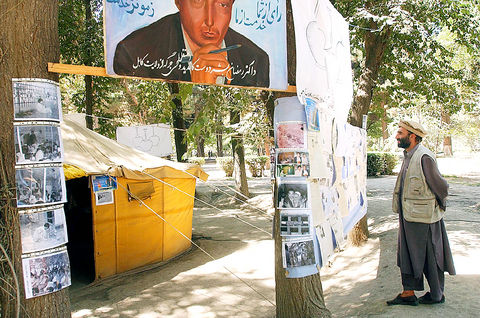
PHOTO: AP
But the Taliban Islamic movement, which was ousted from control in Afghanistan in late 2001, will continue its attacks on military targets even after the elections, Hakimi was quoted as saying.
An American military spokeswoman, Lieutenant Cindy Moore, said on Monday that the US-led forces in Afghanistan had killed more than 100 enemy combatants in heavy fighting in the last three weeks in Zabul and Kunar provinces, an indication of the level of combat in the most troublesome provinces. The dead were counted either by troops on the ground or from the air, and sometimes with the cooperation of local authorities, she said.
Hakimi's previous statements often have not borne out. The Taliban have continued an increasingly lethal insurgency in southern and eastern Afghanistan in recent months, attacking election officials and candidates, tribal elders and clerics, as well as American and Afghan troops. The apparent aim has been to disrupt the elections, and, with attacks on roadways, to prevent freedom of movement.
The US military, which has suffered an increase in casualties in recent months in Afghanistan at the hands of the Taliban, welcomed the announcement.
"That is the wish that all are working for, a violent-free or peaceful elections, and any peaceful step is welcome on election day," Moore said. "The elections will be successful, and we'll not be deterred from that success."
Major Andrew Elmes, a spokesman for the NATO peacekeeping force in Afghanistan, which has 10,000 troops helping to provide security for the elections in northern and western Afghanistan, said: "If the Taliban are saying they will not disrupt polling, it is because they know it will play against themselves. Too many people, I mean Afghans, are investing too much in these elections."
Antigovernment elements remain the greatest threat to the election process, said a joint report by the UN mission in Afghanistan and the Afghan Independent Human Rights Commission, released in Kabul on Monday. Surveys from June to the middle of this month showed "escalating threats and attacks against candidates, election workers, civic educators, religious leaders, government leaders and national and international security forces," the report said.
Local commanders have also attempted to interfere in the registration process, the report said. Three parliamentary candidates and two people involved in teaching others about the elections have been killed in recent weeks, although it remained unclear if the killings were directly related to their participation in the electoral process, said Sima Samar, the leader of the commission. Many candidates, especially women, have also been threatened, she said.

Republican US lawmakers on Friday criticized US President Joe Biden’s administration after sanctioned Chinese telecoms equipment giant Huawei unveiled a laptop this week powered by an Intel artificial intelligence (AI) chip. The US placed Huawei on a trade restriction list in 2019 for contravening Iran sanctions, part of a broader effort to hobble Beijing’s technological advances. Placement on the list means the company’s suppliers have to seek a special, difficult-to-obtain license before shipping to it. One such license, issued by then-US president Donald Trump’s administration, has allowed Intel to ship central processors to Huawei for use in laptops since 2020. China hardliners

Conjoined twins Lori and George Schappell, who pursued separate careers, interests and relationships during lives that defied medical expectations, died this month in Pennsylvania, funeral home officials said. They were 62. The twins, listed by Guinness World Records as the oldest living conjoined twins, died on April 7 at the Hospital of the University of Pennsylvania, obituaries posted by Leibensperger Funeral Homes of Hamburg said. The cause of death was not detailed. “When we were born, the doctors didn’t think we’d make 30, but we proved them wrong,” Lori said in an interview when they turned 50, the Philadelphia Inquirer reported. The
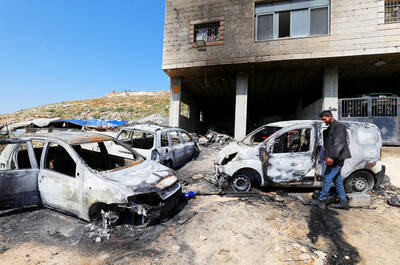
RAMPAGE: A Palestinian man was left dead after dozens of Israeli settlers searching for a missing 14-year-old boy stormed a village in the Israeli-occupied West Bank US President Joe Biden on Friday said he expected Iran to attack Israel “sooner, rather than later” and warned Tehran not to proceed. Asked by reporters about his message to Iran, Biden simply said: “Don’t,” underscoring Washington’s commitment to defend Israel. “We are devoted to the defense of Israel. We will support Israel. We will help defend Israel and Iran will not succeed,” he said. Biden said he would not divulge secure information, but said his expectation was that an attack could come “sooner, rather than later.” Israel braced on Friday for an attack by Iran or its proxies as warnings grew of

A prominent Christian leader has allegedly been stabbed at the altar during a Mass yesterday in southwest Sydney. Bishop Mar Mari Emmanuel was saying Mass at Christ The Good Shepherd Church in Wakeley just after 7pm when a man approached him at the altar and allegedly stabbed toward his head multiple times. A live stream of the Mass shows the congregation swarm forward toward Emmanuel before it was cut off. The church leader gained prominence during the COVID-19 pandemic, amassing a large online following, Officers attached to Fairfield City police area command attended a location on Welcome Street, Wakeley following reports a number


 RSS
RSS