


An uninspiring small stadium and basketball courts alongside a children's playground have become a potent symbol in the struggle to preserve a dwindling amount of recreation space in densely-populated Hong Kong.
A campaign to preserve the courts and play area, known as Southorn Playground, is part of a wider skirmish between government officials, developers and preservationists over the city's dwindling stock of public and cultural space.
Containing some of the world's most densely populated urban areas, the territory has lost not only much of its open areas but also most of the historic low-level structures that allowed at least some sunshine into the darkened chasms between the city skyscrapers.
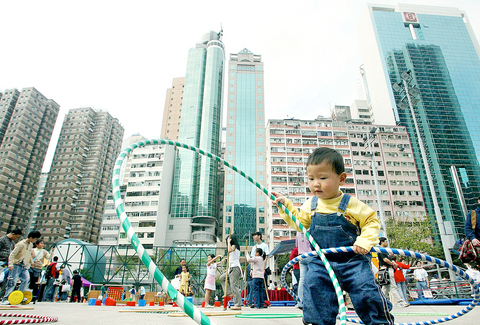
PHOTO: AFP
Swimming pools, beaches, parks and heritage buildings have been lost in recent years to make way for lucrative office and residential space in a territory where the vast majority of its 6.9 million residents live and work in just a third of its 1,098km2 area.
It is a struggle that has found greatest focus in the rapidly changing Wan Chai district where Southorn Playground is located.
"This is such a vital, busy little space that it is absolutely of the utmost importance that it is maintained as a public park," says Thomas Heatherwick, the British architect who is one half of the design team behind a proposed park refurbishment.
"Right now it is looking like an ideal candidate for sale to the next big developer and if that is lost so will be all these intricate networks of relationships and activities that go on among the thousands of people who use the park," he said.
In a city where space is at a premium, the companies that develop it have all the power.
"The government's Lands Department is supposed to decide what can and can't be done but everybody knows the developers are the ones that run the Lands Department," said Marina Lo, head of the Center for Heritage at Hong Kong's leading preservation group, the Conservancy Association.
"If the developers decide they want to do something, there's little anyone can do to stop them," she said.
Invited by the British Council in partnership with Wan Chai district council, Heatherwick's team conducted a public consultation earlier this year before designing a blueprint for the future of the park, which has been a public space since early last century.
"The more we can make this a more fantastic place -- a stage for sports, relaxation and greenery -- the more it will consolidate that space and save it from the developers," Heatherwick said following the consultation process.
The design includes a futuristic Perspex platform 5m overhead, where boys and girls play basketball on "floating" courts watched by an audience of office staff in the surrounding skyscrapers.
Below, children gambol in a shrub-ringed playground, a football match is played in a small stadium and seniors perform taichi under a row of banyan trees, according to the proposal.
"The intention was to ensure that the space really did remain public and open to all," said Fred Manson, Heatherwick's partner.
The plan is still awaiting approval by government and planning agencies, after which funding would have to be secured.
Southorn provides a vital hole in the dense pin-cushion of the city's seemingly endless swath of light-blocking skyscrapers. Two low-rise Victorian-era police station compounds, one in the Central business district, the other in the heart of the Kowloon tourist belt, perform a similar function. Both have been tagged for redevelopment into high-rises.
There are countless other similar sites dotted throughout the territory, all significant buildings or spaces at risk of being crushed in the rush to develop profitable real estate.
Just a few blocks to the west of Southorn Playground, among a small cluster of buildings centred on what is known as Wedding Card Street, a government regeneration plan proposes demolishing the district's only remaining pre-war tenement buildings, a long strip of dishevelled but handsome stores.
Down on Wan Chai's docks, a longstanding legal tussle rages over proposals to reclaim more land from the famous harbor to build a by-pass road. The scheme envisages the loss of a sports stadium and waterfront walkways.
"We really do have to fight tooth and nail to save anything in this city," Lo said.
"Unfortunately we suffer for two things here -- a lack of government will to protect these places and public ignorance of their importance," Lo said.
"People only tend to act once things are too late," she said.
But Lo believes Southorn Playground does not have much to fear from developers.
"It is part of everybody's life here -- there really would be an outrage if that was taken away," she said.
SEEKING CHANGE: A hospital worker said she did not vote in previous elections, but ‘now I can see that maybe my vote can change the system and the country’ Voting closed yesterday across the Solomon Islands in the south Pacific nation’s first general election since the government switched diplomatic allegiance from Taiwan to Beijing and struck a secret security pact that has raised fears of the Chinese navy gaining a foothold in the region. The Solomon Islands’ closer relationship with China and a troubled domestic economy weighed on voters’ minds as they cast their ballots. As many as 420,000 registered voters had their say across 50 national seats. For the first time, the national vote also coincided with elections for eight of the 10 local governments. Esther Maeluma cast her vote in the
Nearly half of China’s major cities are suffering “moderate to severe” levels of subsidence, putting millions of people at risk of flooding, especially as sea levels rise, according to a study of nationwide satellite data released yesterday. The authors of the paper, published by the journal Science, found that 45 percent of China’s urban land was sinking faster than 3mm per year, with 16 percent at more than 10mm per year, driven not only by declining water tables, but also the sheer weight of the built environment. With China’s urban population already in excess of 900 million people, “even a small portion

UNSETTLING IMAGES: The scene took place in front of TV crews covering the Trump trial, with a CNN anchor calling it an ‘emotional and unbelievably disturbing moment’ A man who doused himself in an accelerant and set himself on fire outside the courthouse where former US president Donald Trump is on trial has died, police said yesterday. The New York City Police Department (NYPD) said the man was declared dead by staff at an area hospital. The man was in Collect Pond Park at about 1:30pm on Friday when he took out pamphlets espousing conspiracy theories, tossed them around, then doused himself in an accelerant and set himself on fire, officials and witnesses said. A large number of police officers were nearby when it happened. Some officers and bystanders rushed

HYPOCRISY? The Chinese Ministry of Foreign Affairs yesterday asked whether Biden was talking about China or the US when he used the word ‘xenophobic’ US President Joe Biden on Wednesday called for a hike in steel tariffs on China, accusing Beijing of cheating as he spoke at a campaign event in Pennsylvania. Biden accused China of xenophobia, too, in a speech to union members in Pittsburgh. “They’re not competing, they’re cheating. They’re cheating and we’ve seen the damage here in America,” Biden said. Chinese steel companies “don’t need to worry about making a profit because the Chinese government is subsidizing them so heavily,” he said. Biden said he had called for the US Trade Representative to triple the tariff rates for Chinese steel and aluminum if Beijing was


 RSS
RSS