


Nestled in the far northern niche of the Red Sea, cheek by jowl with Israel, Egypt and Saudi Arabia, the resort of Aqaba has long been safe and attractive for both tourists and world leaders -- mostly because of Jordan's tight security and relative tranquility.
Islamic militants said Friday they attacked it because of the presence of US naval ships, which had been there temporarily carrying out joint exercises with the Jordanian army.
With Israel's resort of Eilat visible only kilometers to the west along the beach, Aqaba has also been a key site for Arab-Israeli peacemaking. Jordan and Israel signed their 1994 peace treaty at a ceremony in the desert attended by then-US President Bill Clinton. In June 2003, the town hosted an Israeli-Palestinian summit attended by US President George W. Bush and Jordan's King Abdullah II. Nine years earlier.
The only port in a country that has only about 20km of coastline, Aqaba is also vital for Jordan's economy. Its port is also used for Iraq's imports from Asia and the Far East -- just as in the past when active trade between the Mideast, Africa and Asia passed through Aqaba.
In 2001, King Abdullah declared the city a free trade zone, creating tax breaks on a range of goods and services. That has attracted investment, including a host of American fast-food joints and hotel chains.
Aqaba, Arabic for "obstacle," was a once a sleepy fishing village, dragged into modern times when the border with neighboring Saudi Arabia was adjusted in 1965. Jordan gained a few extra kilometers of coastline and coral reef south of Aqaba, allowing for the construction of full-size port facility.
The city of 30,000 inhabitants -- just south of a chain of rose red mountains in the midst of desert terrain -- has since become a tourist attraction. Even during times of heightened hostility in the volatile Mideast, Westerners and eastern Europeans flocked into Aqaba because of the relative security it enjoyed.
Since the war that toppled Saddam Hussein in 2003, US military and other officials have come to Aqaba for respite from the battleground in neighboring Iraq.
Aqaba has also been a favorite vacation spot for Jordan's royal family, who keep a compound of palaces on the city's western edge bordering Israel.
Claiming responsibility for Friday's rocket attack, which killed a Jordanian soldier, the al-Qaeda-linked Abdullah Azzam Brigades said in a statement posted on the Internet that a group of "holy warriors ... targeted a gathering of American military ships docking in Aqaba port."
It threatened to topple Abdullah and warned that more attacks would follow.
Jordan has been a target for al-Qaeda and other terrorists for several years. The kingdom is a longtime US ally and Abdullah has been an active player in the US-led global war on terror. The Western-educated monarch has maintained close ties with his Israeli neighbor.

Republican US lawmakers on Friday criticized US President Joe Biden’s administration after sanctioned Chinese telecoms equipment giant Huawei unveiled a laptop this week powered by an Intel artificial intelligence (AI) chip. The US placed Huawei on a trade restriction list in 2019 for contravening Iran sanctions, part of a broader effort to hobble Beijing’s technological advances. Placement on the list means the company’s suppliers have to seek a special, difficult-to-obtain license before shipping to it. One such license, issued by then-US president Donald Trump’s administration, has allowed Intel to ship central processors to Huawei for use in laptops since 2020. China hardliners

Conjoined twins Lori and George Schappell, who pursued separate careers, interests and relationships during lives that defied medical expectations, died this month in Pennsylvania, funeral home officials said. They were 62. The twins, listed by Guinness World Records as the oldest living conjoined twins, died on April 7 at the Hospital of the University of Pennsylvania, obituaries posted by Leibensperger Funeral Homes of Hamburg said. The cause of death was not detailed. “When we were born, the doctors didn’t think we’d make 30, but we proved them wrong,” Lori said in an interview when they turned 50, the Philadelphia Inquirer reported. The
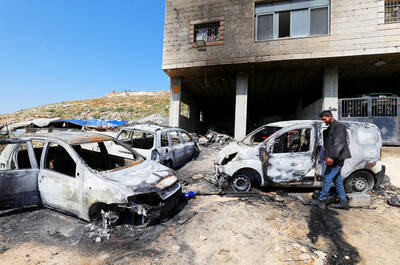
RAMPAGE: A Palestinian man was left dead after dozens of Israeli settlers searching for a missing 14-year-old boy stormed a village in the Israeli-occupied West Bank US President Joe Biden on Friday said he expected Iran to attack Israel “sooner, rather than later” and warned Tehran not to proceed. Asked by reporters about his message to Iran, Biden simply said: “Don’t,” underscoring Washington’s commitment to defend Israel. “We are devoted to the defense of Israel. We will support Israel. We will help defend Israel and Iran will not succeed,” he said. Biden said he would not divulge secure information, but said his expectation was that an attack could come “sooner, rather than later.” Israel braced on Friday for an attack by Iran or its proxies as warnings grew of

IN PURSUIT: Israel’s defense minister said the revenge attacks by Israeli settlers would make it difficult for security forces to find those responsible for the 14-year-old’s death Israeli Prime Minister Benjamin Netanyahu on Saturday condemned the “heinous murder” of an Israeli teenager in the occupied West Bank as attacks on Palestinian villages intensified following news of his death. After Benjamin Achimeir, 14, was reported missing near Ramallah on Friday, hundreds of Jewish settlers backed by Israeli forces raided nearby Palestinian villages, torching vehicles and homes, leaving at least one villager dead and dozens wounded. The attacks escalated in several villages on Saturday after Achimeir’s body was found near the Malachi Hashalom outpost. Agence France-Presse correspondents saw smoke rising from burned houses and fields. Mayor Amin Abu Alyah, of the


 RSS
RSS