


Supreme leader Ayatollah Ali Khamenei said Iran has no intention of building nuclear bombs, but it will not give up its right to enrich uranium as it aims to be self-sufficient in nuclear reactor fuel.
Iran's next step will be to build nuclear power plants without help from abroad, Khamenei said Friday. Russia is currently putting the finishing touches on Iran's first nuclear reactor at Bushehr in the south of the country.
"They [the West] speak as if Iran is seeking nuclear weapons and they oppose it. This is a propaganda trick to deceive their own public opinion," Khamenei told tens of thousands of worshippers at the Friday prayers sermon at Tehran University.
"I've said it repeatedly that we are not seeking nuclear weapons," he said in the sermon, which was broadcast live.
After his speech, about 500 worshippers demonstrated in the streets outside the university, chanting: "nuclear energy is our right!"
Khamenei, who has the final say on all state matters, said Iran wants to enrich uranium to low levels for fuel in power-generating reactors. But the US believes Iran would also enrich uranium to the high levels suitable for building bombs.
"We want to enrich our own uranium, excavated from our own mines, with equipment and technology that belongs to ourselves, developed by our young scientists, to produce fuel for our nuclear power plants," he said.
Earlier this month, Iran rejected a package of incentives, including the purchase of nuclear fuel, that the Europeans offered in return for Iran's abandoning enrichment.
"They [the Europeans] say purchase [nuclear fuel] from us. That means dependency," Khamenei said. He added the European proposals for Iran to import fuel and abandon enrichment were tantamount to "coercion."
He reminded the audience that enrichment for peaceful purposes was one of Iran's rights as a signatory to the Nuclear Nonproliferation Treaty.
"We don't fear anybody. We have the necessary might and means to defend our rights, and we won't give up our rights," Khamenei said, drawing shouts of "never, never!" from the worshippers.
Iran's nuclear program is a source of national pride. Foreign attempts to curb the program are routinely met with criticism and anger. Iran suspended enrichment in 2003 and expanded the suspension last November to include uranium reprocessing activities and building the centrifuges that are used to enrich uranium. The moves were made to avoid referral to the UN Security Council for possible sanctions and to build trust in the negotiations with Europe.
Last week, after the talks with Europeans failed to make progress, Iran resumed uranium reprocessing activities at its Uranium Conversion Facility in Isfahan.
Iran called last week for negotiations with the Europeans on its plans to resume actual enrichment, which would involve injecting uranium gas into centrifuges. It said the reaction of the EU would heavily influence the timing of when it restarts enrichment.
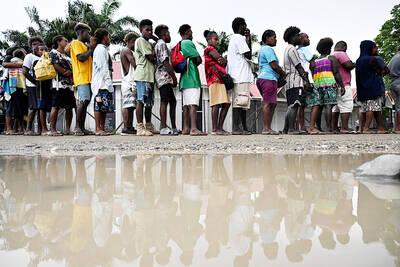
SEEKING CHANGE: A hospital worker said she did not vote in previous elections, but ‘now I can see that maybe my vote can change the system and the country’ Voting closed yesterday across the Solomon Islands in the south Pacific nation’s first general election since the government switched diplomatic allegiance from Taiwan to Beijing and struck a secret security pact that has raised fears of the Chinese navy gaining a foothold in the region. The Solomon Islands’ closer relationship with China and a troubled domestic economy weighed on voters’ minds as they cast their ballots. As many as 420,000 registered voters had their say across 50 national seats. For the first time, the national vote also coincided with elections for eight of the 10 local governments. Esther Maeluma cast her vote in the
Nearly half of China’s major cities are suffering “moderate to severe” levels of subsidence, putting millions of people at risk of flooding, especially as sea levels rise, according to a study of nationwide satellite data released yesterday. The authors of the paper, published by the journal Science, found that 45 percent of China’s urban land was sinking faster than 3mm per year, with 16 percent at more than 10mm per year, driven not only by declining water tables, but also the sheer weight of the built environment. With China’s urban population already in excess of 900 million people, “even a small portion

UNSETTLING IMAGES: The scene took place in front of TV crews covering the Trump trial, with a CNN anchor calling it an ‘emotional and unbelievably disturbing moment’ A man who doused himself in an accelerant and set himself on fire outside the courthouse where former US president Donald Trump is on trial has died, police said yesterday. The New York City Police Department (NYPD) said the man was declared dead by staff at an area hospital. The man was in Collect Pond Park at about 1:30pm on Friday when he took out pamphlets espousing conspiracy theories, tossed them around, then doused himself in an accelerant and set himself on fire, officials and witnesses said. A large number of police officers were nearby when it happened. Some officers and bystanders rushed

HYPOCRISY? The Chinese Ministry of Foreign Affairs yesterday asked whether Biden was talking about China or the US when he used the word ‘xenophobic’ US President Joe Biden on Wednesday called for a hike in steel tariffs on China, accusing Beijing of cheating as he spoke at a campaign event in Pennsylvania. Biden accused China of xenophobia, too, in a speech to union members in Pittsburgh. “They’re not competing, they’re cheating. They’re cheating and we’ve seen the damage here in America,” Biden said. Chinese steel companies “don’t need to worry about making a profit because the Chinese government is subsidizing them so heavily,” he said. Biden said he had called for the US Trade Representative to triple the tariff rates for Chinese steel and aluminum if Beijing was


 RSS
RSS