


The last Moroccan prisoners of war -- 404 soldiers, some held for up to 20 years in desert camps -- have returned home, hours after they were freed by Western Sahara guerrillas in a US-mediated release.
Two US-military chartered planes carrying the freed POWs who had been held in southwest Algeria touched down at the airport in Morocco's southern coastal city of Agadir.
US Senator Richard Lugar, who had overseen the handover ceremony on Thursday in Tindouf, a bleak desert outpost where the guerillas are based, greeted the men at the foot of the aircraft. He had arrived in a separate aircraft. Moroccan Foreign Minister Mohamed Benaissa and other political and military officials were also present.
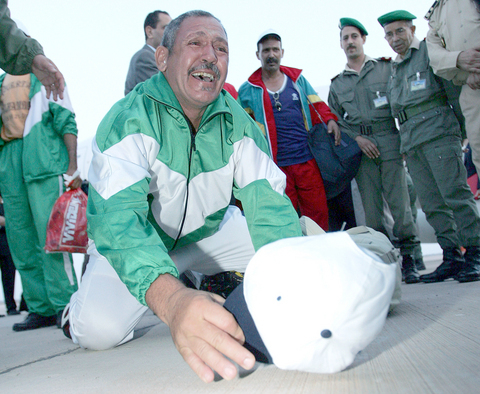
PHOTO: AFP
The former prisoners, flown home under the auspices of the International Committee of the Red Cross (ICRC), were quickly whisked away on buses. Lugar's office said the prisoners had been the longest held in the world at this time.
The men had been captured by the Polisario Front, which for years fought Morocco for the independence of the mineral-rich Western Sahara region. The US expressed hope that the release of the POWs would provide momentum for a settlement of the three-decade-long dispute.
"Although our mission is purely humanitarian, I am hopeful that Algeria and Morocco can seize on this occasion to create a climate conducive to the settlement of the Western Sahara issue," Lugar said.
Lugar, chairman of the Senate Foreign Relations Committee, had traveled to the region at the request of US President George W. Bush. The White House said the prisoner release was "the product of quiet and intense diplomatic efforts among the United States, Morocco and Algeria."
Morocco rejoiced at the release of the prisoners, praising the role of the US, a solid ally. However, a Foreign Ministry statement suggested the return of the POWs alone would not unblock the bitter stalemate over Western Sahara, which Morocco refers to as its "southern provinces."
The mass release was but a "belated accomplishment of an international obligation" that "in no way" can be viewed as a gesture by the Polisario or an intervention by Algeria, said the statement, quoted by the official MAP news agency.
Morocco praised the prisoners for enduring "suffering, exactions, intimidation and humiliation inflicted by their various torturers and jailers."
Mohamed Belkadi, freed in 2003 after 25 years, two months and 25 days as a Polisario prisoner, said he was "enormously happy" about the mass release.
The Moroccan former fighter pilot was captured when his F-5 jet was shot down.
"I spent 17 years without contact with my family. I got to write my first letter to my child in 1995. We were allowed two letters of 11 lines each per year. It was terrible," he said in Rabat, Morocco's capital.
The Polisario Front hoped that releasing the last of the more than 2,000 prisoners it once held would pressure Morocco to allow a long-delayed referendum on Western Sahara's future and release or account for missing civilians and Polisario POWs -- although the UN says the ICRC verified that all Polisario POWs had been released by 1996.

Republican US lawmakers on Friday criticized US President Joe Biden’s administration after sanctioned Chinese telecoms equipment giant Huawei unveiled a laptop this week powered by an Intel artificial intelligence (AI) chip. The US placed Huawei on a trade restriction list in 2019 for contravening Iran sanctions, part of a broader effort to hobble Beijing’s technological advances. Placement on the list means the company’s suppliers have to seek a special, difficult-to-obtain license before shipping to it. One such license, issued by then-US president Donald Trump’s administration, has allowed Intel to ship central processors to Huawei for use in laptops since 2020. China hardliners
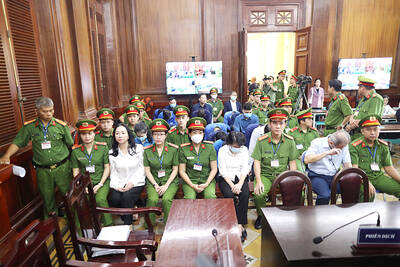
A top Vietnamese property tycoon was on Thursday sentenced to death in one of the biggest corruption cases in history, with an estimated US$27 billion in damages. A panel of three hand-picked jurors and two judges rejected all defense arguments by Truong My Lan, chair of major developer Van Thinh Phat, who was found guilty of swindling cash from Saigon Commercial Bank (SCB) over a decade. “The defendant’s actions ... eroded people’s trust in the leadership of the [Communist] Party and state,” read the verdict at the trial in Ho Chi Minh City. After the five-week trial, 85 others were also sentenced on

‘DELUSIONAL’: Targeting the families of Hamas’ leaders would not push the group to change its position or to give up its demands for Palestinians, Ismail Haniyeh said Israeli aircraft on Wednesday killed three sons of Hamas’ top political leader in the Gaza Strip, striking high-stakes targets at a time when Israel is holding delicate ceasefire negotiations with the militant group. Hamas said four of the leader’s grandchildren were also killed. Ismail Haniyeh’s sons are among the highest-profile figures to be killed in the war so far. Israel said they were Hamas operatives, and Haniyeh accused Israel of acting in “the spirit of revenge and murder.” The deaths threatened to strain the internationally mediated ceasefire talks, which appeared to gain steam in recent days even as the sides remain far

Conjoined twins Lori and George Schappell, who pursued separate careers, interests and relationships during lives that defied medical expectations, died this month in Pennsylvania, funeral home officials said. They were 62. The twins, listed by Guinness World Records as the oldest living conjoined twins, died on April 7 at the Hospital of the University of Pennsylvania, obituaries posted by Leibensperger Funeral Homes of Hamburg said. The cause of death was not detailed. “When we were born, the doctors didn’t think we’d make 30, but we proved them wrong,” Lori said in an interview when they turned 50, the Philadelphia Inquirer reported. The


 RSS
RSS