


North and South Korea yesterday began landmark talks on agriculture aimed at helping the cash-strapped North wean itself off international food aid.
Agriculture experts from both countries met at Kaesong City, just north of the inter-Korean border, for a two-day session, said an official from South Korea's Unification Ministry.
South Korean officials said Seoul would present a few pilot projects including joint farming, the supply of saplings from the South for the denuded mountains in the North as well as the provision of technological aid.
"In the long term, it will be more significant than providing emergency food aid to help North Koreans to find means to feed themselves," an official of the Unification Ministry said.
South Korea's chief delegate, vice agricultural minister Lee Myung-soo, said the talks were historic.
"This marks the first time that agricultural authorities from the North and South have met since the division of Korea," he said.
Lee's North Korean counterpart Mun Ung-jo said the meetings would "help lay the ground for reunification of the fatherland."
North and South Korea have been expanding economic exchanges since a historic inter-Korean summit in 2000, even though the two sides are still technically at war .
South Korea remains the main provider of humanitarian aid to Pyongyang. For this year alone, it supplied 500,000 tonnes of food and 350,000 tonnes of fertilizer.
The UN World Food Program (WFP) warned last week that more than 3 million North Koreans face a hungry winter unless more food donations are received.
The WFP, which has been supplying food to 6.5 million vulnerable people in the impoverished North, said it was unable to provide rations of cereals, its staple commodity, to nearly one million North Koreans at present.
North Korea has relied since 1995 on foreign aid to feed its 23 million people.
"This year's food crisis in the North has been exceptionally severe, owing to an acute lack of affordable local staples, not least because of record-high cereal prices in private markets," said WFP director James Morris.
A famine may have left up to 2 million dead in the mid-to-late 1990s, according to humanitarian aid workers in the reclusive state.
The UN agency has repeatedly warned that the 1990s famine could recur unless urgent action is taken.
Nearly half of China’s major cities are suffering “moderate to severe” levels of subsidence, putting millions of people at risk of flooding, especially as sea levels rise, according to a study of nationwide satellite data released yesterday. The authors of the paper, published by the journal Science, found that 45 percent of China’s urban land was sinking faster than 3mm per year, with 16 percent at more than 10mm per year, driven not only by declining water tables, but also the sheer weight of the built environment. With China’s urban population already in excess of 900 million people, “even a small portion

‘IN A DIFFERENT PLACE’: The envoy first visited Shanghai, where he attended a Chinese basketball playoff match, and is to meet top officials in Beijing tomorrow US Secretary of State Antony Blinken yesterday arrived in China on his second visit in a year as the US ramps up pressure on its rival over its support for Russia while also seeking to manage tensions with Beijing. The US diplomat tomorrow is to meet China’s top brass in Beijing, where he is also expected to plead for restraint as Taiwan inaugurates president-elect William Lai (賴清德), and to raise US concerns on Chinese trade practices. However, Blinken is also seeking to stabilize ties, with tensions between the world’s two largest economies easing since his previous visit in June last year. At the

UNSETTLING IMAGES: The scene took place in front of TV crews covering the Trump trial, with a CNN anchor calling it an ‘emotional and unbelievably disturbing moment’ A man who doused himself in an accelerant and set himself on fire outside the courthouse where former US president Donald Trump is on trial has died, police said yesterday. The New York City Police Department (NYPD) said the man was declared dead by staff at an area hospital. The man was in Collect Pond Park at about 1:30pm on Friday when he took out pamphlets espousing conspiracy theories, tossed them around, then doused himself in an accelerant and set himself on fire, officials and witnesses said. A large number of police officers were nearby when it happened. Some officers and bystanders rushed
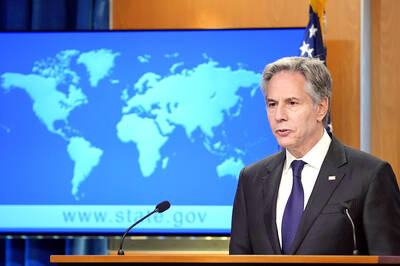
Beijing is continuing to commit genocide and crimes against humanity against Uyghurs and other Muslim minorities in its western Xinjiang province, U.S. Secretary of State Antony Blinken said in a report published on Monday, ahead of his planned visit to China this week. The State Department’s annual human rights report, which documents abuses recorded all over the world during the previous calendar year, repeated language from previous years on the treatment of Muslims in Xinjiang, but the publication raises the issue ahead of delicate talks, including on the war in Ukraine and global trade, between the top U.S. diplomat and Chinese


 RSS
RSS