


China said yesterday it is setting up elite anti-terror and riot police units equipped with everything from batons to armored vehicles, in a sign of growing concern over social unrest.
The special force will cover 36 key cities and one of the first detachments, a 500-member squad, has already been formed in Zhengzhou, capital of Henan Province, the Xinhua news agency said.
"We're training for real combat, so in our day-to-day exercise we require of our people that they behave as if they were in a sharp situation," Ge Hongjun, a Henan police officer in charge of training the unit, said.
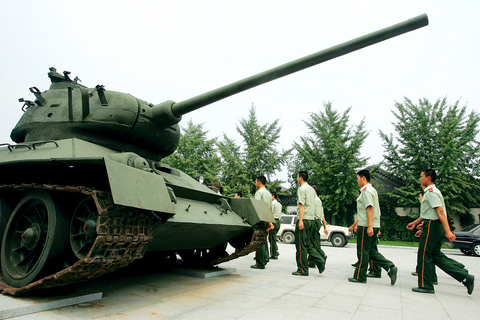
PHOTO: EPA
The brigades will be responsible for dealing with terrorist crimes, violent crimes, riots and disturbances, according to the agency.
Beijing and Shanghai will get similar units with 600 highly trained men, while Chongqing and Tianjin each will get 500-member units.
The move comes at a time when unrest is reported on an increasingly regular basis, and amid growing indications that the government is worried about the consequences.
The People's Daily, the Communist Party's mass-circulation mouthpiece, published a front-page commentary late last month warning that under no circumstances would threats against social stability be tolerated.
"Only if we preserve social stability will we be able to deepen reform and speed up development and solve the problems and contradictions emerging in the course of reform," the commentary said.
In an unusually frank statement, Public Security Minister Zhou Yongkang also said recently that 3.8 million people participated in 74,000 protests last year, up from 10,000 protests a decade earlier.
"They are clearly concerned about this issue," said David Zweig, a China expert at Hong Kong University of Science and Technology.
"A protest begins in China every five minutes. If the protests run longer than five minutes, then there are two going on at the same time," he said.
Unrest has become more frequent as economic reform has created inequality and intensified competition for land and other scarce resources.
"They are accepting the fact that this kind of unrest is going to happen," Zweig said.
"They want rapid growth. The only thing to do then is to have rapid growth and tighten up," he added.
It is no coincidence that Henan Province is slated to get one of the largest contingents of anti-riot police.
The province is one of the most troubled areas in China, with regular reports of unrest.
About 30 people were injured in August of last year when a land dispute in a village near Zhengzhou escalated into a violent clash with paramilitary police armed with teargas and shotguns, according to reports.
Three months later, tensions between Han Chinese and the Muslim minority, also in a rural area near Zhengzhou, boiled over and locals reported several fatalities, according to reports.
China already has a unit that is dedicated to curbing massive riots, the paramilitary People's Armed Police with nearly 1 million members, and the ministry of public security could not be reached to comment on why a new force was being created.

Republican US lawmakers on Friday criticized US President Joe Biden’s administration after sanctioned Chinese telecoms equipment giant Huawei unveiled a laptop this week powered by an Intel artificial intelligence (AI) chip. The US placed Huawei on a trade restriction list in 2019 for contravening Iran sanctions, part of a broader effort to hobble Beijing’s technological advances. Placement on the list means the company’s suppliers have to seek a special, difficult-to-obtain license before shipping to it. One such license, issued by then-US president Donald Trump’s administration, has allowed Intel to ship central processors to Huawei for use in laptops since 2020. China hardliners
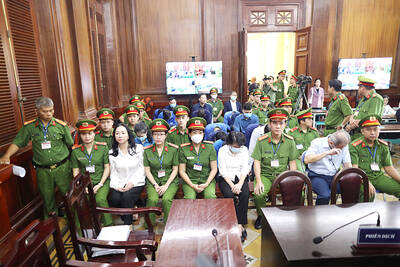
A top Vietnamese property tycoon was on Thursday sentenced to death in one of the biggest corruption cases in history, with an estimated US$27 billion in damages. A panel of three hand-picked jurors and two judges rejected all defense arguments by Truong My Lan, chair of major developer Van Thinh Phat, who was found guilty of swindling cash from Saigon Commercial Bank (SCB) over a decade. “The defendant’s actions ... eroded people’s trust in the leadership of the [Communist] Party and state,” read the verdict at the trial in Ho Chi Minh City. After the five-week trial, 85 others were also sentenced on

‘DELUSIONAL’: Targeting the families of Hamas’ leaders would not push the group to change its position or to give up its demands for Palestinians, Ismail Haniyeh said Israeli aircraft on Wednesday killed three sons of Hamas’ top political leader in the Gaza Strip, striking high-stakes targets at a time when Israel is holding delicate ceasefire negotiations with the militant group. Hamas said four of the leader’s grandchildren were also killed. Ismail Haniyeh’s sons are among the highest-profile figures to be killed in the war so far. Israel said they were Hamas operatives, and Haniyeh accused Israel of acting in “the spirit of revenge and murder.” The deaths threatened to strain the internationally mediated ceasefire talks, which appeared to gain steam in recent days even as the sides remain far
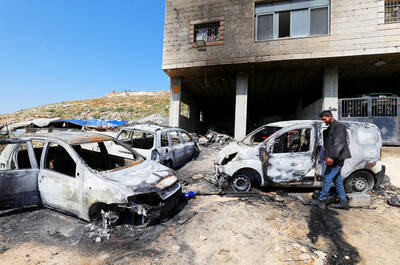
RAMPAGE: A Palestinian man was left dead after dozens of Israeli settlers searching for a missing 14-year-old boy stormed a village in the Israeli-occupied West Bank US President Joe Biden on Friday said he expected Iran to attack Israel “sooner, rather than later” and warned Tehran not to proceed. Asked by reporters about his message to Iran, Biden simply said: “Don’t,” underscoring Washington’s commitment to defend Israel. “We are devoted to the defense of Israel. We will support Israel. We will help defend Israel and Iran will not succeed,” he said. Biden said he would not divulge secure information, but said his expectation was that an attack could come “sooner, rather than later.” Israel braced on Friday for an attack by Iran or its proxies as warnings grew of


 RSS
RSS