


State Department analysts warned the Clinton administration in July 1996 that Osama bin Laden's move to Afghanistan would give him an even more dangerous haven as he sought to expand radical Islam "well beyond the Middle East," but the government chose not to deter the move, newly declassified documents show.
In what would prove a prescient warning, the analysts said in a top-secret assessment that summer that bin Laden's "prolonged stay in Afghanistan could prove more dangerous to US interests in the long run than his three-year liaison with Khartoum," in Sudan.
Hundreds of "Arab mujahedeen" receive terrorist training and key extremist leaders often congregate in Afghanistan, the report noted.
The declassified documents were obtained by the conservative legal advocacy group Judicial Watch as part of a Freedom of Information Act request and were provided to the New York Times.
The documents shed light on a murky and controversial chapter in bin Laden's history: his relocation from Sudan to Afghanistan as the Clinton administration was striving to understand the threat he posed and explore ways of confronting him.
Before 1996, bin Laden was regarded more as a financier of terrorism than a mastermind.
But the State Department assessment, which came a year before he publicly urged Muslims to attack the US, indicated that officials suspected he was taking a more active role, including his part in the bombings in June 1996 that killed 19 US soldiers at the Khobar Towers in Dhahran, Saudi Arabia.
Two years after the State Department's warning, with bin Laden firmly entrenched in Afghanistan and overseeing terrorist training and financing operations, al-Qaeda struck two US embassies in East Africa, leading to failed military efforts by the Clinton administration to capture or kill him in Afghanistan.
Three years later, on Sept. 11, 2001, al-Qaeda struck the World Trade Center and the Pentagon in an operation overseen from the base in Afghanistan.
Critics of the Clinton administration have accused it of ignoring the threat posed by bin Laden in the mid-1990s while he was still in Sudan, and they point to claims by some Sudanese officials that they offered to turn him over to Americans before ultimately expelling him in 1996 under international pressure.
But Clinton administration diplomats have adamantly denied that they received such an offer, and the Sept. 11 commission concluded in one of its staff reports that it had "not found any reliable evidence to support the Sudanese claim."
The newly declassified documents do not directly address the question of whether Sudan ever offered to turn over bin Laden. But the documents go well beyond previous news and historical accounts in detailing the Clinton administration's active monitoring of bin Laden's movements and the realization that his move to Afghanistan could make him an even greater threat.
Several former senior officials in the Clinton administration did not return phone calls this week seeking comment on the newly declassified documents.
Nearly half of China’s major cities are suffering “moderate to severe” levels of subsidence, putting millions of people at risk of flooding, especially as sea levels rise, according to a study of nationwide satellite data released yesterday. The authors of the paper, published by the journal Science, found that 45 percent of China’s urban land was sinking faster than 3mm per year, with 16 percent at more than 10mm per year, driven not only by declining water tables, but also the sheer weight of the built environment. With China’s urban population already in excess of 900 million people, “even a small portion

UNSETTLING IMAGES: The scene took place in front of TV crews covering the Trump trial, with a CNN anchor calling it an ‘emotional and unbelievably disturbing moment’ A man who doused himself in an accelerant and set himself on fire outside the courthouse where former US president Donald Trump is on trial has died, police said yesterday. The New York City Police Department (NYPD) said the man was declared dead by staff at an area hospital. The man was in Collect Pond Park at about 1:30pm on Friday when he took out pamphlets espousing conspiracy theories, tossed them around, then doused himself in an accelerant and set himself on fire, officials and witnesses said. A large number of police officers were nearby when it happened. Some officers and bystanders rushed
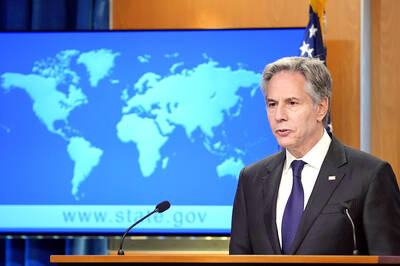
Beijing is continuing to commit genocide and crimes against humanity against Uyghurs and other Muslim minorities in its western Xinjiang province, U.S. Secretary of State Antony Blinken said in a report published on Monday, ahead of his planned visit to China this week. The State Department’s annual human rights report, which documents abuses recorded all over the world during the previous calendar year, repeated language from previous years on the treatment of Muslims in Xinjiang, but the publication raises the issue ahead of delicate talks, including on the war in Ukraine and global trade, between the top U.S. diplomat and Chinese

HYPOCRISY? The Chinese Ministry of Foreign Affairs yesterday asked whether Biden was talking about China or the US when he used the word ‘xenophobic’ US President Joe Biden on Wednesday called for a hike in steel tariffs on China, accusing Beijing of cheating as he spoke at a campaign event in Pennsylvania. Biden accused China of xenophobia, too, in a speech to union members in Pittsburgh. “They’re not competing, they’re cheating. They’re cheating and we’ve seen the damage here in America,” Biden said. Chinese steel companies “don’t need to worry about making a profit because the Chinese government is subsidizing them so heavily,” he said. Biden said he had called for the US Trade Representative to triple the tariff rates for Chinese steel and aluminum if Beijing was


 RSS
RSS