


Thousands of people gathered at the largest mosque in tsunami-ravaged Aceh province yesterday to witness the televised signing of an agreement to end a three-decade civil war that has claimed 15,000 lives. The crowd clapped and shouted as the Indonesian government inked the deal with separatist rebels in Helsinki, Finland, but the celebration was remarkably subdued.
"All we want is peace," said Nassruddin, a high school physics teacher who goes by one name. "A few years ago we teachers were targeted by the rebels. They burned a lot of schools. We were always scared."
"I can't predict what will happen now," the 47-year-old said. "I only know we want to see an end to the fighting, we want prosperity, and to feel safe."
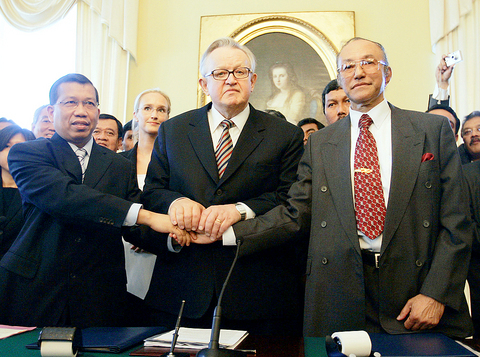
PHOTO: AFP
Many were hopeful the deal would bring a permanent end to the conflict. But others warned fear and mistrust runs deep, saying a 200-member international monitoring mission that will oversee the disarmament of the rebels and the demobilization of Indonesian troops was crucial to its success.
The last agreement collapsed in 2003, with the rebels and the government each accusing the other of violations. The army kicked out foreign observers, declared martial law and arrested rebel negotiators.
But conditions this time are much different and the chances of success much higher. The Dec. 26 tsunami that killed more than 130,000 people in Aceh and left a half-million homeless created a strong impetus for both the Indonesian government and separatist rebels to return to the negotiating table. Leaders of the Free Aceh Movement, many of whom have lived abroad for years, decided they didn't want to add to the suffering. And the government recognized that peace would smooth the way for a more than US$5 billion reconstruction and rehabilitation effort.
When the two sides met in Helsinki last month to wrap up negotiations, both made major concessions.
"The context was very different," said Rizal Sukma, a member of the non-governmental Aceh Recovery Forum. "You had a powerful humanitarian conflict that put pressure on both parties to iron out their differences."
The rebels gave up their long-held demand for independence and agreed to hand in their weapons. In return, the government offered them amnesty, economic compensation and, most importantly, the right to political representation. In addition to its own flag and hymn, Aceh will hold elections next year and 2009 to chose a regional head and a legislature. Members of the Free Aceh Movement will be eligible for those posts.
Another contentious issue, the province's vast mineral wealth, was also settled: 70 percent of the current and future revenues from Aceh's natural resources, including oil and gas, will go the local government. Syarwan Madi, who lost several friends in the fighting, all rebel sympathizers, said he hoped for peace but was skeptical the government would follow through with its promises.
"I don't think the government is sincere," Madi said, who predicted the military would continue to hunt down members of the Free Aceh Movement in six months time, when international peace monitors leave.
They won't give up on the resource-rich province so easily, he said.
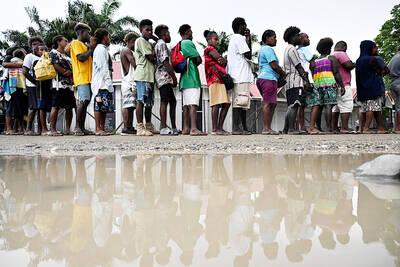
SEEKING CHANGE: A hospital worker said she did not vote in previous elections, but ‘now I can see that maybe my vote can change the system and the country’ Voting closed yesterday across the Solomon Islands in the south Pacific nation’s first general election since the government switched diplomatic allegiance from Taiwan to Beijing and struck a secret security pact that has raised fears of the Chinese navy gaining a foothold in the region. The Solomon Islands’ closer relationship with China and a troubled domestic economy weighed on voters’ minds as they cast their ballots. As many as 420,000 registered voters had their say across 50 national seats. For the first time, the national vote also coincided with elections for eight of the 10 local governments. Esther Maeluma cast her vote in the
Nearly half of China’s major cities are suffering “moderate to severe” levels of subsidence, putting millions of people at risk of flooding, especially as sea levels rise, according to a study of nationwide satellite data released yesterday. The authors of the paper, published by the journal Science, found that 45 percent of China’s urban land was sinking faster than 3mm per year, with 16 percent at more than 10mm per year, driven not only by declining water tables, but also the sheer weight of the built environment. With China’s urban population already in excess of 900 million people, “even a small portion

UNSETTLING IMAGES: The scene took place in front of TV crews covering the Trump trial, with a CNN anchor calling it an ‘emotional and unbelievably disturbing moment’ A man who doused himself in an accelerant and set himself on fire outside the courthouse where former US president Donald Trump is on trial has died, police said yesterday. The New York City Police Department (NYPD) said the man was declared dead by staff at an area hospital. The man was in Collect Pond Park at about 1:30pm on Friday when he took out pamphlets espousing conspiracy theories, tossed them around, then doused himself in an accelerant and set himself on fire, officials and witnesses said. A large number of police officers were nearby when it happened. Some officers and bystanders rushed

HYPOCRISY? The Chinese Ministry of Foreign Affairs yesterday asked whether Biden was talking about China or the US when he used the word ‘xenophobic’ US President Joe Biden on Wednesday called for a hike in steel tariffs on China, accusing Beijing of cheating as he spoke at a campaign event in Pennsylvania. Biden accused China of xenophobia, too, in a speech to union members in Pittsburgh. “They’re not competing, they’re cheating. They’re cheating and we’ve seen the damage here in America,” Biden said. Chinese steel companies “don’t need to worry about making a profit because the Chinese government is subsidizing them so heavily,” he said. Biden said he had called for the US Trade Representative to triple the tariff rates for Chinese steel and aluminum if Beijing was


 RSS
RSS