


Six US soldiers died in roadside bombings and a shooting, the military said yesterday, as lawmakers tried to persuade Sunni Arabs to accept federalism provisions in the draft constitution that is due today.
Three of the soldiers were killed in a roadside bombing late Friday near Tuz Khormato, 150km north of Baghdad, the military said. Another soldier was wounded in the blast and evacuated from the site.
One soldier on a patrol was killed yesterday and three others wounded in a blast east of Rutbah, 400km west of Baghdad, the military said. In another roadside bombing, one soldier was killed Saturday and another wounded in western Baghdad.
On Friday a US commander said the number of roadside bomb attacks against US convoys in Iraq had doubled in the past year to about 30 per week. Dozens of bombings, usually detonated by remote control, target US and Iraqi patrols each day.
The military said in a brief statement from Baghdad that one soldier was found dead Friday of a gunshot wound. The military said an investigation was underway and did not say where the soldier was found or if an attack was suspected in the soldier's death.
In the capital, a senior Iraqi Central Bank official, Haseeb Kadum, was kidnapped yesterday outside his home, police 1st Lieutenant Thaer Mahmoud said. The beheaded body of an unidentified woman was found in the violent southern neighborhood of Dora, Mahmoud added.
In northeast Baghdad, four police officers on a patrol were wounded by a roadside bombing late Saturday, police Captain Nabil Abdul Qadir said. Another bomb along a highway killed one civilian yesterday and injured another in Mahmoudiya, about 30km south of Baghdad, police Captain Saad al-Samaraei said.
Police also said two women were injured early yesterday when a mortar fell at the Noor Hospital in northwest Baghdad.
The violence came one day after US and UN diplomats stepped up pressure on Sunni Arabs to accept a new constitution that is due to be presented to parliament today. A top Sunni official said his group would never accept terms that they fear would lead to the division of the country.
Sunni Arabs were to meet yesterday with members of former Prime Minister Ayad Allawi's secular party and the Shiites would confer with Kurds, Iraqi officials said, adding that US Ambassador Zalmay Khalilzad was expected to attend both sessions.
A parliament session scheduled for yesterday was postponed because many legislators were working on the constitution, said Aref Tayfour, the deputy speaker of the assembly.
President Jalal Talabani predicted Saturday that a draft constitution would be ready by the deadline, and a Kurdish official said the draft would be presented to parliament with or without Sunni approval. Sunni leaders said they would not bow to pressure.
"We will not be subdued and will continue to cling to our stance," Sunni negotiator Kamal Hamdoun said Saturday. "We don't accept federalism ... We don't want federalism. We are confident that federalism means division and federalism cannot be approved at this time."
Mahmoud Othman, a Kurdish parliamentarian and member of the committee drafting the constitution, said the Shiites and Kurds had reached a number of agreements and were working to persuade the Sunnis to join them.
Othman cautioned Saturday that "if the Sunnis refuse to accept the agreements, we will present the draft as it is to the National Assembly."
Hamdoun, the Sunni leader, said his group did not consider themselves bound by an agreements worked out between the Shiites and Kurds. He said the Sunni Arabs were under "Iraqi and non-Iraqi pressure" but "we are not affected by pressure."
That strategy could backfire, however, in the Oct. 15 referendum when voters will be asked to ratify the constitution. According to the country's interim charter, the constitution will be void if it is rejected by two-thirds of voters in three of the 18 provinces. Sunni Arabs are a majority in four.
The US considers the charter a key part of the process to curb a Sunni-dominated insurgency. In his weekly radio address, US President George W. Bush said that the Iraqi constitution "is a critical step on the path to Iraqi self-reliance."
Talabani told reporters that negotiations were concentrating on the federalism question and the role of Islam in the government.
"We have gone forward," Talabani said Saturday. "There is a meeting today and another meeting tomorrow and God willing we will finish the job tomorrow."
Negotiations were thrown into a tailspin Thursday when the leader of the biggest Shiite party, Abdul-Aziz al-Hakim, called for a Shiite autonomous government in central and southern Iraq, including the southern oil fields. The demand was immediately rejected by Sunni Arab delegates.
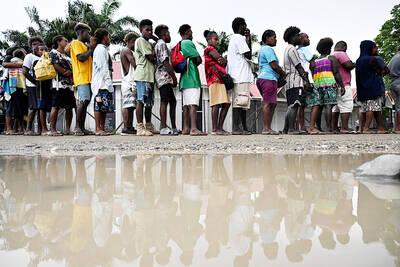
SEEKING CHANGE: A hospital worker said she did not vote in previous elections, but ‘now I can see that maybe my vote can change the system and the country’ Voting closed yesterday across the Solomon Islands in the south Pacific nation’s first general election since the government switched diplomatic allegiance from Taiwan to Beijing and struck a secret security pact that has raised fears of the Chinese navy gaining a foothold in the region. The Solomon Islands’ closer relationship with China and a troubled domestic economy weighed on voters’ minds as they cast their ballots. As many as 420,000 registered voters had their say across 50 national seats. For the first time, the national vote also coincided with elections for eight of the 10 local governments. Esther Maeluma cast her vote in the
Nearly half of China’s major cities are suffering “moderate to severe” levels of subsidence, putting millions of people at risk of flooding, especially as sea levels rise, according to a study of nationwide satellite data released yesterday. The authors of the paper, published by the journal Science, found that 45 percent of China’s urban land was sinking faster than 3mm per year, with 16 percent at more than 10mm per year, driven not only by declining water tables, but also the sheer weight of the built environment. With China’s urban population already in excess of 900 million people, “even a small portion

UNSETTLING IMAGES: The scene took place in front of TV crews covering the Trump trial, with a CNN anchor calling it an ‘emotional and unbelievably disturbing moment’ A man who doused himself in an accelerant and set himself on fire outside the courthouse where former US president Donald Trump is on trial has died, police said yesterday. The New York City Police Department (NYPD) said the man was declared dead by staff at an area hospital. The man was in Collect Pond Park at about 1:30pm on Friday when he took out pamphlets espousing conspiracy theories, tossed them around, then doused himself in an accelerant and set himself on fire, officials and witnesses said. A large number of police officers were nearby when it happened. Some officers and bystanders rushed

HYPOCRISY? The Chinese Ministry of Foreign Affairs yesterday asked whether Biden was talking about China or the US when he used the word ‘xenophobic’ US President Joe Biden on Wednesday called for a hike in steel tariffs on China, accusing Beijing of cheating as he spoke at a campaign event in Pennsylvania. Biden accused China of xenophobia, too, in a speech to union members in Pittsburgh. “They’re not competing, they’re cheating. They’re cheating and we’ve seen the damage here in America,” Biden said. Chinese steel companies “don’t need to worry about making a profit because the Chinese government is subsidizing them so heavily,” he said. Biden said he had called for the US Trade Representative to triple the tariff rates for Chinese steel and aluminum if Beijing was


 RSS
RSS