


Hamas came out of hiding Saturday, holding a mass news conference for the first time in a decade and distributing the phone numbers of 34 multilingual spokesmen as a battle for control of the Gaza Strip gained steam ahead of Israel's withdrawal next week.
In this struggle between Hamas and the Palestinian Authority -- both of whom claim responsibility for Israel's evacuation of 21 Gaza Strip settlements and four West Bank enclaves -- spokesmen, Internet accessible media centers and TV availability to late-night Hamas training sessions are the weapons of choice.
For the first time since Israel began targeting Hamas' top leadership two years ago, the Islamic group surfaced, handing out phone numbers of spokesmen fluent in Arabic, English and French.
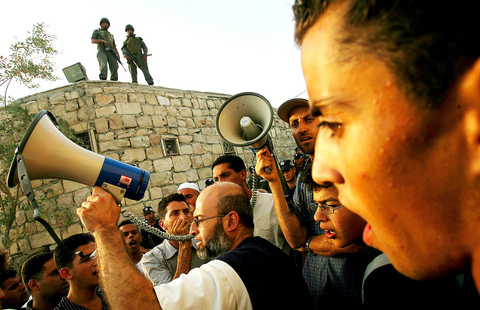
PHOTO: AP
Palestinian President Mahmoud Abbas, determined to beat Hamas in the war for the airwaves, inaugurated on Saturday a special Gaza withdrawal media center, complete with live feed points for TV crews, a 24-hour SMS service for news updates, maps and free hats and T-shirts.
"The center will facilitate the media in all they need. It is ready to meet all your demands. A group of Cabinet ministers and officials will be ready at all times to answer your questions," Abbas assured the journalists gathered at the media center.
Earlier in the day, founders and top Hamas political leaders gathered on the same stage for the first time in a decade, vowing to go on fighting Israel and claiming victory for the impending withdrawal.
On Thursday, Hamas for the first time invited TV cameras to film a nighttime training session, complete with militants rappelling off high-rise walls and jumping through flaming hoops. Islamic Jihad also released Saturday training footage of militants dressed in camouflage with masked faces crawling through tunnels and under mesh-wiring while coming under live fire.
Hamas has hired the spokesmen "to take on the huge responsibility of educating the world about the importance of the withdrawal," said Mushir Masri, one of the militant group's army of spokesmen.
"The media presence is in high demand especially since the enemy has been defeated and there is no longer a security concern preventing them from appearing in public," Masri told reporters.
The Hamas leadership went underground two years ago when Israel began targeting the group's founders and top brass, including spiritual leader Sheik Ahmed Yassin and his successor, Abdel Aziz Rantisi, both killed in missile strikes.
But recently Hamas has been openly challenging the Palestinian Authority, and even made a strong showing in West Bank and Gaza municipal elections. On Saturday, the Hamas leadership said at its news conference that Abbas' Fatah movement could not be the sole decision-making body and insisted it has the right to possess arms.
"Hamas remains committed to the choice of resistance as a strategic choice. Hamas remains committed to its military wing and its right to possess weapons," said Ismail Haniyye, a top Hamas leader.
Hamas does not plan to battle the Palestinian Authority, but "rejects the idea of allowing any single party to monopolize the decision-making process," Haniyye added.
Hamas' news conference came just a day after Abbas attended the first official Palestinian Authority celebration of Israel's upcoming withdrawal, promising his people the Gaza pullout was the first step to an independence.
At Friday's Gaza sea-front rally, Cabinet minister Mohammed Dahlan said all events would take place under the official Palestinian flag, a warning to Hamas, which is planning its own military-style celebrations.
Meanwhile, Palestinian Interior Minister Nasser Yousef placed his forces in the Gaza Strip on Saturday on their highest alert level. The forces are responsible for preventing militants from firing on troops and settlers withdrawing from the Gaza Strip. Israel promised to harshly retaliate if Palestinians fire on forces and settlers.
"You are the defenders of the homeland," Yousef told his troops.
Hundreds of Palestinian security officers took up positions in areas closest to the Jewish settlements. Hundreds of security forces were sent to southern Gaza, especially near the Khan Younis and Rafah refugee camps.
Hours later, about 200 Palestinian troops in Khan Younis made a human chain to prevent some 2,000 demonstrators from marching toward the checkpoint separating the refugee camp and the nearby settlements.
Israeli soldiers fired in the air to keep the Palestinian flag-waving demonstrators back. A local Fatah leader told the crowd to save its energy for after the Israeli withdrawal when they will be able to enter their "liberated lands."

Republican US lawmakers on Friday criticized US President Joe Biden’s administration after sanctioned Chinese telecoms equipment giant Huawei unveiled a laptop this week powered by an Intel artificial intelligence (AI) chip. The US placed Huawei on a trade restriction list in 2019 for contravening Iran sanctions, part of a broader effort to hobble Beijing’s technological advances. Placement on the list means the company’s suppliers have to seek a special, difficult-to-obtain license before shipping to it. One such license, issued by then-US president Donald Trump’s administration, has allowed Intel to ship central processors to Huawei for use in laptops since 2020. China hardliners
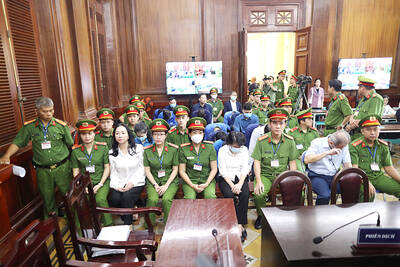
A top Vietnamese property tycoon was on Thursday sentenced to death in one of the biggest corruption cases in history, with an estimated US$27 billion in damages. A panel of three hand-picked jurors and two judges rejected all defense arguments by Truong My Lan, chair of major developer Van Thinh Phat, who was found guilty of swindling cash from Saigon Commercial Bank (SCB) over a decade. “The defendant’s actions ... eroded people’s trust in the leadership of the [Communist] Party and state,” read the verdict at the trial in Ho Chi Minh City. After the five-week trial, 85 others were also sentenced on

‘DELUSIONAL’: Targeting the families of Hamas’ leaders would not push the group to change its position or to give up its demands for Palestinians, Ismail Haniyeh said Israeli aircraft on Wednesday killed three sons of Hamas’ top political leader in the Gaza Strip, striking high-stakes targets at a time when Israel is holding delicate ceasefire negotiations with the militant group. Hamas said four of the leader’s grandchildren were also killed. Ismail Haniyeh’s sons are among the highest-profile figures to be killed in the war so far. Israel said they were Hamas operatives, and Haniyeh accused Israel of acting in “the spirit of revenge and murder.” The deaths threatened to strain the internationally mediated ceasefire talks, which appeared to gain steam in recent days even as the sides remain far
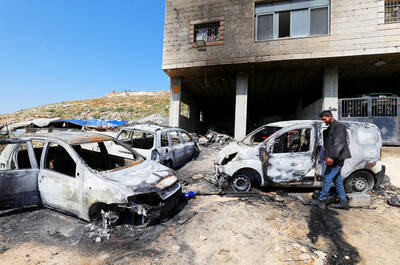
RAMPAGE: A Palestinian man was left dead after dozens of Israeli settlers searching for a missing 14-year-old boy stormed a village in the Israeli-occupied West Bank US President Joe Biden on Friday said he expected Iran to attack Israel “sooner, rather than later” and warned Tehran not to proceed. Asked by reporters about his message to Iran, Biden simply said: “Don’t,” underscoring Washington’s commitment to defend Israel. “We are devoted to the defense of Israel. We will support Israel. We will help defend Israel and Iran will not succeed,” he said. Biden said he would not divulge secure information, but said his expectation was that an attack could come “sooner, rather than later.” Israel braced on Friday for an attack by Iran or its proxies as warnings grew of


 RSS
RSS