


As Asia celebrates the 60th anniversary of the end of World War II, Japan's earth-shaking defeat of Russian armies on Chinese soil 100 years ago has all but been forgotten.
The Russo-Japanese War of 1904-05 marked Japan's rise as a global power and was the first time an Asian country had defeated a Western nation since the Mongol Genghis Khan fought his way to Europe.
The conflict also unleashed for the first time the brutal killing machines that marked the two World Wars of the 20th century.
"Japan's victory shocked the world not only because it defeated Russia, but also because of its naval and siege tactics," said Bill Madison, founder of the US-based Russo-Japanese War Research Society.
"Japan's victory showed that its armies were on a par with other imperialist powers in the carving up of China."
Following the war, Japan occupied Korea and by 1931 invaded Manchuria, attacked south of China's Great Wall in 1937 and then extended its invasion throughout Asia during World War II.
Despite its defeat in World War II, Japan continued its dramatic rise, albeit economically and largely through its Cold War alliance with the United States.
But it is its defeat of Russia that has long been a reminder of what a rising power can do if it can equip its military with state-of-the-art weapons.
Japan's fighting spirit and the willingness of its soldiers to die for the nation was in full evidence in the 1904-05 war, suffering some 190,000 casualties despite winning every battle on land and sea.
The war was the first "modern war" where big bore guns and automatic weapons showed to terrible effect that traditional mass infantry attacks against entrenched positions were obsolete, Madison said.
"This was the first time you saw trench warfare, the weapons were the most lethal ever, machine guns, rapid-fire howitzers, 280mm artillery shells, armoured ships, barbed wire, all these were used to devastating effect," Madison said.
"In naval battle, this war proved that close-in fighting would also lead to massive casualties and destruction."
The war began in February 1904 with a surprise Japanese attack on Russian naval forces at Port Arthur, a tactic Japan had used successfully in the 1894-95 Sino-Japanese war and would again use against the United States at Pearl Harbor in 1941.
Lushun, then known as Port Arthur, rests at the tip of China's Liaodong peninsula and was occupied in 1897 by Russia, which needed a warm water port for its Pacific Fleet.
After blockading the fleet, Japan began landing its soldiers in Korea and further up the Liaodong peninsula routing Russian resistance in the battles of Yalu, Nanshan and Dalian and eventually laying a land siege to Port Arthur for 244 days.
During the siege, Japanese infantry and cannon incessantly attacked the 22 forts that Russia had built on surrounding hill tops despite a hail of Russian shells and bullets.
Japan lost nearly 58,000 soldiers, as wave after wave of attacks assaulted the fortified positions. Some 31,000 Russian soldiers met their deaths in the battle, considered one of the earliest instances of trench warfare.
"If the lessons of Port Arthur would have been better learned by military commanders in Europe then maybe the trench tactics of World War I could have been avoided," Madison said.
After taking the hills around Port Arthur, Japanese guns further destroyed the remaining Russian ships in the harbour and forced a surrender in January 1905.
Japan then turned its attention to Russia's retreating armies in Manchuria to the north, where its army of 250,000 soldiers routed some 320,000 Russians in the bloody battles of Liaoyang and Mukden.
As Port Arthur was falling, Russian Tzar Nicholas II dispatched his Baltic Fleet half way around the world but it arrived too late and was wiped out in the Battle of Tsushima in the Strait of Japan in one of the biggest naval battles ever.
"Historically this war showed the extent of world imperialism at the beginning of the last century with two belligerent powers fighting a war on the soil of a third country," said Guan Jie, co-author of The Japanese-Russo War, a book published earlier this year.
"The Qing government was too weak and too corrupt and could not defend China against the advanced weapons of the invaders."
Russia and Japan, both exhausted from the war and unable to achieve decisive victory in Manchuria, reached a peace agreement in the September 1905 Treaty of Portsmouth, brokered by the United States.
With the end of the war, Japan began a 40-year occupation of Port Arthur and the bustling seaport of Dalian, 60km to the north.
A month after Tsushima, uprisings caused by general discontent, including Russia's humiliating defeat to Japan, erupted across Russia in the first revolution that lit the fuse of the 1917 Bolshevik Revolution.
"At the end of World War II, the Soviet Union armies liberated Dalian and Port Arthur, so this is why we say that 2005 marks the 60th anniversary of Dalian's liberation," Guan said.
Locals tend to ignore the fact that following liberation Port Arthur remained in Soviet hands until 1955 when Josef Stalin finally agreed to return it to Chinese sovereignty.
Today the green, rolling hills around Lushun are silent of gun fire, although war memorials and buildings built by Japan and Russia remain key fixtures.
The port is now home to China's nuclear-powered submarine fleet and remains a strategic naval base protecting the mouth of the Bohai Sea and the cities of Beijing and Tianjin to the west.

Republican US lawmakers on Friday criticized US President Joe Biden’s administration after sanctioned Chinese telecoms equipment giant Huawei unveiled a laptop this week powered by an Intel artificial intelligence (AI) chip. The US placed Huawei on a trade restriction list in 2019 for contravening Iran sanctions, part of a broader effort to hobble Beijing’s technological advances. Placement on the list means the company’s suppliers have to seek a special, difficult-to-obtain license before shipping to it. One such license, issued by then-US president Donald Trump’s administration, has allowed Intel to ship central processors to Huawei for use in laptops since 2020. China hardliners
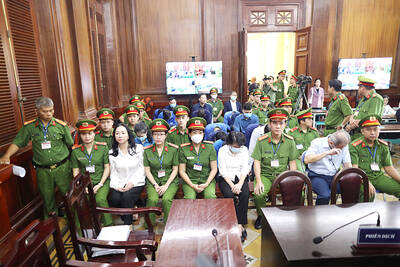
A top Vietnamese property tycoon was on Thursday sentenced to death in one of the biggest corruption cases in history, with an estimated US$27 billion in damages. A panel of three hand-picked jurors and two judges rejected all defense arguments by Truong My Lan, chair of major developer Van Thinh Phat, who was found guilty of swindling cash from Saigon Commercial Bank (SCB) over a decade. “The defendant’s actions ... eroded people’s trust in the leadership of the [Communist] Party and state,” read the verdict at the trial in Ho Chi Minh City. After the five-week trial, 85 others were also sentenced on

Conjoined twins Lori and George Schappell, who pursued separate careers, interests and relationships during lives that defied medical expectations, died this month in Pennsylvania, funeral home officials said. They were 62. The twins, listed by Guinness World Records as the oldest living conjoined twins, died on April 7 at the Hospital of the University of Pennsylvania, obituaries posted by Leibensperger Funeral Homes of Hamburg said. The cause of death was not detailed. “When we were born, the doctors didn’t think we’d make 30, but we proved them wrong,” Lori said in an interview when they turned 50, the Philadelphia Inquirer reported. The
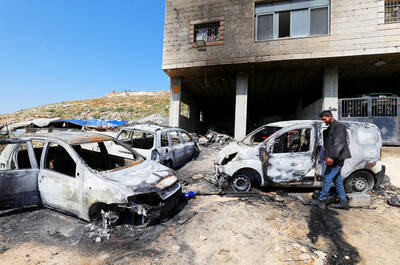
RAMPAGE: A Palestinian man was left dead after dozens of Israeli settlers searching for a missing 14-year-old boy stormed a village in the Israeli-occupied West Bank US President Joe Biden on Friday said he expected Iran to attack Israel “sooner, rather than later” and warned Tehran not to proceed. Asked by reporters about his message to Iran, Biden simply said: “Don’t,” underscoring Washington’s commitment to defend Israel. “We are devoted to the defense of Israel. We will support Israel. We will help defend Israel and Iran will not succeed,” he said. Biden said he would not divulge secure information, but said his expectation was that an attack could come “sooner, rather than later.” Israel braced on Friday for an attack by Iran or its proxies as warnings grew of


 RSS
RSS