


Kokichi Morimoto knows his father only as a kimono-clad man in a black-and-white photograph dated Dec. 25, 1942 -- the day he joined Japan's imperialist war in Asia as a soldier, never to return.
The family later received a military letter confirming Toshio Morimoto's death on Dec. 3, 1944 at the age of 30 on patrol in Boikin, a town in northeastern Papua New Guinea. But his body has never been recovered or identified.
"If it is difficult to identify each one of them, we should at least bring home as many of them as possible so they can rest in peace," said Morimoto, 62, who has joined bereaved families fighting to identify the remains of lost soldiers.
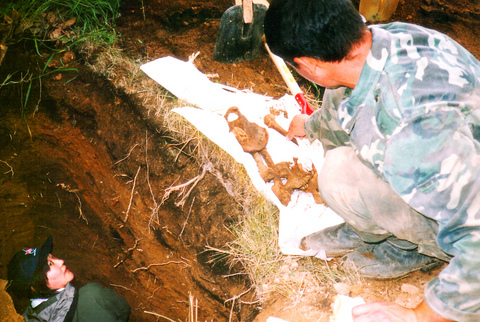
PHOTO: AP
As the 60th anniversary of the end of World War II approaches tomorrow, Japan faces a grim reminder of the price it paid for its war of aggression in Asia: the government says half of the 2.4 million Japanese who died overseas have never been recovered.
And the odds are rising that they never will be properly accounted for. While families like Morimoto's hope recent advances in DNA testing could help, Health Minister Hidehisa Otsuji says the remains "have become so fragile they almost crumble when you touch them. They have almost turned into soil."
"At some point we should conduct an intensive search and then draw the line," he told a Parliamentary committee.
Of the Japanese who died overseas during the war, including 300,000 civilians, about 850,000 have been identified, most of them from China. Another 350,000 unidentified remains were recovered and are interred as unknown soldiers at Tokyo's Chidorigafuchi memorial. The rest -- about 1.16 million -- are scattered anonymously over the vast war zone, from the killing fields of Iwo Jima, Saipan, Okinawa in the Pacific, to Papua New Guinea in the south and Burma, Mongolia and the former Soviet Union in the west.
The number is far below that given for the former Soviet Union. Some 2.3 million World War II fighters are unaccounted for, according to Defense Ministry figures. Germany's missing total 1.3 million soldiers and civilians. About 78,000 US servicemen are unaccounted for, according to the US.
China and North Korea, still aggrieved over Japan's wartime invasions, bar Japanese search parties. But teams of veterans, bereaved families and volunteers have had greater freedom to operate in Russia since the collapse of the Soviet Union. In Japan, reverence for ancestors places a premium on proper burial and annual observances. Still, officials say interest is waning as war memories fade and survivors die off. They say of 6,000 families asked to participate in DNA testing, only 1,000 responded.
Morimoto didn't give up. In 2003, just months after his retirement, he joined a government-sponsored trip to Papua New Guinea, where the group excavated a vegetable field and found more than 100 remains of unknown Japanese soldiers. The remains were too decayed to determine whether Morimoto's father was among them.
"The skeletons appearing from the soil just broke my heart ... abandoned for so many years in the middle of nowhere so far away from home," he said.
The effort continues. On Thursday, the remains of eight soldiers who died in the 1939 battle with the Soviets near the border between northeastern China and Mongolia were returned and await examination for possible DNA testing. More than 3,000 other soldiers are believed still buried at that battlefield. But Japan lacks facilities to handle such old remains, and since 2003, only 67 war dead have been identified.
Keiko Tatsumi, 66, has made several trips to eastern Papua New Guinea, where fellow veterans say her father, Tatsuo, was last seen alive 62 years ago. The search also brought Tatsumi to grips with Japan's wartime past. Villagers angrily told her how Japanese troops murdered their relatives.
But after repeated visits they have become friends, she said.
"I just want to be where my father spent his final days," Tatsumi said. "I promised my father that I'll come back and look for him."

Republican US lawmakers on Friday criticized US President Joe Biden’s administration after sanctioned Chinese telecoms equipment giant Huawei unveiled a laptop this week powered by an Intel artificial intelligence (AI) chip. The US placed Huawei on a trade restriction list in 2019 for contravening Iran sanctions, part of a broader effort to hobble Beijing’s technological advances. Placement on the list means the company’s suppliers have to seek a special, difficult-to-obtain license before shipping to it. One such license, issued by then-US president Donald Trump’s administration, has allowed Intel to ship central processors to Huawei for use in laptops since 2020. China hardliners
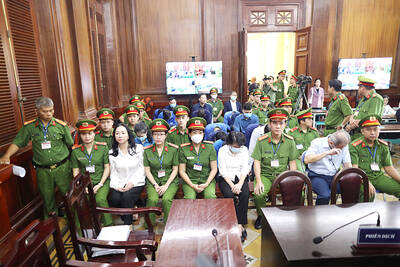
A top Vietnamese property tycoon was on Thursday sentenced to death in one of the biggest corruption cases in history, with an estimated US$27 billion in damages. A panel of three hand-picked jurors and two judges rejected all defense arguments by Truong My Lan, chair of major developer Van Thinh Phat, who was found guilty of swindling cash from Saigon Commercial Bank (SCB) over a decade. “The defendant’s actions ... eroded people’s trust in the leadership of the [Communist] Party and state,” read the verdict at the trial in Ho Chi Minh City. After the five-week trial, 85 others were also sentenced on

‘DELUSIONAL’: Targeting the families of Hamas’ leaders would not push the group to change its position or to give up its demands for Palestinians, Ismail Haniyeh said Israeli aircraft on Wednesday killed three sons of Hamas’ top political leader in the Gaza Strip, striking high-stakes targets at a time when Israel is holding delicate ceasefire negotiations with the militant group. Hamas said four of the leader’s grandchildren were also killed. Ismail Haniyeh’s sons are among the highest-profile figures to be killed in the war so far. Israel said they were Hamas operatives, and Haniyeh accused Israel of acting in “the spirit of revenge and murder.” The deaths threatened to strain the internationally mediated ceasefire talks, which appeared to gain steam in recent days even as the sides remain far
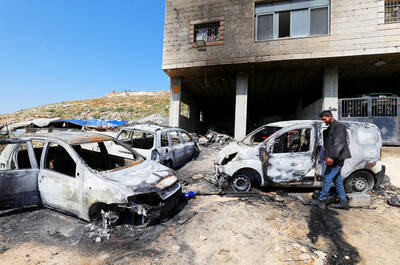
RAMPAGE: A Palestinian man was left dead after dozens of Israeli settlers searching for a missing 14-year-old boy stormed a village in the Israeli-occupied West Bank US President Joe Biden on Friday said he expected Iran to attack Israel “sooner, rather than later” and warned Tehran not to proceed. Asked by reporters about his message to Iran, Biden simply said: “Don’t,” underscoring Washington’s commitment to defend Israel. “We are devoted to the defense of Israel. We will support Israel. We will help defend Israel and Iran will not succeed,” he said. Biden said he would not divulge secure information, but said his expectation was that an attack could come “sooner, rather than later.” Israel braced on Friday for an attack by Iran or its proxies as warnings grew of


 RSS
RSS