


A vast expanse of western Siberia is undergoing an unprecedented thaw that could dramatically increase the rate of global warming, climate scientists warned yesterday.
Researchers who have recently returned from the region found that an area of permafrost spanning 1 million km2 -- the size of France and Germany combined -- has started to melt for the first time since it formed 11,000 years ago at the end of the last ice age.
The area, which covers the entire sub-Arctic region of western Siberia, is the world's largest frozen peat bog and scientists fear that, as it thaws, it will release billions of tonnes of methane, a greenhouse gas 20 times more potent than carbon dioxide, into the atmosphere.
It is a scenario climate scientists have feared since first identifying "tipping points" -- delicate thresholds where a slight rise in the Earth's temperature can cause a dramatic change in the environment that itself triggers a far greater hike in global temperatures.
The discovery was made by Sergei Kirpotin at Tomsk State University in western Siberia and Judith Marquand at Oxford University and was reported in New Scientist yesterday.
The researchers found that what was until recently a barren expanse of frozen peat is turning into a broken landscape of mud and lakes, some more than 1km across.
Kirpotin told the magazine the situation was an "ecological landslide that is probably irreversible and is undoubtedly connected to climatic warming."
He added that the thaw had probably begun in the past three or four years.
Climate scientists yesterday reacted with alarm to the finding, and warned that predictions of future global temperatures would have to be revised upwards.
"When you start messing around with these natural systems, you can end up in situations where it's unstoppable. There are no brakes you can apply," said David Viner, a scientist at the Climatic Research Unit at the University of East Anglia. "This is a big deal because you can't put the permafrost back once it's gone. The causal effect is human activity and it will ramp up temperatures even more than our emissions are doing."
Scientists are particularly concerned about the permafrost because as it thaws, it reveals bare ground which warms up more quickly than ice and snow, and so accelerates the rate at which the permafrost thaws.
The permafrost is likely to take many decades at least to thaw, so the methane locked within it will not be released into the atmosphere in one burst, said Stephen Sitch, a scientist at the Met Office's Hadley Centre in Exeter.
But calculations by Sitch and his colleagues show that even if methane seeped from the permafrost over the next 100 years, it would add around 700 million tonnes of carbon into the atmosphere each year, roughly the same amount that is released annually from the world's wetlands and agriculture. It would effectively double atmospheric levels of the gas, leading to a 10 percent to 25 percent increase in global warming, he said.
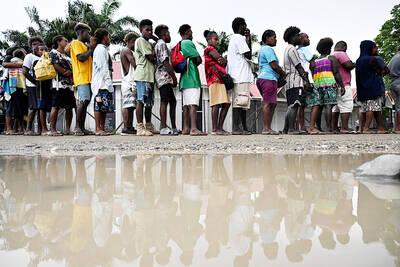
SEEKING CHANGE: A hospital worker said she did not vote in previous elections, but ‘now I can see that maybe my vote can change the system and the country’ Voting closed yesterday across the Solomon Islands in the south Pacific nation’s first general election since the government switched diplomatic allegiance from Taiwan to Beijing and struck a secret security pact that has raised fears of the Chinese navy gaining a foothold in the region. The Solomon Islands’ closer relationship with China and a troubled domestic economy weighed on voters’ minds as they cast their ballots. As many as 420,000 registered voters had their say across 50 national seats. For the first time, the national vote also coincided with elections for eight of the 10 local governments. Esther Maeluma cast her vote in the
Nearly half of China’s major cities are suffering “moderate to severe” levels of subsidence, putting millions of people at risk of flooding, especially as sea levels rise, according to a study of nationwide satellite data released yesterday. The authors of the paper, published by the journal Science, found that 45 percent of China’s urban land was sinking faster than 3mm per year, with 16 percent at more than 10mm per year, driven not only by declining water tables, but also the sheer weight of the built environment. With China’s urban population already in excess of 900 million people, “even a small portion

UNSETTLING IMAGES: The scene took place in front of TV crews covering the Trump trial, with a CNN anchor calling it an ‘emotional and unbelievably disturbing moment’ A man who doused himself in an accelerant and set himself on fire outside the courthouse where former US president Donald Trump is on trial has died, police said yesterday. The New York City Police Department (NYPD) said the man was declared dead by staff at an area hospital. The man was in Collect Pond Park at about 1:30pm on Friday when he took out pamphlets espousing conspiracy theories, tossed them around, then doused himself in an accelerant and set himself on fire, officials and witnesses said. A large number of police officers were nearby when it happened. Some officers and bystanders rushed

HYPOCRISY? The Chinese Ministry of Foreign Affairs yesterday asked whether Biden was talking about China or the US when he used the word ‘xenophobic’ US President Joe Biden on Wednesday called for a hike in steel tariffs on China, accusing Beijing of cheating as he spoke at a campaign event in Pennsylvania. Biden accused China of xenophobia, too, in a speech to union members in Pittsburgh. “They’re not competing, they’re cheating. They’re cheating and we’ve seen the damage here in America,” Biden said. Chinese steel companies “don’t need to worry about making a profit because the Chinese government is subsidizing them so heavily,” he said. Biden said he had called for the US Trade Representative to triple the tariff rates for Chinese steel and aluminum if Beijing was


 RSS
RSS