


US President George W. Bush said he was "deeply suspicious" of Iran but was not ready to seek UN sanctions against Tehran for its suspected nuclear-weapons program.
Speaking to reporters at his Texas ranch on Tuesday, Bush said the newly elected president of Iran, Mahmoud Ahmadinejad, had indicated a willingness to continue discussions with European nations.
"The man said he wanted to negotiate," Bush said following a meeting with his economic advisers.
He added that if Iran does not cooperate, UN sanctions are "a potential consequence."
While expressing a willingness to talk, Ahmadinejad named Ali Larijani, one of the most hardline elements in the Islamic government, to head the negotiations. Ali Agha Mohammadi, a spokesman of Iran's Supreme National Security Council, told AP of Larijani's appointment.
Over the weekend, Iran rejected a package of economic, political and technological incentives offered by Britain, France and Germany. The incentives were extended in return for assurances that Tehran would not pursue nuclear weapons. Iranian officials said the package was rejected mainly because it did not recognize Iran's right to enrich uranium, which can be used for producing both nuclear energy and nuclear weapons.
On Monday, Iran resumed the process of converting uranium at its Isfahan nuclear facility -- a step that Europeans and the US have warned would prompt them to seek UN sanctions.
State Department spokesman Adam Ereli on Monday characterized the new conversion activities as "Iran thumbing its nose" at the Europeans' diplomatic offer.
In the past, Bush has issued stern warnings against Iran, which insists its nuclear program is peaceful and geared solely toward generating energy. The US and other nations think Tehran is hiding a weapons program, especially since Iran has vast supplies of petroleum and natural gas.
At the ranch, Bush seemed to take a softer approach.
"Just as I was walking in here, I received word that the new Iranian president said he was willing to get back to the table," Bush said, calling that a positive sign.
It is unclear, however, how long the Bush administration will back negotiations with the conservative new Iranian president.
Because of uncertainty about his role in events surrounding the US embassy takeover in 1979, the State Department is considering whether to grant Ahmadinejad a US visa to attend a massive UN General Assembly gathering in New York next month.
Bush said that Iran should be clear that the US stands squarely behind the negotiations led by the three European nations, dubbed the EU-3.
"In terms of consequences if the Iranians continue to balk, we'll work with the EU-3," Bush said.
"They're the lead negotiators on behalf of the free world. And we will work with them in terms of what consequences there may be. And certainly the United Nations is a potential consequence," he said.
Also on Tuesday, the UN nuclear watchdog agency held an emergency meeting in Vienna to assess Iran's resumption of uranium conversion.
Diplomats in Vienna said the International Atomic Energy Agency (IAEA) was likely to issue a resolution by today urging Tehran to again suspend its nuclear activities.
"Iran must not be allowed to violate its international commitments and must not be allowed to develop nuclear weapons," said Gregory Schulte, US envoy to the IAEA.
In Washington, US Defense Secretary Donald Rumsfeld called Iran "notably unhelpful" in US-led efforts to pacify neighboring Iraq.
He said some conventional weapons from Iran were reaching insurgents in Iraq, but suggested it was unclear whether elements of the Iranian government played a role in supplying them.
"It is true that weapons, clearly, unambiguously from Iran, have been found in Iraq," Rumsfeld said at a Pentagon press conference.
"It's notably unhelpful for the Iranians to be allowing weapons of those types to be crossing the border," he said.
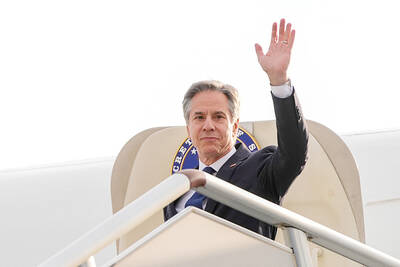
‘IN A DIFFERENT PLACE’: The envoy first visited Shanghai, where he attended a Chinese basketball playoff match, and is to meet top officials in Beijing tomorrow US Secretary of State Antony Blinken yesterday arrived in China on his second visit in a year as the US ramps up pressure on its rival over its support for Russia while also seeking to manage tensions with Beijing. The US diplomat tomorrow is to meet China’s top brass in Beijing, where he is also expected to plead for restraint as Taiwan inaugurates president-elect William Lai (賴清德), and to raise US concerns on Chinese trade practices. However, Blinken is also seeking to stabilize ties, with tensions between the world’s two largest economies easing since his previous visit in June last year. At the
Nearly half of China’s major cities are suffering “moderate to severe” levels of subsidence, putting millions of people at risk of flooding, especially as sea levels rise, according to a study of nationwide satellite data released yesterday. The authors of the paper, published by the journal Science, found that 45 percent of China’s urban land was sinking faster than 3mm per year, with 16 percent at more than 10mm per year, driven not only by declining water tables, but also the sheer weight of the built environment. With China’s urban population already in excess of 900 million people, “even a small portion
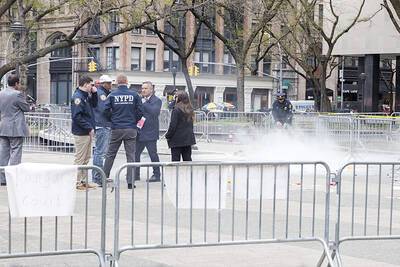
UNSETTLING IMAGES: The scene took place in front of TV crews covering the Trump trial, with a CNN anchor calling it an ‘emotional and unbelievably disturbing moment’ A man who doused himself in an accelerant and set himself on fire outside the courthouse where former US president Donald Trump is on trial has died, police said yesterday. The New York City Police Department (NYPD) said the man was declared dead by staff at an area hospital. The man was in Collect Pond Park at about 1:30pm on Friday when he took out pamphlets espousing conspiracy theories, tossed them around, then doused himself in an accelerant and set himself on fire, officials and witnesses said. A large number of police officers were nearby when it happened. Some officers and bystanders rushed
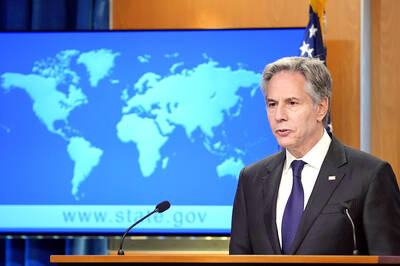
Beijing is continuing to commit genocide and crimes against humanity against Uyghurs and other Muslim minorities in its western Xinjiang province, U.S. Secretary of State Antony Blinken said in a report published on Monday, ahead of his planned visit to China this week. The State Department’s annual human rights report, which documents abuses recorded all over the world during the previous calendar year, repeated language from previous years on the treatment of Muslims in Xinjiang, but the publication raises the issue ahead of delicate talks, including on the war in Ukraine and global trade, between the top U.S. diplomat and Chinese


 RSS
RSS