


Tears course from Sidi Moham-med's protruding eyes and the frail 12-month-old boy squirms and mewls in his mother's arms as she tries to get him to drink from a blue plastic cup of vitamin-rich gruel aid workers have brought to northeastern Mali.
The aid workers say the food crisis here is raging largely unnoticed by a world preoccupied with hunger in next-door Niger. There are fears of a replay of the drama in Niger, where the world ignored repeated warnings and only rushed in when images of starving children hit the airwaves.
Across the chronically dry and dusty West African region on the edge of the Sahara, malnutrition is a yearly occurrence for many. Poor rains and a plague of locusts last year have made the situation worse, leaving hundreds of thousands in dire need of help. Malnourished children like Sidi and his three siblings are dangerously underfed and reliant on food aid. Burkina Faso and Mauritania also are affected.
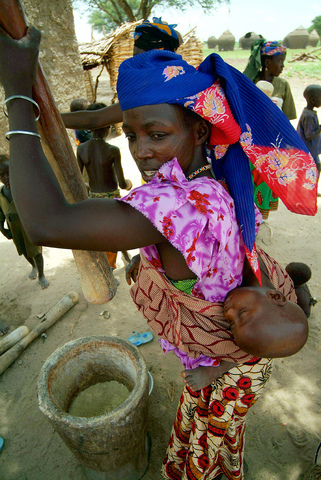
PHOTO: AP
"We had nothing to eat except the milk of our three sheep. I was very afraid. What could I do for my children?" says Sidi's mother, 25-year-old Ahmetan Ahmedu.
In Mali, a nation of 11 million to Niger's west, the government says some 1.5 million people are in the midst of a food crisis after their crops were wiped out and herds thinned last year, with an estimated 144,000 malnourished children on the edge in the sere north and east.
Mali's difficulties aren't believed to be as severe as Niger's -- yet. The UN's World Food Program said on July 28 tshat 5,000 children in the north were suffering acute malnutrition after agricultural production was 42 percent lower last year than the year earlier.
In the worst-affected areas, between 16 and 33 percent of Malian children are believed malnourished, which untreated can kill or stunt growth and cause behavior difficulties in later years, the government and aid groups say.
The UN World Food Program said an appeal for US$7.5 million was facing a shortfall of 85 percent. The UN agency calls the lack of funding for Mali "devastating."
A similar appeal for Niger had reached 70 percent of the US$16 million sought, with Australia, Germany and the US the biggest Niger donors. But the first calls for help for the entire region went out in November and the response for Niger came only in recent weeks.
Aid workers say the crisis is unfolding deep in Mali's dusty bush, where many of Mali's widely wandering Fulani, Tuareg and Tamachek people tend their flocks.
"The TV cameras whose horrific images of hunger in Niger caught the international community's attention have not yet reached the affected areas of Mali," the World Food Program said in a statement.
Mali's government made its own appeal in May and also started free food distributions early this year to partially cover a deficit of 315,000 tonnes of grains and other harvest goods.
Nearly half of China’s major cities are suffering “moderate to severe” levels of subsidence, putting millions of people at risk of flooding, especially as sea levels rise, according to a study of nationwide satellite data released yesterday. The authors of the paper, published by the journal Science, found that 45 percent of China’s urban land was sinking faster than 3mm per year, with 16 percent at more than 10mm per year, driven not only by declining water tables, but also the sheer weight of the built environment. With China’s urban population already in excess of 900 million people, “even a small portion

UNSETTLING IMAGES: The scene took place in front of TV crews covering the Trump trial, with a CNN anchor calling it an ‘emotional and unbelievably disturbing moment’ A man who doused himself in an accelerant and set himself on fire outside the courthouse where former US president Donald Trump is on trial has died, police said yesterday. The New York City Police Department (NYPD) said the man was declared dead by staff at an area hospital. The man was in Collect Pond Park at about 1:30pm on Friday when he took out pamphlets espousing conspiracy theories, tossed them around, then doused himself in an accelerant and set himself on fire, officials and witnesses said. A large number of police officers were nearby when it happened. Some officers and bystanders rushed

Beijing is continuing to commit genocide and crimes against humanity against Uyghurs and other Muslim minorities in its western Xinjiang province, U.S. Secretary of State Antony Blinken said in a report published on Monday, ahead of his planned visit to China this week. The State Department’s annual human rights report, which documents abuses recorded all over the world during the previous calendar year, repeated language from previous years on the treatment of Muslims in Xinjiang, but the publication raises the issue ahead of delicate talks, including on the war in Ukraine and global trade, between the top U.S. diplomat and Chinese

HYPOCRISY? The Chinese Ministry of Foreign Affairs yesterday asked whether Biden was talking about China or the US when he used the word ‘xenophobic’ US President Joe Biden on Wednesday called for a hike in steel tariffs on China, accusing Beijing of cheating as he spoke at a campaign event in Pennsylvania. Biden accused China of xenophobia, too, in a speech to union members in Pittsburgh. “They’re not competing, they’re cheating. They’re cheating and we’ve seen the damage here in America,” Biden said. Chinese steel companies “don’t need to worry about making a profit because the Chinese government is subsidizing them so heavily,” he said. Biden said he had called for the US Trade Representative to triple the tariff rates for Chinese steel and aluminum if Beijing was


 RSS
RSS