


The highest Islamic authority in Indonesia has been criticized by the world's largest Muslim organization over its controversial edicts against "liberal Islamic thought," a report said yesterday.
The Indonesian Ulema Council last week issued 11 edicts to fight "deviance and secularism" in the world's largest Muslim-populated nation.
One of them stated that Islamic interpretations based on liberalism, secularism and pluralism "contradict Islamic teachings."
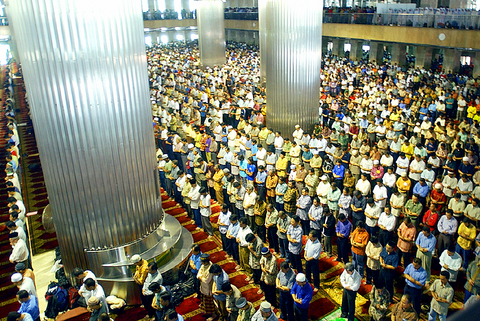
PHOTO: AP
It also reavowed a 25-year-old ban on mixed-faith marriages as being haram or forbidden under Islamic law and banned interfaith prayers.
In addition, it reaffirmed a 1980 ban on the "heretical" Ahmadiyah sect, which recognizes its founder Ghulam Mirza Ahmad as a prophet, in contravention of mainstream Islam, which sees Mohammed as the last prophet.
Ahmadiyah communities have been the targets of repeated attacks in recent years.
The chairman of the world's largest Muslim organization, Nahdlatul Ulama, which has an estimated 40 million members, criticized the edicts and said the council should consider their impact on Indonesia's diverse society, the Jakarta Post said.
Chairman Hasyim Muzadi said "we live in a diverse society and this country is not an Islamic state."
"Any process of fusing Islamic law with state law must be within the framework of the constitution and prevailing regulations," the Post quoted him as saying.
"The important thing is to adopt stances having regard to the social context. We've been living side by side with other religions anyway."
Although 88 percent of Indonesians profess to be Muslim, most adhere to a moderate strain of the religion in the officially-secular nation.
The council is officially the highest authority on Islamic matters in Indonesia but its edicts have not always been closely followed by all Muslims.
"We would ask non-Muslims not to be upset with the edicts as they are only aimed at Muslims, and are not the law of the land," Muzadi said.
The Post said the council was preparing to promote its edicts across the country, with some preachers having started to include them in their sermons at the mosques.

Republican US lawmakers on Friday criticized US President Joe Biden’s administration after sanctioned Chinese telecoms equipment giant Huawei unveiled a laptop this week powered by an Intel artificial intelligence (AI) chip. The US placed Huawei on a trade restriction list in 2019 for contravening Iran sanctions, part of a broader effort to hobble Beijing’s technological advances. Placement on the list means the company’s suppliers have to seek a special, difficult-to-obtain license before shipping to it. One such license, issued by then-US president Donald Trump’s administration, has allowed Intel to ship central processors to Huawei for use in laptops since 2020. China hardliners
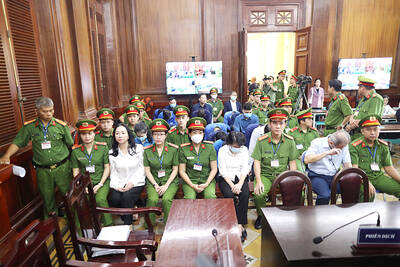
A top Vietnamese property tycoon was on Thursday sentenced to death in one of the biggest corruption cases in history, with an estimated US$27 billion in damages. A panel of three hand-picked jurors and two judges rejected all defense arguments by Truong My Lan, chair of major developer Van Thinh Phat, who was found guilty of swindling cash from Saigon Commercial Bank (SCB) over a decade. “The defendant’s actions ... eroded people’s trust in the leadership of the [Communist] Party and state,” read the verdict at the trial in Ho Chi Minh City. After the five-week trial, 85 others were also sentenced on

Conjoined twins Lori and George Schappell, who pursued separate careers, interests and relationships during lives that defied medical expectations, died this month in Pennsylvania, funeral home officials said. They were 62. The twins, listed by Guinness World Records as the oldest living conjoined twins, died on April 7 at the Hospital of the University of Pennsylvania, obituaries posted by Leibensperger Funeral Homes of Hamburg said. The cause of death was not detailed. “When we were born, the doctors didn’t think we’d make 30, but we proved them wrong,” Lori said in an interview when they turned 50, the Philadelphia Inquirer reported. The

RAMPAGE: A Palestinian man was left dead after dozens of Israeli settlers searching for a missing 14-year-old boy stormed a village in the Israeli-occupied West Bank US President Joe Biden on Friday said he expected Iran to attack Israel “sooner, rather than later” and warned Tehran not to proceed. Asked by reporters about his message to Iran, Biden simply said: “Don’t,” underscoring Washington’s commitment to defend Israel. “We are devoted to the defense of Israel. We will support Israel. We will help defend Israel and Iran will not succeed,” he said. Biden said he would not divulge secure information, but said his expectation was that an attack could come “sooner, rather than later.” Israel braced on Friday for an attack by Iran or its proxies as warnings grew of


 RSS
RSS